Few financial products are pushed harder than life insurance, and few are more misunderstood. Some people who genuinely need it have none; others are paying for expensive policies they never needed. The confusion is profitable for the people selling it. The clarity is simple, though, and it starts with a single question.
The dependents test
Life insurance exists for one job: to replace your income if you die while other people depend on it. So the deciding question is, if you died tomorrow, would someone suffer financially? If the honest answer is no, you probably do not need life insurance at all.
Who actually needs it
You likely need life insurance if:
- You have children or other dependents who rely on your income to live, eat, and stay housed.
- You have a spouse or partner who could not maintain the household — mortgage, bills, lifestyle — on their income alone.
- You carry shared or co-signed debt that someone else would inherit responsibility for, such as a jointly held mortgage or a co-signed loan.
- You are a stay-at-home parent. Even with no paycheck, you provide childcare and household work that would cost real money to replace.
Who usually does not
You probably do not need it if:
- You are single with no dependents and no one is on the hook for your debts. There is no income to replace for anyone's benefit.
- You are a young, child-free couple where each partner could comfortably support themselves alone.
- You are financially independent. If your assets already cover your family's needs, your investments are doing the job insurance was meant to do.
If you are being sold a policy and cannot point to a specific person who would be hurt by your death, pause. That is often a sign you are being sold a product, not solving a problem — the same dynamic explored in how cost-sharing really works when coverage is matched to actual risk rather than fear.
Term over whole life, almost always
If you do need coverage, the type matters enormously. There are two broad families:
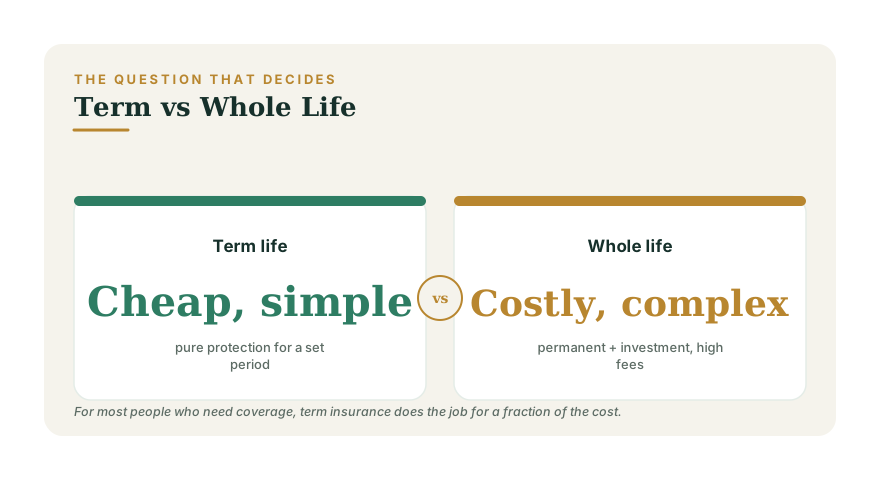
- Term life covers you for a set period — say 20 or 30 years — and pays out only if you die during that term. It is pure, cheap protection. A healthy person in their thirties can often buy a large term policy for the price of a few coffees a week.
- Whole (permanent) life never expires and bundles a savings or investment component. It sounds appealing, but it costs many times more than term, the investment portion typically carries high fees and mediocre returns, and the complexity hides where your money goes.
For the overwhelming majority of people, the right move is "buy term and invest the difference": purchase cheap term coverage for the years your dependents need it, and put the money you would have spent on whole life into low-cost index funds yourself. The reason term wins is also why permanent policies are pushed so hard — the commissions. That sales dynamic is unpacked in Term Life Insurance: How Much Do You Really Need?.
Rough coverage sizing
A common starting rule is 10 to 12 times your annual income, but it is better to size coverage to the actual gap your death would leave. A simple way to think about it:
- Income to replace for the years your dependents need it (for example, until the youngest child is independent).
- Plus any debts that would burden survivors — most of all a mortgage.
- Plus big future costs you want to cover, like college.
- Minus assets and existing coverage that already help.
The goal is enough that your family does not have to upend their life, not so much that you are over-insured. And you only need it for the term when others depend on you — once the kids are grown and the mortgage is gone, the need usually fades. This is the other reason term beats whole life for most people: the need itself is temporary, so paying for permanent coverage is paying to insure a risk that will not exist in twenty or thirty years.
A few practical notes when you buy. Lock in a long enough term that it covers the full stretch of dependence — a 30-year term costs only modestly more than a 20-year one but removes the risk of needing new coverage later when you are older and more expensive to insure. Buy while you are young and healthy, because premiums are set largely by age and health at purchase and stay level for the life of the policy. And name your beneficiaries carefully, since those designations control the payout directly, a point worth understanding alongside the rest of your estate plan.
Putting a number on it
Life insurance is not a wealth-building tool; it is a stopgap that protects the people who count on you during the years they count on you. Get the dependents test right, choose term, size it to the real gap, and you can cover a serious risk cheaply. The Insurance Calculator can help you estimate a coverage amount, and the Financial Resilience assessment shows how a policy fits alongside your emergency fund and other protections.