You can have a perfectly drafted will, a fully funded trust, and every beneficiary form up to date — and still leave your family a mess. Why? Because none of it helps if, in a moment of grief, nobody can find the documents, does not know which accounts exist, and cannot log in to anything. Organization is the unglamorous final step that makes the rest of your estate plan actually work.
The goal is simple: someone you trust should be able to find everything they need, quickly, without you there to explain it. Here is how to build that system.
The master document list
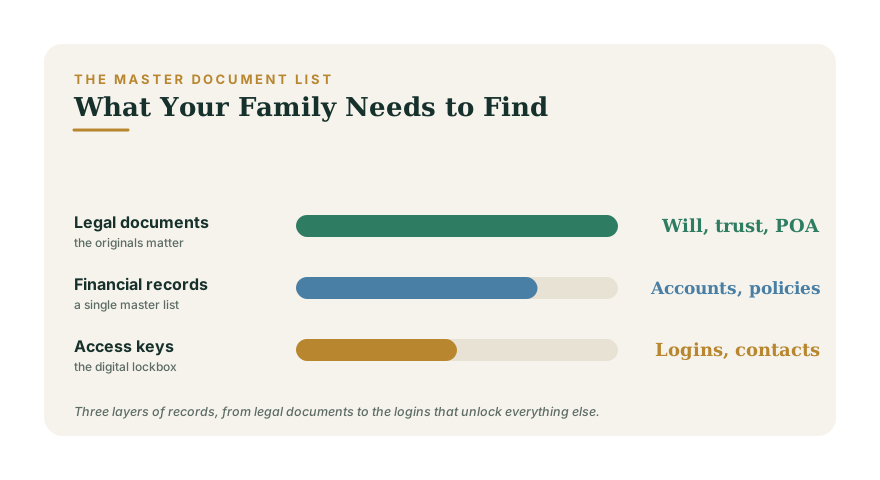
Start with a single master inventory — a one- or two-page document that points to everything else. It does not hold sensitive details so much as it serves as a map. It should cover three layers:
- Legal documents: your will, any trust, durable power of attorney, healthcare directive, and a list of beneficiary designations.
- Financial accounts: bank and brokerage accounts, retirement accounts, insurance policies, pensions, mortgages, and any debts — with the institution name and account numbers, not necessarily balances.
- Access and people: how to reach your attorney, accountant, and financial advisor, plus where the digital logins live (more on that below).
The point of the list is that your executor should never have to play detective. They should not discover a forgotten life insurance policy by accident — or miss it entirely. If you are not sure what a complete picture looks like, the foundation is in Estate Planning Basics Everyone Needs.
Where to store the originals
Originals matter, especially for a will, which often must be the signed original — not a copy — to be accepted by a court. A few guidelines:
- Avoid a bank safe deposit box for your will. It sounds secure, but the box may be sealed or hard to access right when your executor needs the will, creating a chicken-and-egg problem.
- Use a fireproof, waterproof home safe for original legal documents, and tell your executor where it is and how to open it.
- Give a copy to your attorney or keep one in their files, and let your executor know who that is.
- Keep digital scans of everything as a backup, but remember that for some documents only the signed original is legally valid.
The digital piece everyone underestimates
A growing share of your financial life lives behind passwords. Online bank accounts, brokerage logins, email, photos, even cryptocurrency — none of it is reachable if your family cannot get in. Worse, two-factor authentication can lock out even the people you want to have access.
The solution is a secure way to pass on credentials: a reputable password manager with an emergency-access feature, or a sealed list of critical logins stored with your other documents. This is its own discipline — covered fully in Digital Estate Planning — and it is increasingly the part of an estate that causes the most frustration when neglected.
What your executor actually needs
Put yourself in your executor's shoes. In the weeks after a death, they need to: locate the will, identify and access accounts, pay ongoing bills, notify institutions, and eventually distribute assets. Make that possible by leaving them a clear roadmap — and by choosing the right person in the first place, as discussed in Choosing an Executor. A short letter of instruction, separate from the will, is invaluable: it can list immediate to-dos, location of documents, contacts, and even your wishes for things a will does not cover, like funeral preferences.
Tell people while you can
A perfectly organized binder is useless if it stays a secret. At minimum, your executor and a trusted family member should know that a plan exists, where the documents are, and how to reach your professional advisors. You do not have to disclose the contents — just the location and the access. A brief conversation now saves enormous stress later.
Keep it current
Organization is not a one-time project. Accounts open and close, you change advisors, beneficiaries shift after major life events. Review your master list and beneficiary designations roughly once a year and after any big change — a marriage, a birth, a move, a death. To keep the whole estate picture aligned as life evolves, run the Estate Readiness assessment periodically; it will flag the pieces that have drifted out of date.