Most estate-planning advice fixates on death — who gets the house, who inherits the money. But the documents you are statistically more likely to need first are the ones that take effect while you are alive but unable to act for yourself. A car accident, a stroke, or a sudden illness can take away your capacity to make decisions long before it takes your life.
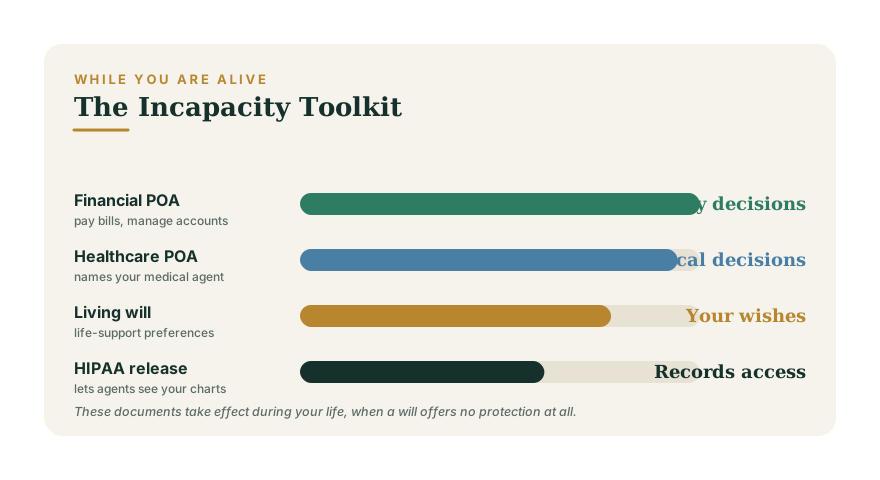
A will is silent during incapacity. These four documents are not.
The Durable Financial Power of Attorney
A financial power of attorney (POA) names someone — your agent or attorney-in-fact — to handle money matters on your behalf. They can pay your bills, manage your accounts, file taxes, and deal with your property. The key word is "durable": a durable POA stays in effect even after you become incapacitated, which is the entire point.
Without a durable POA, your family cannot access your accounts to keep your life running. Their only option is to ask a court to appoint a conservator, a process that is slow, expensive, public, and stressful. The POA you sign in an afternoon prevents all of it.
Springing vs Immediate
You can structure a financial POA two ways. An immediate POA takes effect the moment you sign it. A springing POA takes effect only when a defined trigger occurs, usually a doctor certifying that you are incapacitated.
- Immediate. Simpler and faster to use, but requires real trust because the agent has authority right away.
- Springing. Feels safer, but proving incapacity can cause delays at the worst possible moment, and some institutions resist them.
Many attorneys recommend an immediate POA given to someone you fully trust, precisely to avoid the activation friction springing versions create.
The Healthcare Power of Attorney
A healthcare POA, also called a medical proxy or healthcare agent, names the person who makes medical decisions for you when you cannot. This is separate from the financial POA and often goes to a different person — the sibling who is good with hospitals may not be the one who is good with money.
Choose someone calm under pressure, geographically reachable, and willing to advocate for your wishes even against pressure from doctors or other relatives. Talk to them in advance so they know what you would want.
The Living Will
A living will, or advance directive, records your own preferences about end-of-life care so your healthcare agent is not left guessing. It addresses questions like whether you want a ventilator, feeding tube, resuscitation, or strictly comfort-focused care in a terminal situation.
This document is a gift to your family. Without it, your loved ones must make agonizing decisions with no guidance, often disagreeing with each other in a hospital waiting room. With it, they simply carry out what you already decided.
The HIPAA Authorization
Federal privacy law prevents medical providers from sharing your health information without permission — even with your spouse or your named agent. A HIPAA authorization explicitly allows the people you list to access your medical records and speak with your doctors. Without it, your healthcare agent may be unable to get the information they need to make the very decisions you empowered them to make.
Choosing Your Agents Wisely
The most important decision in all of these documents is who you name. Look for trustworthiness, availability, and the steadiness to act under stress. Name backups in case your first choice is unavailable. And revisit your choices after major life changes, since relationships and circumstances shift over the years.
If you have a will but none of these incapacity documents, you have planned only for the less likely event. Take stock of where you stand, review your overall protection with our free tools, and explore related guides in our library.