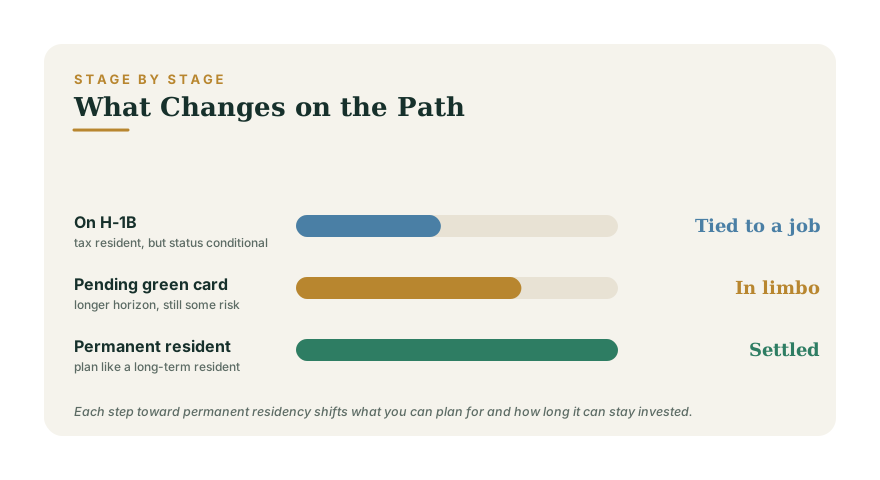
The journey from an H-1B work visa to a green card often stretches across many years, and for some nationalities the wait can run more than a decade. During that long stretch your legal status, your tax situation, and your sense of how permanent your life in the United States feels all evolve. Your money plan should evolve with them. The mistake many people make is treating the whole period as one frozen state of uncertainty and putting off real decisions. A better approach is to recognize what genuinely changes at each stage and what does not.
Tax residency rarely changes — and that matters
One of the most important facts is also the most reassuring: for tax purposes, you are almost certainly already a resident. Most people on an H-1B meet the substantial presence test within their first year, which means the IRS taxes you on your worldwide income exactly as it would a citizen. Getting a green card does not flip this switch — you were already there. So the tax rules you live under on an H-1B are largely the same ones you will live under as a permanent resident. What this means in practice is that you should treat US retirement and investment accounts as fully available to you from day one, not as something reserved for "after the green card."
Retirement accounts: use them now, not later
A common and expensive misconception is that contributing to a 401(k) or IRA is risky if you might eventually leave the country. The opposite is closer to the truth. The employer match in a 401(k) is free money, and the tax advantages compound for years. If you later leave the US, the account does not vanish — you can leave it invested, roll it over, or withdraw it (with tax consequences) from abroad. Capturing the full match should be near the top of your checklist at every stage. The mechanics of these accounts for people on visas are covered in The H-1B Financial Guide.
Investing: a longer horizon as your status firms up
Your investment strategy can sensibly track your sense of permanence. Early on an H-1B, when your status is tied to one employer and a layoff could force a quick departure, you may want a slightly larger cash cushion — enough to cover the costs of an unplanned move home on top of a normal emergency fund. As your green card moves from "someday" to "filed and pending," your effective time horizon lengthens, and you can lean more confidently into long-term, growth-oriented investing in a regular brokerage account. The asset mix itself is the same one any resident would use; what changes is how much short-term safety you keep alongside it.
Big purchases: timing around uncertainty
The biggest decision most people wrestle with is whether to buy a home before the green card comes through. There is no rule that you must wait — visa holders buy homes all the time, and mortgage eligibility depends more on your credit, income, and down payment than on your specific status. The real question is how confident you are that you will stay in the area for at least five to seven years, since that is roughly the horizon over which buying tends to beat renting after transaction costs. We walk through the eligibility and documentation details in Buying a Home as an Immigrant or Visa Holder.
Planning around uncertainty
The honest truth is that the H-1B-to-green-card period contains real risk you cannot fully control. The constructive response is to separate decisions into two buckets. The first bucket is decisions that are good regardless of whether you stay or leave: building an emergency fund, capturing your 401(k) match, keeping your credit strong, and avoiding high-interest debt. Do all of these now, without hesitation, because they pay off in every scenario. The second bucket is decisions that bind you to one location for years, like buying a home or a car you cannot easily sell — be more deliberate with these, and weight them by how settled you genuinely feel.
The credits and benefits you are quietly earning
Throughout your time working in the US, you are paying into Social Security and Medicare with every paycheck, and you are earning credits toward future benefits whether or not you ever get a green card. Many people do not realize these credits can follow them home through international agreements. We cover how that works in Social Security for Immigrants and Totalization.
Build your stage-by-stage plan
The cleanest way to handle a multi-year, uncertain path is to revisit your plan whenever your status changes. When you move from H-1B to a filed I-140, or from pending to approved, treat it as a trigger to reassess your cash cushion, your investment horizon, and any pending big purchases. The Immigrant Financial Readiness assessment can give you a quick read on where you stand, and the planning hub lets you map the foundation decisions you can make confidently at any stage.