The jump from an F-1 student visa to an H-1B work visa is a career milestone, but it is also a financial one. Several rules that governed your money as a student change at or near the moment your status does — how you are taxed, what comes out of your paycheck, and which savings accounts you can finally use. None of it is complicated once you see the moving parts in one place.
The single biggest shift is your tax residency. As an F-1 student you were almost certainly a nonresident alien for tax purposes, taxed only on US-source income and filing a different return. As an H-1B worker you generally become a resident alien, taxed like a US citizen on your worldwide income.
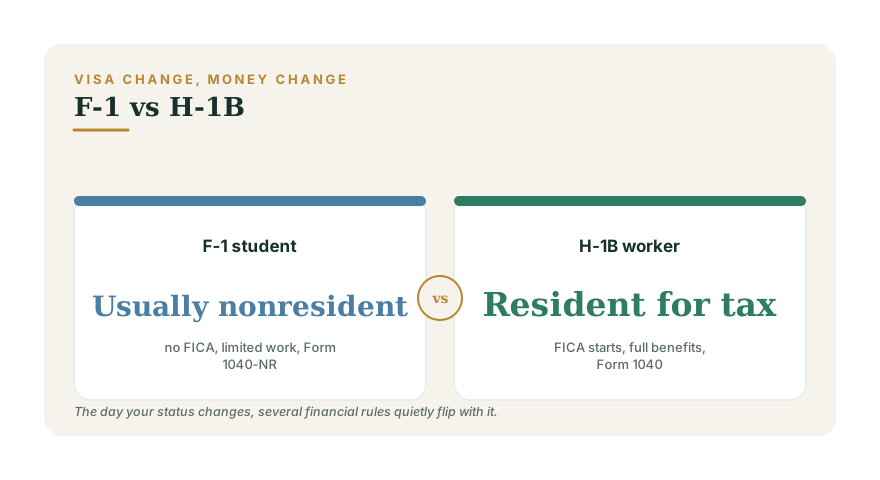
The tax-residency switch: nonresident to resident
The IRS decides residency with the substantial presence test, which counts your days in the country. F-1 students are usually "exempt individuals" whose days do not count for a number of years, which keeps them nonresident. Once you move to H-1B, your days start counting, and most people become resident aliens — sometimes in the same year, creating a dual-status return for the transition year. That first year can be messy, and it is often worth paying a preparer who handles immigrant returns. After that, you file the standard Form 1040 like everyone else.
FICA starts coming out of your check
As an F-1 nonresident, your wages were generally exempt from FICA — the 7.65% Social Security and Medicare tax. On H-1B, that exemption ends, so your take-home pay drops by that amount even at the same salary. It is not a deduction you lost; it is a tax you now owe like every US worker. The upside is that those Social Security credits start building toward future benefits. If you later leave the country, what happens to those contributions is covered in Social Security for Immigrants.
Building credit becomes urgent
A US credit history does not follow you from school into your career automatically, and it certainly did not follow you from your home country. If you were an F-1 student who never opened a US credit card, you may be close to a blank slate. On H-1B, you will want credit for an apartment lease, a car, and eventually a mortgage, so start now. A secured card or a newcomer-friendly product, used lightly and paid in full, builds a record within months. Why scores do not cross borders, and how to rebuild fast, is the whole subject of Can You Transfer Your Credit History to the US?. You can model how specific habits move a score with the Credit Score Simulator.
Retirement accounts you can finally use
An H-1B paycheck usually comes with an employer 401(k), often with a match. The match is free money and the highest-return move available to you, so contribute at least enough to capture all of it. You may also be eligible for an IRA. A common worry is "what if I leave the US before retirement?" — these accounts travel with you, and the planning around that is laid out in Retirement Accounts for Visa Holders. Do not skip retirement saving just because your future is uncertain; the tax advantage is real today.
Start investing and saving deliberately
With a real salary and FICA behind you, build the foundation in order: a starter emergency fund, then the full 401(k) match, then high-interest debt, then a complete three-to-six-month cushion, then broader investing. As a resident alien you can open an ordinary brokerage account and invest in low-cost index funds like any US resident — see How to Start Investing. One trap to avoid: holding foreign mutual funds, which can trigger punishing US reporting, as explained in The PFIC Tax Trap.
The first-90-days checklist
- Confirm your tax-residency status for the transition year, and budget for a possible dual-status return.
- Expect FICA to lower your take-home pay, and adjust your budget to the new net number.
- Enroll in the 401(k) up to the full match in your first month.
- Open or keep using a credit card, paid in full monthly, to build a US history.
- Keep tidy records of your visa dates, pay stubs, and any home-country income.
Put the plan together
The F-1 to H-1B move is mostly a paperwork-and-defaults problem: get the residency status right, let FICA and the 401(k) start, and build credit early. Once those are running, your finances look like any other US professional's. Map out the full sequence and run your numbers at the planning hub, and use the Immigrant Financial Readiness check to find any gaps before they cost you.