Every time an immigrant on a work visa or green card gets paid in the United States, a slice of that paycheck goes to Social Security. A natural question follows: will that money ever come back to me, especially if I do not stay in the country forever? The answer is more reassuring than most people expect, but it depends on how many years you work, where you eventually retire, and whether your home country has a special agreement with the United States.
Earning the 40 credits
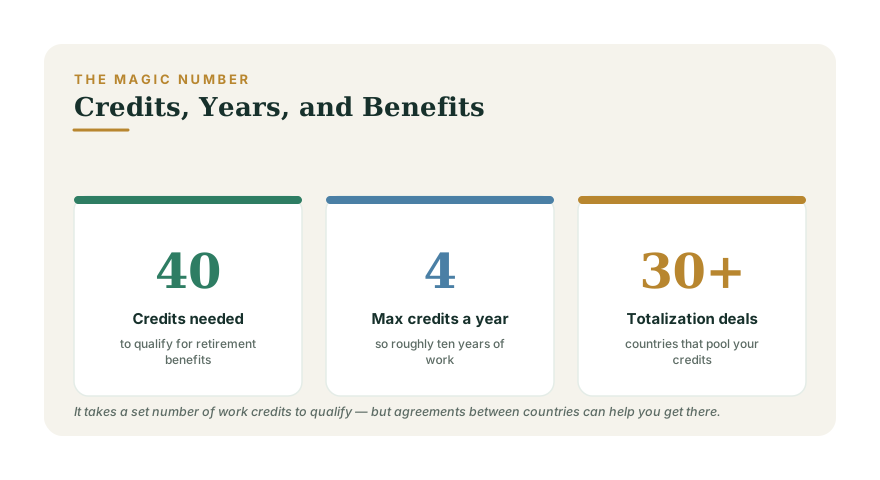
Social Security retirement benefits are not automatic — you have to earn them by accumulating work credits. You can earn up to four credits per year, and you generally need 40 credits to qualify for retirement benefits. In practice that means roughly ten years of covered work. If you work in the US for a decade or more and pay into the system, you have a vested right to a benefit, and being an immigrant does not change that — your credits are tied to your work record, not your citizenship. The catch is the worker who pays in for only a few years and then leaves. Without enough credits, that person could walk away having contributed without ever qualifying. This is exactly the problem totalization agreements were designed to solve.
How totalization agreements work
The United States has totalization agreements with roughly thirty countries. These treaties do two valuable things. First, they prevent double Social Security taxation — if you are sent to work in the US temporarily by an employer in an agreement country, you may keep paying into your home system instead of paying into both. Second, and more important for most immigrants, they let you combine, or "totalize," your work credits from both countries to qualify for a benefit. If you have, say, six years of US credits and several more years in an agreement country, the systems can count your foreign work toward the US 40-credit minimum (and vice versa). Each country then pays a benefit proportional to the work you actually did there. This means years of US contributions are far less likely to be wasted, even if you fall short of 40 US credits on your own. Whether your country has an agreement is the decisive factor — check before assuming your credits are stranded.
What happens to your benefits if you leave
Suppose you qualify and then move abroad in retirement. Can you still collect? In many cases, yes. The US will pay Social Security retirement benefits to people living in many foreign countries, though there are some nations where payments are restricted, and the rules differ for citizens versus non-citizens living abroad. For citizens of most countries with a totalization agreement, benefits generally continue to be paid wherever you live. The practical takeaway: leaving the United States does not automatically forfeit the benefit you earned, but the specifics depend on your citizenship and your country of residence, so confirm your situation before you rely on it. These cross-border benefit rules interact with how your retirement income is taxed, a topic we touch in Tax Treaties and Foreign Income, Explained.
The Windfall Elimination Provision, briefly
One wrinkle catches immigrants who earned a pension abroad. The Windfall Elimination Provision (WEP) can reduce your US Social Security benefit if you also receive a pension from work that was not covered by US Social Security — which often includes a foreign government or employer pension. The reason is technical: Social Security's benefit formula is weighted to favor lower lifetime earners, and someone with substantial uncovered foreign earnings can look artificially low-income to the formula. WEP adjusts for that. It does not erase your benefit, but it can trim it, so if you expect both a US benefit and a foreign pension, factor a possible reduction into your retirement projections rather than being surprised later. Note that totalization agreements and WEP interact in ways worth checking case by case.
Build it into your retirement plan
For an immigrant, Social Security is best treated as one piece of a larger retirement picture that also includes your 401(k), IRAs, and any home-country benefits. Decide how many years you realistically expect to work in the US, find out whether your country has a totalization agreement, and plan accordingly. The broader stage-by-stage view is in H-1B to Green Card: A Financial Checklist, and when you are ready to estimate timing and trade-offs, the Social Security Optimizer and the Retirement Planner let you see how your credits and contributions add up.