A common worry among work-visa holders is whether it even makes sense to lock money away in a US retirement account when you might not stay in the country forever. It is a fair question — but the usual answer is that contributing, especially enough to capture an employer match, is one of the highest-return moves available to you, and the money does not vanish if you leave. Let us walk through eligibility, the match, and the exit.
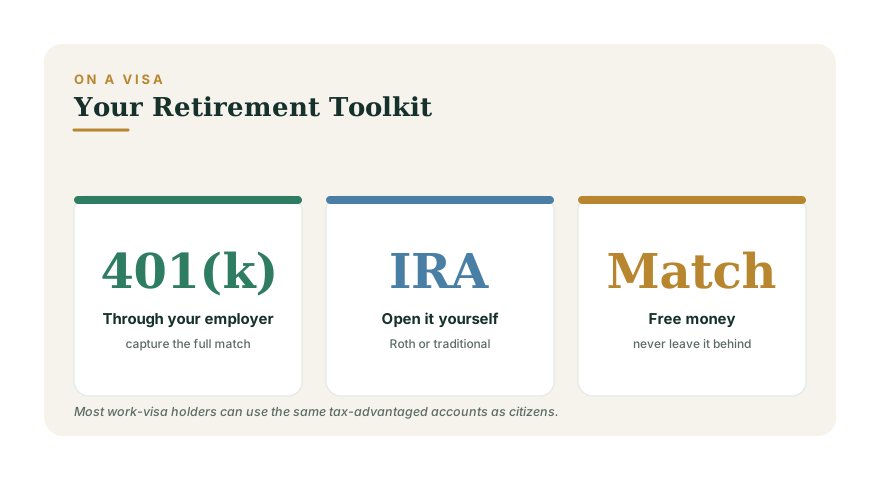
You are usually eligible
Eligibility for retirement accounts is based on having US taxable compensation and a valid tax identification number — not on citizenship. If you are working in the US on a visa with an SSN and earning wages, you can generally:
- Participate in your employer's 401(k) (or 403(b) at many nonprofits and schools) once you meet the plan's eligibility window.
- Open an IRA on your own — traditional or Roth — as long as you have earned income and, for a Roth, your income falls under the limits.
Your tax status does shape some details. If you are a nonresident alien for tax purposes, contributing to a 401(k) still works through payroll, but check the IRA mechanics with your provider; once you are a resident for tax purposes — see US taxes as a non-citizen — the rules look the same as they do for citizens.
Capturing the match is the whole game
If your employer offers a 401(k) match, contributing enough to get all of it is close to a no-brainer. A match is an immediate, guaranteed return on your money — often 50 cents or a dollar for every dollar you put in, up to a percentage of your salary. No investment reliably beats that. Even if you only plan to be in the US for a few years, the match is part of your compensation; skipping it is leaving pay on the table. Just be mindful of vesting: some employers require you to stay a certain number of years before the matched portion is fully yours, which matters if you expect to leave soon.
Roth vs traditional, with an immigrant twist
The usual trade-off applies — a traditional account gives you a tax deduction now and is taxed on withdrawal, while a Roth is funded with after-tax money and comes out tax-free later. For visa holders there is an extra wrinkle: if you expect to leave the US and your home country taxes US retirement withdrawals differently, the future tax picture is genuinely uncertain. Some newcomers favor the flexibility of having both. This is a personal calculation worth modeling rather than guessing.
What happens to the accounts if you leave the US
This is the question that holds people back, so let us be clear: your retirement accounts are yours, and they do not disappear when your visa ends. You generally have several options:
- Leave the money invested. You can typically keep a 401(k) or IRA open after you leave the country and let it continue growing until retirement age. The account does not require you to be a US resident.
- Roll a 401(k) into an IRA. Consolidating into an IRA can give you more control and lower costs while you are abroad, though not every US brokerage keeps accounts open for nonresidents — confirm this before you go. We cover that logistics problem in what happens to your US investments when you leave.
- Cash out. Usually the worst choice. An early withdrawal before retirement age generally triggers income tax plus a 10% penalty, and for nonresidents there may be additional withholding. You would be paying a steep price to unwind years of tax-advantaged growth.
Coordinate with your home country
How your home country treats a US retirement account varies enormously — some recognize the tax-deferred status, others tax the growth or the withdrawals in ways the US would not. A tax treaty may address retirement income specifically. If you are likely to return home, this coordination deserves real attention; for those headed back to India, our H-1B financial guide dives into the cross-border specifics.
Bottom line
For most working visa holders, the answer is to participate: capture the full match without fail, contribute beyond it if your budget allows, and treat the accounts as portable wealth you can carry into the future wherever you end up. To see how these contributions fit your bigger picture, run the numbers in the Retirement Planner and check your overall standing with the Retirement Readiness assessment.