It is one of the most frustrating discoveries a newcomer makes. You spent years building a flawless credit record in your home country — paying every loan, never missing a card — and the moment you land in the United States, none of it seems to exist. Landlords, lenders, and even phone carriers treat you as if you have no history at all. You are not being penalized; the system simply cannot see your past.
Why credit does not move across borders
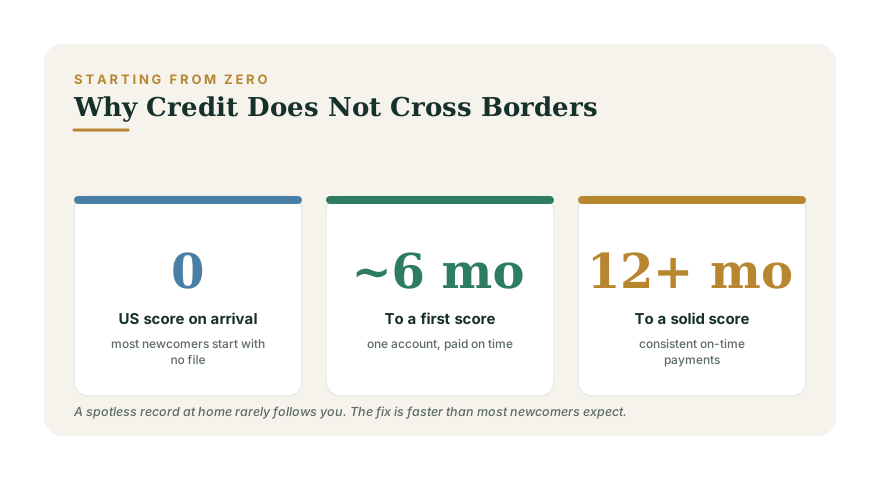
Credit reporting is national, not global. The US has its own bureaus, and lenders in other countries report to their own systems. There is no international clearinghouse that merges them, and privacy laws, different scoring formulas, and incompatible data formats keep them separate. So your home-country bureau cannot simply hand your file to a US bureau, and a US lender pulling your report sees a blank where your history should be. A blank file is not a bad score — it is no score, which means lenders have nothing to judge you on and tend to say no or charge more.
The services that try to bridge the gap
A few approaches attempt to soften the landing, with mixed results:
- Global credit-data services. Some lenders and a handful of credit-bureau programs can pull a translated version of your foreign credit report and consider it for a specific application. Coverage is limited to certain countries and certain products, and it usually helps with one decision rather than creating a US score.
- Newcomer programs at major banks. Some large banks let recent arrivals open accounts or cards using a passport and visa instead of a long US history, sometimes considering your global relationship with that same bank.
- International card issuers. If you held a card with a global bank at home, occasionally it can help you get approved for that issuer's US card.
These are genuine shortcuts for getting a first account, but treat them as on-ramps, not a transfer. None of them imports your years of history into the US system.
How to rebuild fast
The good news: building a US score from scratch is quicker than most people fear. The score rewards a short, clean record almost as much as a long one, so a single account used well can produce a usable score within about six months. The reliable path:
- Open a secured credit card. You put down a refundable deposit that becomes your limit, and the issuer reports your on-time payments like any card. It is the most dependable first rung — see Secured Credit Cards, Explained.
- Keep utilization low. Use only a small slice of your limit and pay the statement in full every month. You can see how that lever moves a score with the Utilization Optimizer.
- Become an authorized user. If a spouse or family member with established US credit adds you to their card, their good history can post to your file.
- Consider a credit-builder loan. A small loan whose payments are reported, with the funds released to you at the end, adds a second account type.
Newcomer-friendly products worth knowing
Beyond secured cards, look for products explicitly aimed at recent arrivals: bank accounts that open with a passport and visa, cards that approve thin files, and apps that report your rent or utility payments to the bureaus so your existing on-time habits start counting. The full newcomer playbook is in Building Credit as a Newcomer, and if you are arriving on a work visa, the timing and sequencing fit into the broader F-1 to H-1B transition.
Be patient, then automatic
You cannot transfer your history, but you can rebuild a strong score faster than the rumor mill suggests. Open one good account, pay it on time every month, keep balances low, and avoid applying for everything at once. Automate the payments so a missed due date never sets you back, and check your progress with the Credit Score Simulator as your file grows.