The hardest part of retirement is not saving — it is spending. Once the paychecks stop, you have to pull money from a portfolio that goes up and down, and the timing of those swings matters enormously. Selling stocks to cover groceries in the middle of a market crash can permanently damage a portfolio, a danger known as sequence-of-returns risk. The bucket strategy is a simple, intuitive way to defend against exactly that.
The core idea: match money to time
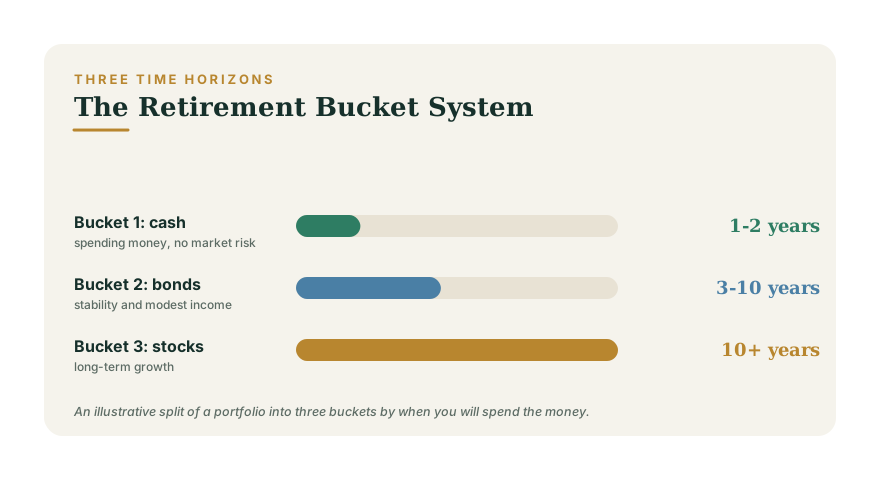
Instead of viewing your savings as one big pile, you divide it into three buckets based on when you will spend the money. Money you need soon goes somewhere safe. Money you will not touch for a decade can stay invested for growth. By keeping near-term spending in cash, you never have to sell stocks at a bad moment to eat, which is the whole point.
Bucket 1: cash for the next year or two
The first bucket holds one to two years of spending in cash and cash-like accounts — a high-yield savings account, a money market fund, or short-term CDs. It earns little, but it is not supposed to earn; it is supposed to be there. This is the money you actually live on, refilled periodically from the other buckets. Because it is stable, a market crash has no effect on your grocery budget. See High-Yield Savings and CD Ladders for where to park it.
Bucket 2: bonds for the medium term
The second bucket covers roughly years three through ten and holds high-quality bonds, bond funds, or a CD ladder. It is more stable than stocks but earns more than cash, and it acts as the reservoir that refills Bucket 1. In a stock downturn, you spend from Buckets 1 and 2 and leave your stocks alone to recover. This bucket is your shock absorber.
Bucket 3: stocks for the long term
The third bucket is money you will not need for a decade or more, invested for growth in a diversified mix of stock index funds. Because its time horizon is long, it can ride out downturns. Over time, its gains flow down to refill the middle and short-term buckets. This is the engine that keeps your plan ahead of inflation across a retirement that may last thirty years.
Refilling and rebalancing
The strategy only works if you tend it. When stocks have a good year, you sell some gains from Bucket 3 to top up Buckets 1 and 2 — selling high, by design. When stocks fall, you pause those refills and live off the safe buckets until markets recover. Some retirees refill on a schedule; others do it opportunistically after strong years. Either way, the discipline of rebalancing keeps the buckets from drifting away from their targets. The main critique of the bucket approach is that it is really just an asset allocation with a helpful mental framing — and that is fine. The framing is what keeps people from panic-selling.
Buckets versus a systematic withdrawal
The bucket method is one of several ways to turn savings into a paycheck. A simpler alternative is a fixed percentage withdrawal from a balanced portfolio, along the lines of the 4 percent rule. Buckets do not necessarily produce more money; their advantage is behavioral and emotional — you can see, concretely, that your next few years of spending are safe, which makes it far easier to leave your stocks untouched through a scary market. For many retirees, that peace of mind is worth more than any spreadsheet edge. Compare approaches in Building a Retirement Drawdown Strategy.
Putting it to work
Start by estimating your annual spending, set aside one to two years of it in cash, build a bond reserve for the medium term, and keep the rest growing in stocks. Refill the safe buckets in good years and spend from them in bad ones. Test how the split holds up across different markets with the Retirement Planner, size your safety cushion with the Emergency Fund Calculator, and check your overall footing with the Retirement Readiness assessment before you finalize a plan at the planning hub.