Most budgets fail because they are guesses that never get reconciled. Zero-based budgeting takes the opposite approach: before the month begins, you assign every dollar of expected income to a specific job — bills, savings, debt, groceries, fun — until the amount left to assign is exactly zero. Zero here does not mean spend everything; it means nothing is left undecided. Saving and investing are jobs too.
The method has been around for decades, but in 2026 the tooling has changed enough to be worth a fresh look. Bank connections are more reliable, several once-free apps now charge, and a wave of privacy-conscious users have moved to spreadsheets and manual-entry apps on purpose. The core discipline, though, is the same as it ever was.
How the method actually works
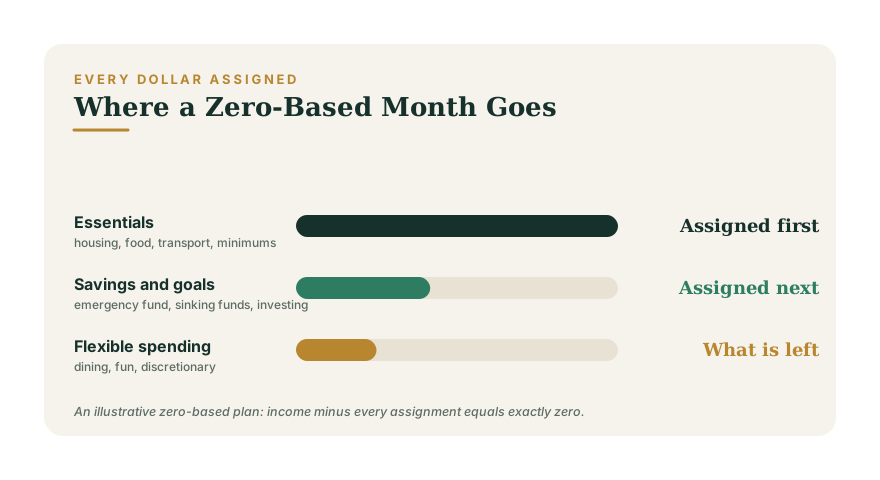
You start with the money you actually have or are certain to receive, not a hopeful projection. Then you assign it in order of priority. A workable sequence is essentials first (housing, utilities, food, transport, minimum debt payments), then your savings and goal categories, then whatever remains for discretionary spending. When the last dollar is assigned, you are done planning and you spend against those categories through the month, adjusting as reality intervenes. The step-by-step mechanics are laid out in the Zero-Based Budgeting Guide; this piece focuses on making it stick in 2026.
Why it works when other budgets do not
A percentage rule like the 50/30/20 rule tells you the shape of a healthy budget but not what to do on the fifteenth when you are staring at a restaurant menu. Zero-based budgeting answers that question directly, because the money is already spoken for. It also surfaces the truth quickly: if you cannot get to zero without shortchanging a real bill, you have found a spending or income problem that a vaguer method would have hidden for months.
The app landscape in 2026
There is no single best app, only the right style for how you think. Broadly, three camps have emerged:
- Dedicated envelope-style apps. Purpose-built for giving every dollar a job, with rollover categories and a strong workflow. They enforce the discipline well but usually carry a subscription, and you are trusting a third party with your bank connections.
- Aggregator dashboards. These pull all your accounts into one view and auto-categorize spending. Great for visibility and after-the-fact review, weaker at forcing the pre-month assignment that defines zero-based budgeting.
- Spreadsheets and manual-entry apps. Free or cheap, private, and infinitely customizable. Manual entry sounds like a chore but it is the feature — typing in a purchase makes you feel it. Many disciplined budgeters have moved back here as free apps shut down or started charging.
If you are choosing between styles more broadly, Best Budgeting Methods Compared weighs the trade-offs, and Envelope Budgeting in a Cashless World covers the digital-envelope idea that most zero-based apps borrow from.
The traps that make it fail
Zero-based budgeting is simple but not effortless, and it fails in predictable ways:
- Forgetting irregular expenses. Car registration, annual insurance, and the holidays are not surprises — they are appointments. If you do not fund them a little each month, they blow up the budget. The fix is a system of sinking funds.
- Budgeting income you do not have yet. Assign only money in hand. If your income is uneven, budget last month's income this month so you are always working with real dollars — see Budgeting on an Irregular Income.
- Too many categories. Forty categories collapse under their own weight. Start with ten to fifteen and split only when a category keeps blowing up.
- Not reconciling. A plan you never check against reality is a wish. A five-minute monthly money review keeps it honest.
A first month you can actually finish
Pull your last two or three months of transactions to see what you really spend. Build categories from that reality, not from aspiration. Assign this month's dollars to zero, funding at least a small amount toward an emergency fund before discretionary categories. Then track as you go and reconcile weekly. Use the Budget Analyzer to see whether your assignments are realistic against typical spending, and pressure-test the whole plan with the Financial Resilience assessment.
The payoff
Zero-based budgeting is less about restriction than about intention. When every dollar has a job, you stop wondering where your money went and start deciding where it goes. Build the habit, pick the tool that matches your temperament, and map the rest of your plan at the planning hub.