Ask most people what blows up their budget and they will describe an emergency. Look closer and it usually was not one. The car needed new tires, the insurance premium came due, the holidays arrived on the same date they arrive every year, and the property-tax bill landed exactly when it always does. None of these are emergencies. They are predictable, irregular expenses — and they wreck budgets only because we pretend they are surprises.
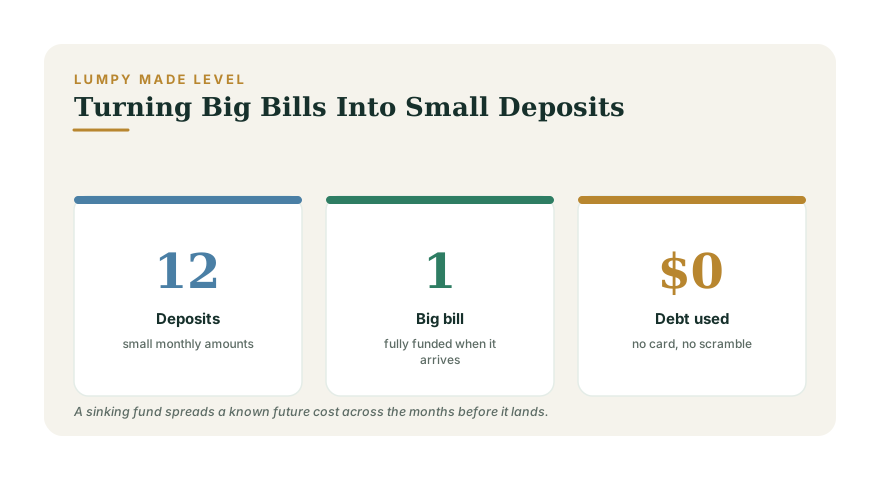
The tool that solves this is the sinking fund: a pot of money you build up gradually toward a specific known expense, so that when the bill arrives, the money is already there. Instead of one painful hit, you make a series of small, calm deposits.
Sinking fund vs emergency fund
These two get confused constantly, and keeping them separate is the whole point. An emergency fund is for the genuinely unexpected — a job loss, a medical event, a truly out-of-nowhere repair. A sinking fund is for expenses you can see coming but that do not arrive monthly. If you raid your emergency fund every December for gifts and every spring for insurance, you never actually have an emergency fund; you have a slush fund that is always empty when a real crisis hits. The distinction, and why both matter, is covered in Sinking Funds, Explained.
Building the system: list, price, divide
A sinking-funds system is just three steps repeated for every lumpy expense you can name:
- List every irregular expense. Car maintenance and registration, insurance premiums paid annually or semi-annually, holidays and gifts, property taxes, annual subscriptions, medical and dental, travel, pet care, home repairs, and any known one-off on the horizon.
- Estimate the annual cost of each. Use last year's real numbers where you can. Round up rather than down; being over-funded is a good problem.
- Divide by the months you have. An eight-hundred-dollar annual premium is roughly sixty-seven dollars a month. If the bill is due in four months, divide by four instead. That monthly figure becomes a line in your budget.
Add every monthly figure together and you have the total you need to set aside each month to never be surprised again. That number is often eye-opening — and it is exactly why so many budgets that ignore it fail.
How to hold the money
You do not need a dozen bank accounts. Two common structures work:
- One account, many categories. Keep all your sinking funds in a single high-yield savings account and track the individual balances in your budgeting app or spreadsheet. Simplest, and it earns interest — see High-Yield Savings and CD Ladders.
- Named sub-accounts. Some banks let you open multiple named savings buckets under one login. This makes each fund visible and harder to accidentally spend.
Wherever the money lives, keep it separate from your everyday checking so it does not get spent by default. For where short-horizon money belongs generally, see The Best Way to Save for Short-Term Goals.
Fitting it into your budget
Sinking funds and zero-based budgeting are natural partners: in a zero-based month, each sinking-fund contribution is just another dollar with a job. Automate the transfers so they happen the day after payday and require no willpower — the same logic behind automating your finances. Start small if the full total is unaffordable; even partial funding turns a crisis into a smaller top-up.
Start with the next bill
You do not have to build the whole system at once. Pick the next irregular expense you know is coming, divide it by the months you have, and start the transfer this week. Add another fund next month. Use the Budget Analyzer to fit the contributions into your cash flow, size your separate emergency fund so it stays untouched, and check your overall cushion with the Financial Resilience assessment. The full plan lives at the planning hub.