Most budgets fail in the same quiet way. You set up categories, track for a few weeks, and then a gap opens between what you planned and what actually happened. The leak is rarely the big stuff. It is the unassigned money, the cash that lands in checking with no instructions, that drifts toward whatever is convenient. Zero-based budgeting closes that gap by refusing to leave any dollar unassigned.
What zero-based budgeting actually means
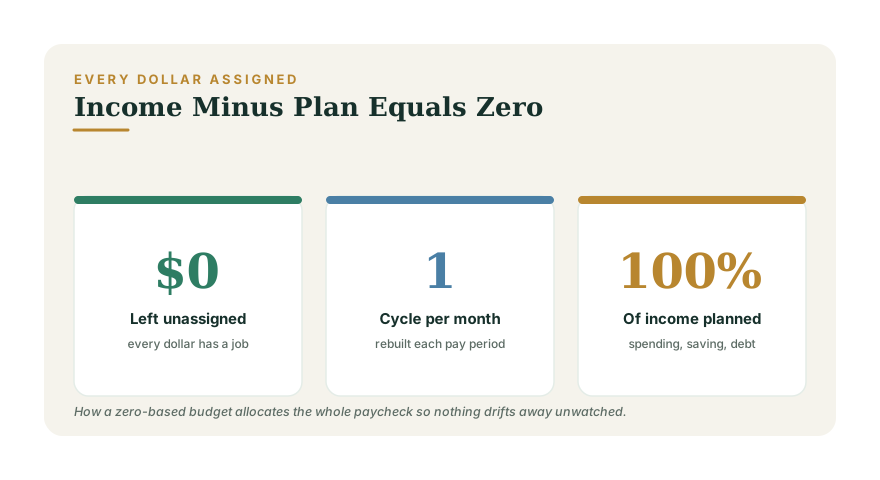
The name confuses people. A zero-based budget does not mean you spend down to zero or empty your account. It means that when you finish planning, the math reads: income minus everything you have assigned equals zero. Every dollar that comes in is given a job before the month begins. Some dollars are assigned to rent, some to groceries, some to debt payoff, and some to savings or investing. Saving is a job. An emergency fund is a job. The point is intention, not exhaustion. You are not allowed to leave a pile of money labeled "whatever."
Contrast this with a percentage framework like the 50/30/20 rule, which hands you ratios, or a simple tracking budget where you record spending and hope it lands somewhere reasonable. Zero-based budgeting is more deliberate than either. It forces a decision about every dollar, which is its whole strength and also its main cost in effort.
The monthly cycle, step by step
Zero-based budgeting runs on a repeating loop. You rebuild it each month rather than setting it once and forgetting it, because real income and real expenses move around.
- Start with the income you can count on. Use the money you will actually receive this month, not an annualized average. If income is uneven, plan against what is already in the account.
- List every obligation and goal. Fixed bills first, then variable spending like food and gas, then savings, debt extra payments, and sinking funds for irregular costs.
- Assign dollars to each category until you hit zero. When the leftover reaches zero, the budget is done. If you still have money, assign it, often to savings or debt. If you go negative, cut something now, on paper, before the month happens.
- Track as you spend and adjust. When you overspend in one category, you move money from another. The total stays balanced; the categories flex.
The rebuild matters. A raise, a quarterly bill, a holiday month, or a slow sales month all change the picture, and a fresh allocation each cycle keeps the plan honest.
What it does well
The biggest payoff is awareness. When you have to justify every dollar, you notice money you were leaking without deciding to. People often find a few hundred dollars a month that was simply unassigned and therefore spent by default. It also makes trade-offs explicit. You cannot fund a vacation and aggressively pay down a card in the same month without seeing exactly what each choice costs the other.
It is also flexible at the category level while staying strict at the total level. Overspending on dining does not blow up the plan; it just means dining borrowed from another envelope, and you watch that happen in real time.
Where it gets hard
Zero-based budgeting asks more of you than most methods. Assigning every dollar and rebuilding monthly takes time and attention, and people with chaotic schedules or low patience for spreadsheets often abandon it. It can also feel relentless. Some find that micromanaging each dollar creates a scarcity mindset rather than calm.
Irregular income complicates it too. The method works best when you budget money you already have rather than money you expect, so commission earners and freelancers usually pair it with a buffer account and lag their budgeting by a pay period.
Tools that make it stick
You can run a zero-based budget on paper or a basic spreadsheet, and plenty of people do exactly that. Dedicated apps built around this philosophy automate the running balance and let you reassign money with a tap, which removes most of the friction that kills the method. The tool matters less than the discipline of leaving nothing unassigned. Choose whatever you will actually open every few days.
Who it suits
- People who feel money slips away without knowing where, and want to see every dollar accounted for.
- Couples or households who need a shared, explicit plan to avoid friction over discretionary spending.
- Anyone paying down debt aggressively, because the method surfaces every spare dollar that could go to the balance.
- Detail-oriented planners who find a percentage rule too loose and want full control.
If that level of effort sounds exhausting, a lighter framework may serve you better, and that is fine. The best budget is the one you keep. If zero-based budgeting fits your temperament, it is one of the most powerful ways to make a paycheck do exactly what you intend. Map it against your own numbers and goals over on the plan.