The internet loves to crown a single "best" budget, but that is the wrong question. Every method here works when followed and fails when abandoned, so the real question is which one fits how your brain operates. A detailed plan that you ignore is worse than a simple plan you actually keep.
Below are the four most common approaches, what each is good at, and the kind of person each suits. They are not mutually exclusive — many people blend two — but it helps to understand each on its own first.
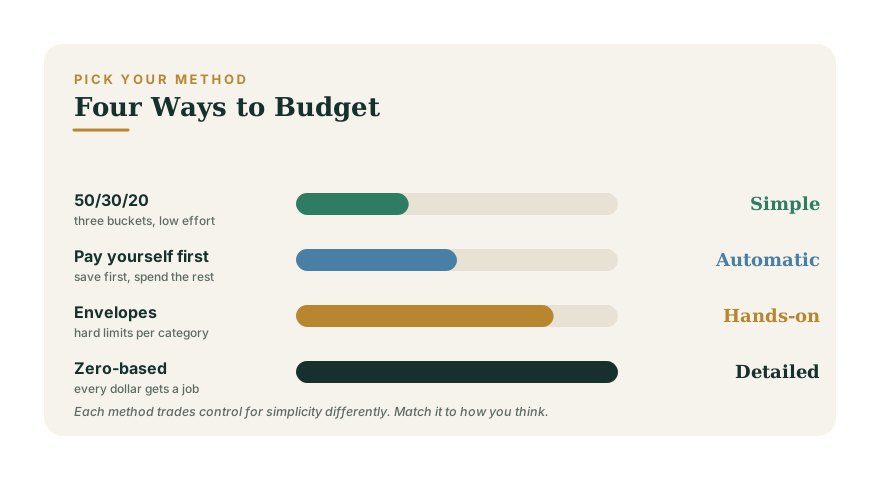
50/30/20: the simple starter
The 50/30/20 rule splits your take-home pay into three buckets: about 50% for needs (housing, groceries, utilities, minimum debt payments), 30% for wants (dining out, hobbies, travel), and 20% for savings and extra debt payoff. You do not track individual purchases — you just keep each bucket roughly in range.
Good for: beginners, and anyone who finds detailed budgeting exhausting. It gives structure without micromanagement. The trade-off is that it is loose; a "want" can hide inside the 30% without scrutiny. The full breakdown is in The 50/30/20 Rule, Explained.
Zero-based budgeting: every dollar gets a job
Zero-based budgeting means you assign every dollar of income to a specific category until you reach zero — not zero in your account, but zero unassigned. Income minus all your planned allocations (including savings) equals nothing left over. Nothing is "miscellaneous."
Good for: detail-oriented people who want maximum control and are willing to plan each month. It is the most powerful method for finding leaks and the most demanding to maintain. If you like knowing exactly where every dollar goes, this is your method.
Envelopes: hard limits you can feel
The envelope system gives each spending category a fixed amount for the month — historically literal cash in labeled envelopes, today usually digital "envelopes" or separate sub-accounts. When the grocery envelope is empty, grocery spending stops until next month. The limit is concrete, not theoretical.
Good for: people who overspend in specific categories and need a hard stop, not a gentle suggestion. The tactile feedback is powerful. In a cashless world you replicate it with app categories or multiple accounts.
Pay-yourself-first: save before you spend
Pay-yourself-first flips the usual order. Instead of spending and saving whatever is left, you save a set amount the moment you get paid — automatically — and then spend the rest freely. Savings is treated as the first bill, not the last priority.
Good for: people who hate tracking and just want the saving to happen. It is the least granular method but arguably the most effective at the one thing that matters most, because it makes saving automatic and removes willpower from the equation. Many people pair it with a loose 50/30/20 for the spending side.
Matching the method to your personality
Be honest about who you are, not who you wish you were:
- You want the lowest effort possible. Pay-yourself-first plus a loose 50/30/20. Automate the saving; do not sweat the rest.
- You like detail and control. Zero-based budgeting. You will enjoy the planning, and you will find money others miss.
- You overspend in certain categories. Envelopes. Hard limits where you are weak, freedom everywhere else.
- You are brand new and overwhelmed. Start with 50/30/20, then graduate to something tighter once it feels natural.
You can blend them
These are tools, not religions. A very common and effective combination is pay-yourself-first for savings (automated on payday), envelopes for two or three categories you tend to overspend, and a loose 50/30/20 to keep the big picture in range. Start with one method, and add structure only where you actually need it.
Whichever you choose, it works far better when built on real numbers rather than guesses — so pair it with How to Track Your Spending (Without Hating It), and use targeted budgets for big seasonal costs like How to Budget for the Holidays. To test a structure against your actual income and bills, run it through the Budget Analyzer.