Restricted Stock Units, or RSUs, have become the standard equity grant at public tech companies and many other employers. They are refreshingly simple compared with stock options: there is no strike price to pay and nothing goes underwater. A unit is just a promise to give you one share once it vests. But that simplicity hides a tax mechanic that catches a lot of people at filing time.
Vesting is ordinary income, period
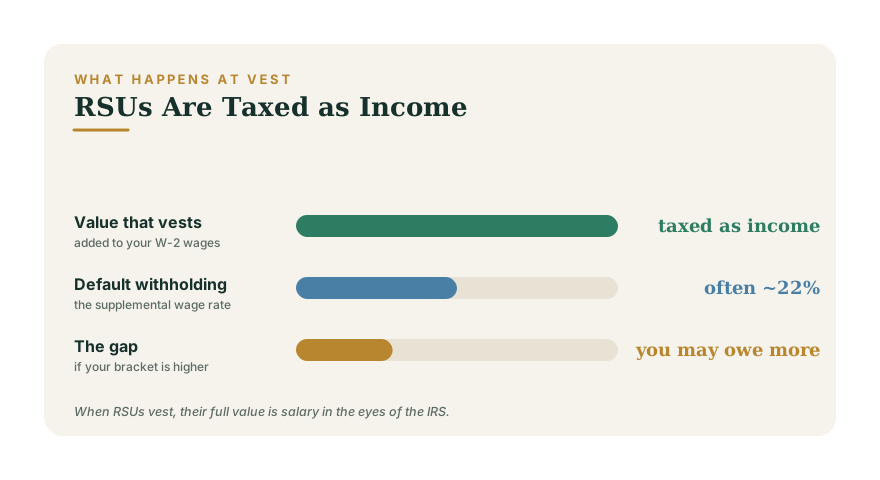
The moment your RSUs vest, the full market value of those shares is treated as ordinary income — exactly like a cash bonus of the same amount. If 100 shares vest when the stock is $80, you just earned $8,000 of taxable wages, and it lands on your W-2. This happens whether or not you sell. You now own the shares, and your cost basis is that $80 vesting price.
This is the single most important fact about RSUs: you are taxed at vest, not at sale. Anything that happens to the price afterward is a separate capital gain or loss, measured from the vesting value.
The sell-to-cover withholding gap
Your employer knows it owes taxes on that vesting income, so it usually performs a sell-to-cover: it automatically sells a portion of the vested shares and remits the proceeds as withholding, handing you the rest. Sounds complete — but there is a trap.
RSU income is typically withheld at the flat supplemental wage rate of about 22%. If your actual marginal tax bracket is higher than that — and for many people receiving sizable RSUs, it is — then not enough was withheld. The shortfall does not disappear; it shows up as a surprise balance due when you file. The bigger your grant and the higher your bracket, the wider this gap. The fix is to set aside extra cash, or adjust your W-4 withholding to make up the difference during the year. You can also pressure-test the math with our RSU and ESPP calculator.
Why you should usually sell at vest
Here is a thought experiment that clears up the most common RSU mistake. When shares vest, you have already paid (or will pay) ordinary income tax on their full value. Holding them afterward is exactly the same financial decision as taking that same dollar amount in cash and choosing to buy your employer's stock with it. Ask yourself plainly: if my company handed me $8,000 in cash today, would I put all of it into a single stock — my employer's?
For most people the honest answer is no. That is the argument for the boring default: sell RSUs as they vest and reinvest the proceeds into a diversified portfolio. There is usually little or no extra tax to selling immediately, because the cost basis equals the vesting price, so the gain is roughly zero. Holding instead piles single-company risk on top of the paycheck you already get from that same company. The danger is the same concentration problem that haunts option holders.
When holding can make sense
Selling at vest is a strong default, not an absolute rule. You might choose to hold some shares if you have genuine conviction in the company and your overall portfolio is already well diversified, so the position is a small, deliberate bet rather than your whole net worth. If you do hold and the stock rises, remember that selling later triggers capital gains measured from the vesting price — held over a year, those gains get lower long-term rates. Where you hold matters too; see asset location.
Don't let RSUs feed lifestyle creep
Because RSUs feel like a bonus rather than salary, it is tempting to mentally spend them before they even vest, inflating your lifestyle to match a stock price you do not control. A cleaner habit is to treat vested-and-sold RSU cash as a deliberate funding source — topping up retirement accounts, an emergency fund, or specific goals — rather than blending it into everyday spending. Guarding against lifestyle creep is what turns equity comp into lasting wealth instead of a fancier zip code.
RSUs are simple once you internalize one line: taxed as income at vest, then it is just stock you happen to own. Run your grant through the planning hub and decide your sell-or-hold rule before the next vesting date arrives.