"Money market" is one of the most confusing labels in personal finance, because it describes two different things that sit one letter apart. A money market account is a savings product at a bank. A money market fund is an investment you hold at a brokerage. They behave similarly day to day, but their risks and protections are not the same, and the difference matters.
What a money market fund actually holds
A money market fund is a type of mutual fund that invests in very short-term, high-quality debt: Treasury bills, government agency paper, and short-term corporate or bank IOUs. Because these holdings mature in days or months and come from creditworthy borrowers, the fund's value is extremely stable. Funds are managed so that each share is worth a steady $1.00, and the interest they earn is paid out to you as a yield. In practice it feels like a savings account that lives inside your brokerage.
How it differs from a money market account
The key distinction is what stands behind your money:
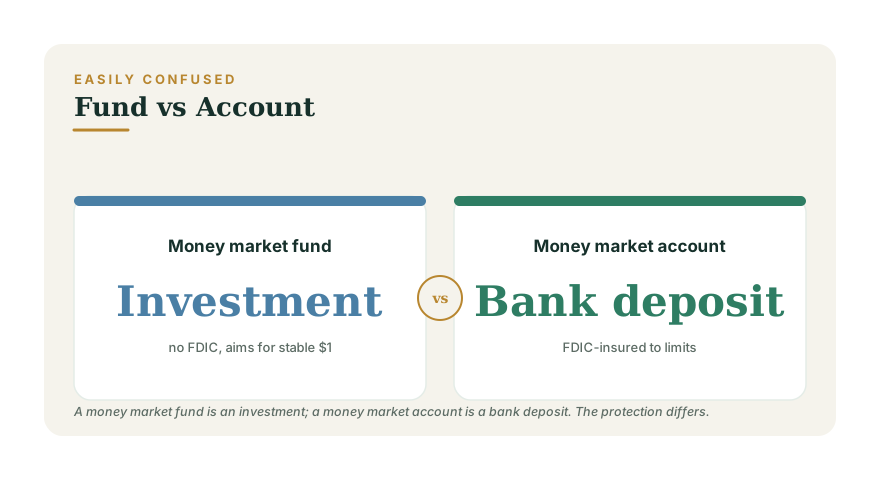
- A money market account at a bank is a deposit, and like a savings account it is FDIC-insured up to the legal limits. If the bank fails, the government makes you whole.
- A money market fund at a brokerage is a security you own. It is not FDIC-insured. It targets a stable $1 share price, but that stability is an objective, not a guarantee.
This sits within the broader cash menu covered in Savings Account vs Money Market vs CD, which is the right place to start if you are deciding where to park cash.
The "break the buck" risk
The signature risk of a money market fund is breaking the buck — when the fund's per-share value slips below $1.00. This is rare. It has happened only a couple of times in the history of these funds, most notably during the 2008 financial crisis when one large fund fell to 97 cents after a borrower it lent to collapsed. Even then, investors lost only a few cents on the dollar, not their whole balance.
After 2008, rules were tightened, and the safest category — government and Treasury money market funds — holds only government-backed paper, making a buck-breaking event extraordinarily unlikely. Prime funds, which hold some corporate debt, carry slightly more risk and a slightly higher yield. For most people prioritizing safety, a government or Treasury money market fund is the sensible default.
Why people still use them for cash
Despite the lack of FDIC insurance, money market funds are popular for good reasons:
- Convenience — the cash sits right next to your investments, so moving money to buy stocks or funds is instant. Many sit inside a brokerage account as the default sweep for uninvested cash.
- Competitive yield — their yields track short-term rates closely and often beat what big banks pay on savings.
- Liquidity — you can typically access the money within a day, with no lockup like a CD.
- Tax options — there are even municipal money market funds whose income can be partly tax-free, useful in higher brackets.
When a fund is the right tool — and when it isn't
A money market fund is a strong home for cash you want both safe and ready: a brokerage cash position, money waiting to be invested, or a near-term goal. For a true emergency fund, the FDIC backing of a bank savings account or money market account brings extra peace of mind, though many investors are comfortable using a government money market fund for part of it. For cash you can lock up, a CD or a CD ladder may pay more — see High-Yield Savings, CDs, and How to Build a CD Ladder.
The bottom line
A money market fund is a low-risk investment, not a bank account — stable and convenient, but uninsured and capable, in rare moments, of dipping below a dollar. Stick to government or Treasury versions for safety, keep your true emergency cushion somewhere you trust completely, and let the fund do what it does best: hold ready cash that still earns a yield. To see how much cash you should keep liquid in the first place, run the Emergency Fund Calculator.