The price-to-earnings ratio — the P/E — is the single most quoted number in investing. Pundits cite it to declare stocks "cheap" or "expensive," and beginners often assume a low P/E means a good deal. The reality is more nuanced and more useful: the P/E is a starting question, not a verdict.
Here is what it actually measures, the difference between its two common versions, where it quietly breaks, and why a long-term index investor doesn't need to obsess over it at all.
What a P/E ratio actually is
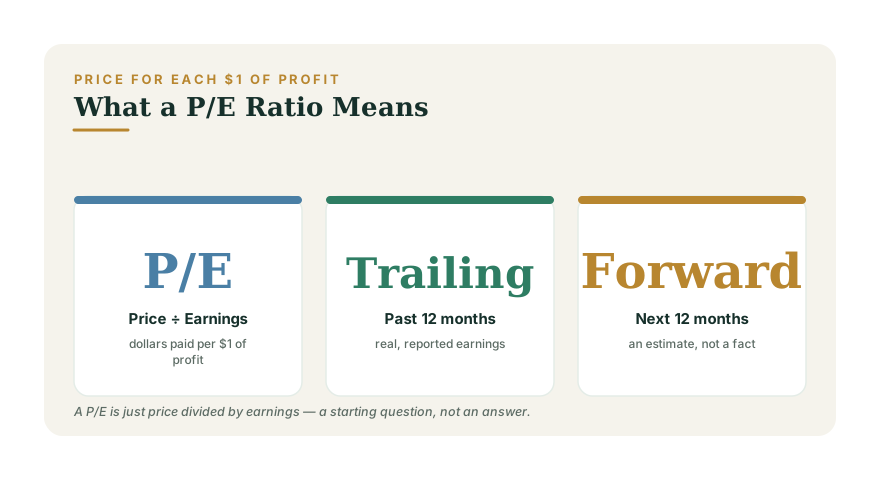
The P/E ratio is simply a company's share price divided by its earnings (profit) per share. If a stock trades at $100 and earned $5 per share last year, its P/E is 20. The cleanest way to read that: you are paying $20 for every $1 of the company's annual profit.
A higher P/E means investors are paying more per dollar of current earnings — usually because they expect those earnings to grow quickly in the future. A lower P/E means they are paying less, often because growth is expected to be slow, or because the market sees more risk. So the P/E isn't really a price tag; it's a measure of expectations baked into the price.
Trailing vs forward P/E
You will see two versions, and the difference matters:
- Trailing P/E uses the past 12 months of actual, reported earnings. The number is real and verifiable, but it looks backward — it tells you what was, not what will be.
- Forward P/E uses analysts' estimates of the next 12 months of earnings. It is more forward-looking, which is what investors care about, but it rests on forecasts that are routinely wrong. A low forward P/E can simply mean analysts are (perhaps too) optimistic about earnings rising.
Neither is "the right one." Trailing is grounded but stale; forward is relevant but speculative. Looking at both, and knowing which you're quoting, is the honest approach.
Why a low P/E is not automatically a bargain
This is the trap. A low P/E can mean a stock is genuinely undervalued — or it can mean the market expects its earnings to shrink, and the price has dropped for good reason. A cheap-looking P/E attached to a declining business is a classic value trap. The same logic applies to high yields: an eye-popping dividend often signals a price that fell because trouble is coming, a pattern we cover in the high-yield dividend trap.
Where the P/E breaks down
The P/E is a blunt tool with real blind spots:
- No earnings, no ratio. A company losing money has no meaningful P/E at all, which is common for young, fast-growing firms.
- Earnings can be massaged. The "E" comes from accounting, which has flexibility. Reported profit can be inflated or depressed by one-time items.
- Industries differ wildly. A fast-growing tech company and a stable utility naturally carry very different P/Es. Comparing across sectors is mostly meaningless.
- It ignores debt and cash. Two firms with the same P/E can have completely different balance-sheet risk.
This is part of why professional stock pickers, armed with far more than a P/E ratio, still struggle to consistently beat the market. Valuation is genuinely hard, and a single number can't capture it.
Why index investors needn't obsess over it
Here is the freeing part. If you invest through broad, low-cost index funds, you are deliberately choosing not to bet on individual valuations. You own a slice of the whole market, which means you automatically own the cheap and the expensive, the right calls and the wrong ones. You don't need to decide whether any one stock's P/E is justified — you're accepting the market's overall verdict and capturing its long-term return at minimal cost.
Even at the index level, valuation tells you something modest: when the broad market's P/E is historically very high, future long-term returns have tended to be somewhat lower, and vice versa. But that is a weak, slow signal — useless for timing and no reason to abandon a sound plan. The takeaway is calm, not action: keep investing steadily and keep costs low.
The bottom line
A P/E ratio is a quick, honest way to ask "how much am I paying for this company's profits?" — but it is a question, not an answer, and it says nothing on its own about whether a stock is a good buy. For most people, the practical move is to skip the stock-by-stock guesswork entirely and own the market through index funds. If you want help turning that into a concrete portfolio, explore the portfolio builder and our model portfolios.