Walk into a brokerage office and the same mutual fund can be offered to you under different letters — Class A, Class B, Class C, and sometimes more. The underlying investments are identical. What changes is how, and how much, you pay the firm that sold it to you. These are called share classes, and they exist almost entirely to package the sales commission in different ways. Knowing the differences keeps a salesperson from quietly steering you into the version that pays them best.
What a "load" actually is
A load is a sales charge — a commission paid to the broker or advisor who sold you the fund. It is not an investment cost and it does not improve the fund's performance by a single dollar; it is the toll for buying through a salesperson. A fund with no such charge is called no-load. The whole share-class system is just different ways of collecting (or hiding) that toll.
Class A: the front-end load
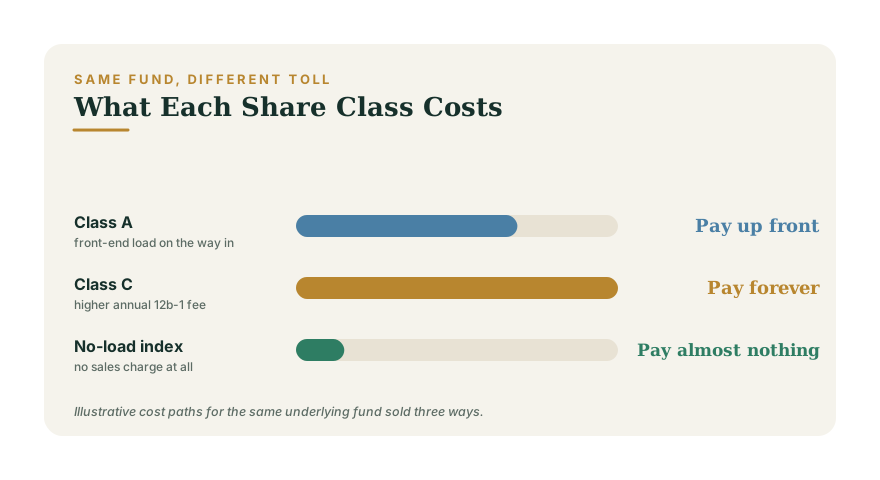
Class A shares charge a front-end load — a percentage skimmed off the top the moment you invest. Put in $10,000 with a 5% load and only $9,500 actually goes to work; the other $500 is gone before you earn a cent. In exchange, Class A shares usually carry the lowest ongoing annual fees of the loaded classes, and large investments often qualify for "breakpoints" that reduce the load. They are the least-bad loaded option for someone investing a big sum and holding for a long time — but "least-bad among loaded funds" is a low bar.
Class B: the back-end load (mostly extinct)
Class B shares flip the timing: no charge going in, but a back-end load (formally a contingent deferred sales charge) if you sell within a set number of years. The charge typically declines each year and eventually disappears, at which point B shares often convert to A shares. They also carry higher annual fees while you hold them. Because that structure was widely seen as a trap, most fund families have phased Class B shares out — but you may still encounter them in an inherited or old account.
Class C: the level load
Class C shares usually have no front-end charge and only a small, short-lived back-end charge, which makes them look cheap. The catch is a permanently higher annual fee — a level load baked into the expense ratio that you pay every single year you own the fund. Over a long holding period, that ongoing drag often costs more than a one-time front-end load would have. Class C shares can look attractive to a salesperson precisely because they keep paying out year after year.
The 12b-1 fee hiding in the expense ratio
Tucked inside a fund's annual expense ratio is often a 12b-1 fee — an annual charge, named after an SEC rule, that pays for marketing and, more to the point, ongoing compensation to the advisor who sold you the fund. It is the engine behind the "level load" on Class C shares. A 12b-1 fee of, say, 0.25% to 1% a year sounds tiny, but it compounds against you for as long as you hold the fund. To see how corrosive small annual percentages are over decades, read How Expense Ratios Quietly Destroy Your Wealth.
Why no-load index funds usually win
Step back and the pattern is clear: every share-class variation is a different way to route money to a salesperson. None of them improves the investment itself. A plain no-load index fund skips all of it — no front-end load, no back-end load, no 12b-1 fee — and typically charges a tiny fraction of a percent in annual expenses. Less of your money is consumed by fees, so more of it stays invested and compounding. That cost gap is a big part of why most actively managed, loaded funds underperform simple index funds over time.
This does not mean every advisor is out to fleece you, but it does mean you should always ask one direct question: "Is this fund load or no-load, and what is the 12b-1 fee?" An advisor paid by commission has a built-in reason to prefer loaded share classes; a fee-only advisor does not.
How to read it on the page
Every fund must disclose its loads and 12b-1 fee in the prospectus and the fee table. Learn to find them; the practice of decoding that document is covered in How to Read a Fund Fact Sheet. Once you know what to look for, the differences between share classes stop being mysterious letters and become exactly what they are: price tags.
Putting it together
If you are choosing investments yourself, default to low-cost, no-load index funds and you sidestep the entire share-class question. If you already own loaded funds, check whether you are paying an ongoing 12b-1 fee and whether a cheaper equivalent exists. You can run the long-term cost difference between a high-fee and a low-fee fund using the Opportunity Cost Calculator — the number it produces is usually enough to settle the debate.