The single most important question you can ask a financial advisor has nothing to do with markets, returns, or strategy. It is: who pays you? The answer quietly shapes every recommendation you will ever get from them. This is the biggest conflict of interest in the entire industry, and it hides behind friendly job titles that all sound roughly the same. They are not.
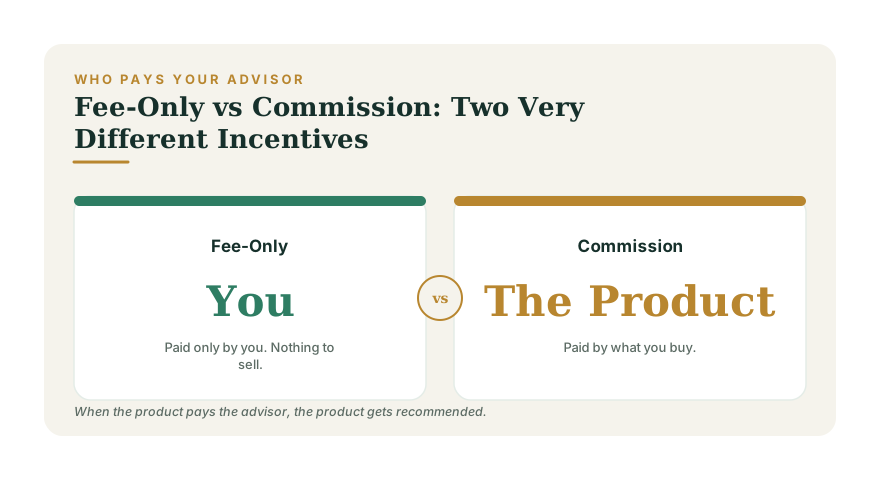
Understand the three payment models and you will understand whose interest your advisor is really serving.
The Three Models, Plainly
Fee-only. The advisor is paid only by you - a flat fee, an hourly rate, or a percentage of the assets they manage. They earn nothing from selling products. There is no commission, no kickback, no incentive to steer you toward anything in particular. Their income goes up only if your relationship continues, which usually means keeping you happy and your portfolio healthy.
Commission. The advisor (often called a broker or registered representative) is paid by the companies whose products they sell to you. A mutual fund pays them a sales load; an insurance company pays them an annuity commission. They may charge you little or nothing directly, because the manufacturer pays them when you buy. Their income depends on transactions.
Fee-based. This is the confusing one, and the confusion is the point. "Fee-based" sounds almost identical to "fee-only," but it means the advisor charges you a fee and can also collect commissions. It is a hybrid - one foot on each side. The word was chosen precisely because it blurs the line. If an advisor says "fee-based," they can still earn commissions, and you should treat them as a commission advisor until proven otherwise.
How Commissions Bend the Advice
Nobody has to be dishonest for commissions to distort a recommendation. People simply respond to incentives. Imagine two funds that do roughly the same job. Fund A is a low-cost index fund that pays the advisor nothing. Fund B is an actively managed fund with a 5.75% front-end load. On a $100,000 investment, Fund B hands the advisor $5,750 the day you buy. Fund A hands them zero. Which one do you think gets enthusiastically recommended, with a story about "professional management" attached?
The data bears this out. Studies of broker-sold versus directly purchased funds consistently find that commission-paid advisors recommend higher-fee, actively managed funds far more often than fee-only advisors do - and those funds, weighed down by their costs, tend to underperform. The advisor is not necessarily lying about anything. The incentive just quietly tilts every close call toward the option that pays them.
The Math of the Tilt
Say a commission advisor's recommendations leave you in funds averaging 1.0% in expense ratios, plus a 1% wrap fee, versus a fee-only setup of index funds at 0.05% plus a 0.5% flat-equivalent advisory cost. That is roughly 2.0% a year versus 0.55% - a 1.45% annual gap.
On $300,000 growing at 7% for 25 years, the lower-cost path leaves you with around $1.36 million. The higher-cost path leaves around $960,000. The difference - about $400,000 - did not vanish into bad markets. It went to fees and commissions, paid by you, for advice that was steered by who was writing the advisor's check.
Why the Industry Loves the Gray Zone
If commission conflicts are so costly, why do they survive? Because they are profitable for everyone except the client. Fund companies pay for distribution because loaded funds attract more assets. Brokerages keep the commission channel open because it generates revenue. And the deliberately fuzzy "fee-based" label lets firms market themselves as client-first while keeping the commission spigot on. The vagueness is not an accident; it is the business model.
How to Tell Which One You Have
- Ask directly: "Are you fee-only, fee-based, or commission?" A fee-only advisor will say so instantly and proudly.
- Ask: "Do you ever receive commissions, 12b-1 fees, revenue sharing, or referral payments?" Any yes means commission incentives exist.
- Ask them to confirm in writing that they act as a fiduciary at all times, on the entire relationship.
- Look up the firm's Form ADV and Form CRS - fee-only firms disclose that they take no commissions.
- Be skeptical of "no cost to you." Distribution is never free; you are paying inside the product.
How to Find a Genuine Fee-Only Advisor
You have real options, and many are affordable even for modest portfolios. The National Association of Personal Financial Advisors (NAPFA) lists members who are required to be fee-only fiduciaries. The Garrett Planning Network specializes in hourly, as-needed advice - useful if you want a one-time plan review rather than ongoing management. The XY Planning Network focuses on flat monthly or annual fees with no asset minimums. For people who want a plan but not a salesperson, an hourly or flat-fee engagement can cost a few hundred to a couple thousand dollars and pay for itself many times over.
If your situation is straightforward, you may not need a human at all: a low-cost robo-advisor or a simple set of index funds removes the commission conflict entirely, because there is no one in the middle being paid to sell.
Before you hire anyone, see what fees are actually doing to your money. Model the long-term cost of different fee levels with our tools at /tools, then choose an advisor whose paycheck is aligned with yours.