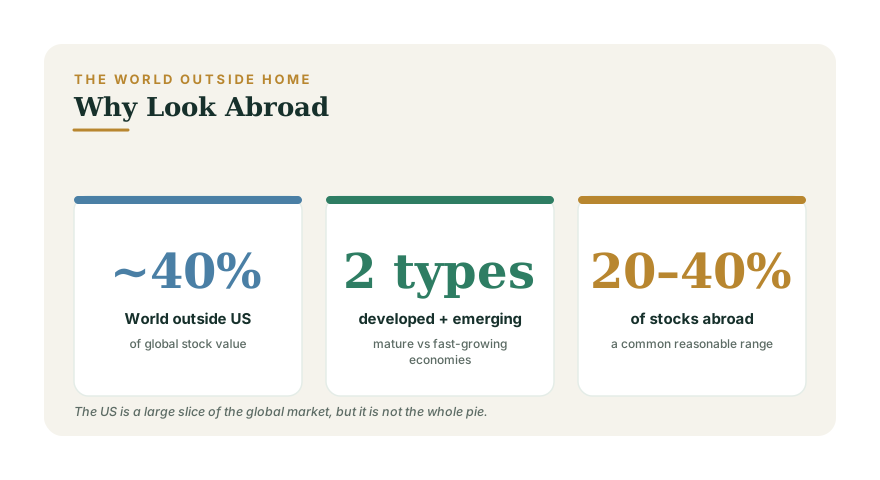
Ask a typical American investor what is in their portfolio, and you will often find almost everything sitting in US companies. That feels natural — it is the market we read about and the economy we live in. But concentrating your entire stock portfolio in one country, even a great one, leaves out roughly 40% of the world's stock value and quietly raises your risk. Here is the case for owning some of the rest of the world.
Home-country bias: the invisible bet
Home-country bias is the well-documented tendency of investors everywhere to overload on companies from their own country. Investors in Japan over-own Japanese stocks; investors in the UK over-own British ones; Americans over-own American ones. It feels safe because it is familiar, but familiarity is not the same as diversification.
A US-only portfolio is, whether you intended it or not, a concentrated bet that one country's market will keep leading. The US has had a tremendous run, and there is no rule that says it will or won't continue — but staking everything on a single nation's continued outperformance is a bet, not a diversified plan. Owning international stocks spreads that bet across many economies, currencies, and political systems, so your future is not tied to one country's fortunes.
Developed vs emerging markets
International stocks come in two broad buckets, and a good total-international fund holds both:
- Developed markets are mature, stable economies outside the US — places like Western Europe, Japan, Canada, and Australia. Their markets are well-established and broadly similar in character to the US market, with large, familiar global companies.
- Emerging markets are faster-growing but less mature economies — places like parts of Asia, Latin America, and elsewhere. They offer higher potential growth but with more volatility and political risk. Over the long run they add a different growth engine to your portfolio.
You do not need to pick between them or buy them separately. A single total-international index fund holds developed and emerging markets together in market-weighted proportions — which is exactly how the international slice works in a simple three-fund portfolio.
How much international is reasonable
This is where reasonable people disagree, and there is no single right answer. The two anchor points are worth knowing:
- At one extreme, holding international stocks at their global market weight — roughly 40% of your stock allocation — means you simply own the world as it is, with no home-country tilt at all.
- At the other, some respected voices argue a smaller slice, or even none, is acceptable for US investors because large US companies already earn substantial revenue overseas.
A common, sensible middle ground is to put somewhere between 20% and 40% of your stock holdings into international. Anywhere in that range is defensible. The most important thing is not nailing the perfect number — it is picking a reasonable allocation and then sticking with it through the inevitable stretches when international underperforms the US (and vice versa). For how the international slice fits alongside your overall stock-and-bond mix, see asset allocation by age.
Currency and the long view
One feature of international investing surprises newcomers: currency. When you own foreign stocks, your returns depend partly on how the dollar moves against other currencies. If the dollar weakens, your international holdings get a tailwind in dollar terms; if it strengthens, a headwind. Over short periods this adds some bounce to your returns.
Over the long run, though, currency swings tend to wash out rather than compound, and they are not a reason to avoid international stocks. If anything, owning assets denominated in other currencies is itself a form of diversification — your wealth is no longer riding entirely on the US dollar. The right frame is the long one: you are not trying to time currencies any more than you are trying to time markets. You are spreading your ownership across the world and letting decades do the work.
The takeaway
A portfolio packed entirely with US stocks is an unintentional bet on one country. Adding international exposure — developed and emerging markets together, somewhere in the 20–40% range of your stock allocation — diversifies that bet across the whole world without adding complexity, since one total-international index fund does the job. If you are still assembling your first portfolio, the beginner's guide to index funds covers the building blocks, and the model portfolios tool can help you set a US-versus-international split you can hold for the long haul.