The Child Tax Credit is one of the most valuable tax breaks available to families, and also one of the most misunderstood. Because it is a credit rather than a deduction, it reduces your tax bill directly — and a meaningful slice of it can be paid to you even if you owe no tax at all. Understanding the rules helps you claim everything you are entitled to and avoid surprises.
Who qualifies as a child for the credit
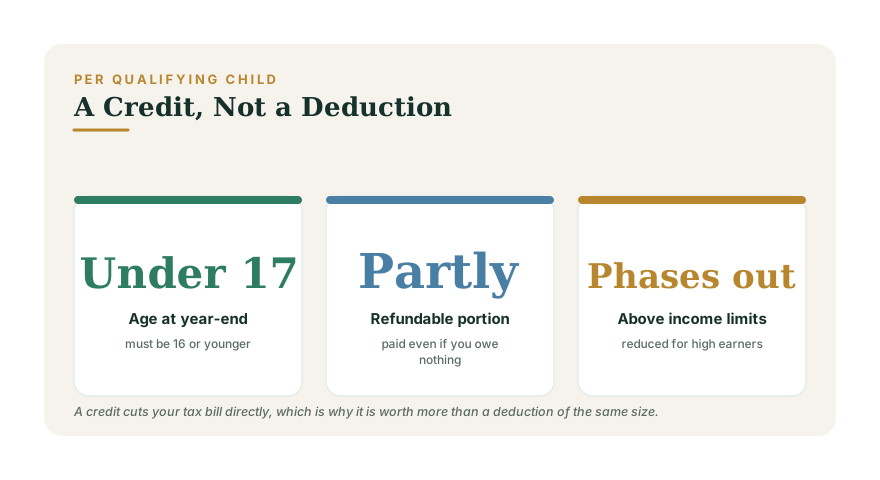
To claim the Child Tax Credit, a child generally has to meet several tests. The child must be under age 17 at the end of the tax year — a 17th birthday on or before December 31 disqualifies them for that year, which catches many parents off guard. The child must be your son, daughter, stepchild, foster child, sibling, or a descendant of any of them (such as a grandchild), and you must claim them as a dependent on your return.
The child also has to be a U.S. citizen, national, or resident, must have lived with you for more than half the year, and generally cannot have provided more than half of their own support. Critically, the child needs a valid Social Security number issued before your filing deadline. The dependent rules that underpin all of this are covered in The Rules for Claiming Dependents.
The partially refundable portion
Tax credits come in two flavors. A nonrefundable credit can only reduce your tax to zero. A refundable credit can go further and turn into a payment to you. The Child Tax Credit is a hybrid: part of it is refundable through what is called the Additional Child Tax Credit.
This matters most for lower- and middle-income families. If your tax bill is small, the nonrefundable part of the credit might wipe it out with value to spare. The refundable portion lets you collect a chunk of that leftover value as a refund rather than losing it. The refundable amount is tied to your earned income above a threshold, so families with very little earned income may receive a smaller refundable amount.
How income phaseouts work
The full credit is aimed at low-, moderate-, and middle-income households, so it begins to shrink once your income climbs past certain limits. The phaseout is based on your modified adjusted gross income (MAGI), and the threshold is higher for married couples filing jointly than for single or head-of-household filers.
Above the threshold, the credit is reduced gradually — typically by a set amount for every increment of income over the limit — until it phases out entirely for high earners. If your income sits near one of these lines, understanding your AGI and MAGI helps you see how close you are and whether moves like extra retirement contributions could keep more of the credit intact.
Why a credit beats a deduction
This is the single most important concept for families to grasp. A deduction lowers the income that gets taxed; its value depends on your tax bracket. A $2,000 deduction for someone in a 12% bracket saves about $240. A credit, by contrast, reduces the tax itself dollar for dollar — a $2,000 credit cuts your bill by the full $2,000 regardless of bracket. The mechanics are laid out in Tax Credits vs Deductions, and it is the reason credits are usually worth chasing first.
The credit for other dependents
Children who age out of the Child Tax Credit, and certain other dependents such as an older child in college or a dependent parent, may still qualify you for a smaller, separate Credit for Other Dependents. It is nonrefundable, but it is real money and easy to miss when a child turns 17 and you assume the benefit simply vanishes.
Claiming it without errors
Most tax software walks you through the Child Tax Credit automatically once you enter your dependents, but errors still happen — a missing or mismatched Social Security number, a child claimed on two returns, or a missed birthday cutoff. Double-check each child's information against their Social Security card. Common slip-ups across the whole return are collected in Common Tax Filing Mistakes.
Put the numbers in context
The Child Tax Credit can meaningfully change a family's refund or balance due, so it is worth folding into your broader plan rather than treating it as a year-end surprise. Run your situation through the tax strategies tool to see how credits and deductions interact, and use the Tax Health assessment to spot other breaks you may be leaving unclaimed.