"Tax credit" and "tax deduction" get used almost interchangeably in everyday conversation, but they are not the same thing, and confusing them can cost you real money. Both lower what you owe, but they work at completely different points in the calculation — and a dollar of credit is worth far more than a dollar of deduction. Once you internalize the difference, a lot of tax planning becomes clearer.
Deductions reduce the income you are taxed on
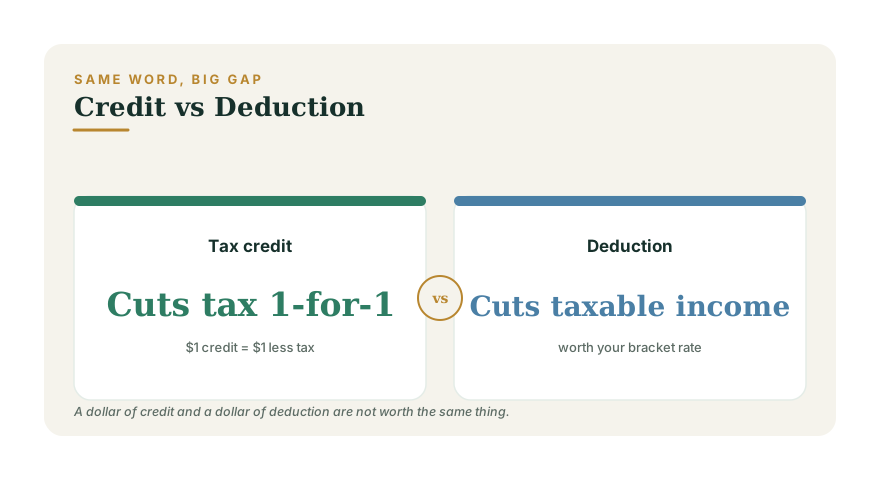
A deduction lowers your taxable income — the figure your tax is calculated from. Its value depends on your tax bracket, because it only saves you the tax you would have paid on that slice of income. If you are in a 22% bracket, a $1,000 deduction saves you about $220, not $1,000. In a 12% bracket, the same deduction is worth only about $120. The higher your bracket, the more a deduction is worth, which is why deductions matter more to high earners.
Deductions come in two flavors: the standard deduction (a flat amount most people simply take) and itemized deductions (mortgage interest, state taxes, charitable gifts, and so on, added up individually). You take whichever is larger. Our piece on standard versus itemized deductions walks through how to decide.
Credits cut your tax bill directly
A tax credit is far more powerful: it reduces your tax dollar for dollar, after the tax has already been calculated. A $1,000 credit lowers your tax by a full $1,000, no matter what bracket you are in. There is no "worth your rate" discount — a credit is the closest thing the tax code has to free money applied straight against your bill.
That is the whole reason credits win. To match a single $1,000 credit, someone in the 22% bracket would need roughly $4,500 in deductions. Credits do the heavy lifting; deductions help around the edges.
A worked example
Imagine two people, each with a $6,000 tax bill before any breaks, each in the 22% bracket.
- Person A gets a $2,000 deduction. It reduces taxable income by $2,000, saving 22% of that — about $440. New tax bill: roughly $5,560.
- Person B gets a $2,000 credit. It comes straight off the tax owed, saving the full $2,000. New tax bill: $4,000.
Same $2,000 figure, wildly different results: $440 versus $2,000. That gap is the entire point. When you are choosing where to focus — or evaluating a "tax-saving" pitch — knowing whether the break is a credit or a deduction tells you how excited to be.
Refundable vs nonrefundable credits
Credits split into two important types:
- A nonrefundable credit can reduce your tax to zero but no further. If you owe $800 and qualify for a $1,000 nonrefundable credit, $200 of it simply disappears.
- A refundable credit can take you below zero — the excess comes back to you as a refund. If you owe $800 and qualify for a $1,000 refundable credit, you wipe out the $800 and receive the extra $200 as cash.
Refundable credits are especially valuable for lower-income households, who might otherwise have too little tax for a credit to fully help. Some credits are partly refundable, blending both behaviors. Always check which type a credit is, because it determines whether you can capture its full value.
Where you actually find them
Plenty of common breaks fall into each camp. Major credits include those for children and dependents, for education (covered in our guide to education tax breaks), for certain energy-efficient home improvements, and the earned income credit. Major deductions include retirement contributions, student loan interest, and the itemized items above. The brackets that determine a deduction's value are explained in how tax brackets really work.
The planning takeaway
None of this means you should ignore deductions — they add up, and for big-ticket items like mortgage interest they are substantial. But when you are comparing strategies, a credit should grab your attention first because each dollar is worth a full dollar. Make sure you are claiming every credit you qualify for before you fine-tune deductions.
To pressure-test your own situation and spot breaks you may be missing, run the Tax Health assessment and explore the tax strategies tool. A few minutes there often surfaces a credit worth real money that would otherwise slip by.