Every investor eventually meets a falling market, and the headlines that come with it are engineered to alarm. But the words used to describe a decline have precise meanings, and knowing them is the first step to staying calm. A drop is not automatically a disaster — most are routine, and history has a remarkably consistent lesson about what to do when one arrives.
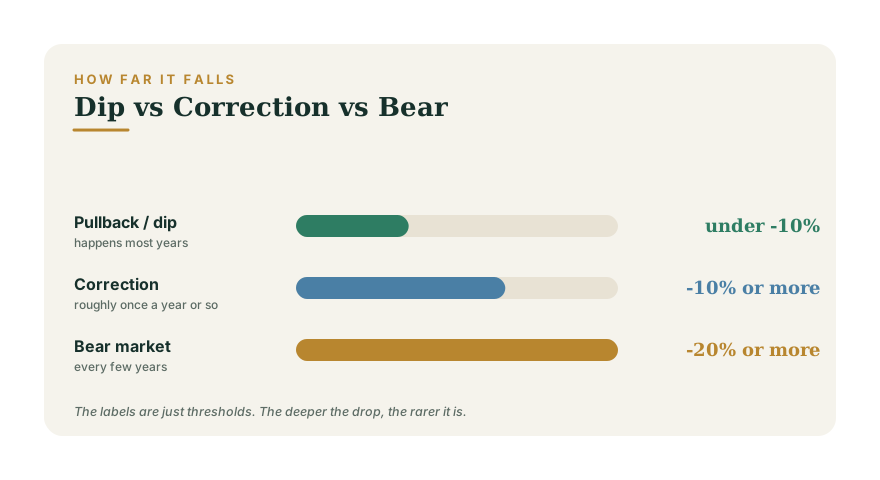
Dip, correction, bear market: just thresholds
The terms sound dramatic, but each is simply a measure of how far the market has fallen from its most recent high:
- A dip or pullback is a decline of less than 10%. These are so common they barely make the news — the market has a handful of them in a typical year.
- A correction is a drop of 10% or more. Uncomfortable, but historically these have arrived roughly once a year on average, and most resolve within a few months.
- A bear market is a fall of 20% or more. These are the ones people remember. They show up every few years, last longer on average, and feel awful while you are in one.
Notice the pattern: the deeper the decline, the less often it happens. None of these thresholds tells you anything about why the market fell or what comes next — they are just rulers measuring distance from a peak.
How often each one happens
Markets do not rise in a straight line; volatility is the price of admission for long-term growth. Pullbacks are constant background noise. Corrections are frequent enough that any long-term investor will live through many of them. Bear markets are rarer but not exotic — over a multi-decade investing life, you should expect to weather several. Crucially, every single one in market history has eventually ended, and the market has gone on to make new highs. The decline is temporary; the recovery, so far, has always come.
Why selling into a decline is the real mistake
The instinct during a sharp drop is to sell and "wait until things calm down." This feels safe and is usually the single most damaging thing an investor can do. The problem is that you have to be right twice — once when you sell, and again when you buy back — and almost nobody is. The market's best days have a stubborn habit of clustering right next to its worst days, often during the scary part of a recovery. Miss a handful of those best days because you were on the sidelines, and your long-run return takes a serious hit.
Selling locks in a loss that was, until that moment, only on paper. It also hands you a second hard decision: when to get back in. Most people who sell in a panic re-enter too late, after the rebound has already happened, having captured the full downside and missed the upside. This is the core reason market timing doesn't work for the vast majority of investors.
The do-nothing playbook
The strategy history rewards is almost insultingly simple: keep doing what you were already doing. For a long-term investor with a sensible plan, a market decline is not a signal to act — it is a test of whether the plan was built correctly in the first place. The playbook:
- Keep contributing on schedule. If you invest every paycheck, a falling market means you are buying the same funds at lower prices — exactly what a long-term buyer wants. This is the quiet advantage of a simple, automated portfolio that runs without your emotions involved.
- Check your time horizon, not the news. If you don't need the money for ten or more years, a decline today is largely irrelevant to that goal. Money you need in the next year or two should not have been in stocks to begin with.
- Rebalance, don't bail. If a drop has thrown your stock and bond mix out of alignment, calmly rebalancing back to your target effectively sells what held up and buys what fell — a disciplined, rules-based response instead of a fearful one.
- Turn off the noise. Checking your balance daily during a bear market is a recipe for bad decisions. The less you look, the easier it is to leave the plan alone.
Prepare before the storm, not during it
The reason most people sell at the bottom is that they took on more risk than they could emotionally tolerate, then discovered it at the worst possible moment. The fix is to set an allocation you can live with before a crash, so you are never forced to make decisions while afraid. Understanding the normal rhythm of ups and downs helps too — see understanding market volatility for why a bumpy ride is the expected experience, not a malfunction.
The takeaway
Declines are not anomalies; they are a permanent feature of investing, and the labels we give them are just measures of depth. The investors who do well are not the ones who dodge every drop — that is impossible — but the ones who refuse to turn a temporary decline into a permanent loss by selling. Build a mix you can hold through a bear market, automate your contributions, and let history do the heavy lifting. To find an allocation you can actually stick with when markets get rough, try the Investor Profile assessment or sketch a long-term mix with the model portfolios tool.