A side hustle — freelancing, driving, selling, consulting on weekends — is one of the better financial moves you can make. But the first tax season after starting one is where many people get blindsided. With a regular job, taxes are quietly withheld from every paycheck. With side income, nobody withholds anything, so the full bill lands at once, and it is bigger than people expect.
1099 income works differently from a W-2
When you do side work as an independent contractor, the businesses that pay you may send a 1099 form instead of a W-2 — typically a 1099-NEC for service work, or a 1099-K if you were paid through a platform or payment app. The key difference is that no tax was taken out. You receive the full amount, which feels great until you realize part of it was never yours to keep. And even if you never receive a 1099 — say a client paid you a small amount — that income is still taxable and you are still required to report it.
Why self-employment tax stings
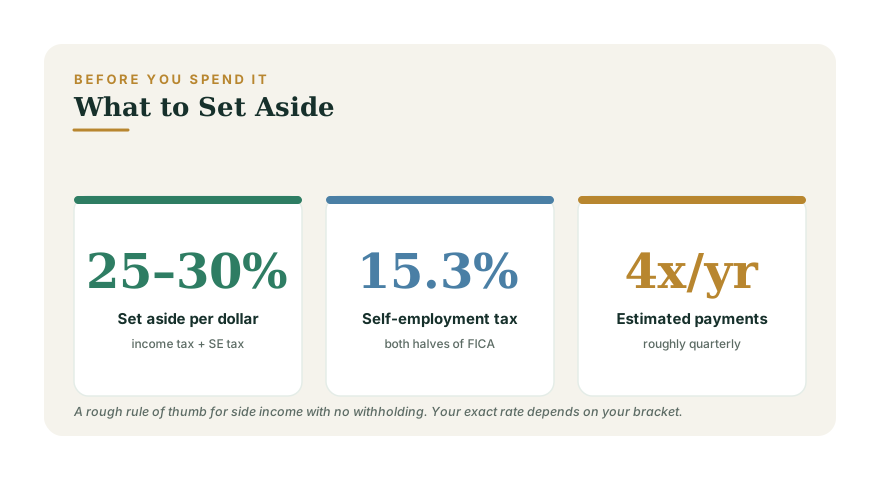
At a normal job you pay 7.65% in FICA (Social Security and Medicare), and your employer quietly pays a matching 7.65% you never see. When you work for yourself, you are both the employee and the employer, so you owe both halves — 15.3% self-employment tax — on top of regular income tax. This is the part that surprises people. A side hustler in, say, the 22% income-tax bracket is effectively facing income tax plus that 15.3%, which is why setting aside roughly a quarter to a third of side income is a safe default. (One small mercy: you get to deduct half of the self-employment tax against your income.)
How much to set aside
A simple, conservative habit: every time a client pays you, move 25% to 30% into a separate savings account you do not touch. If you are a higher earner or live in a high-tax state, lean toward the top of that range or higher. The exact percentage depends on your total income and bracket, but the discipline matters more than precision — money parked the moment it arrives is money you will not have to scramble for in April. Keeping this in a separate high-yield savings account means it even earns a little while it waits.
Quarterly estimated taxes
Here is the part that catches people: the IRS does not want to wait until April. If you will owe a meaningful amount on side income, you are generally expected to pay estimated taxes four times a year, roughly quarterly. Skip them and you can owe an underpayment penalty even if you pay the full balance later. The deadlines and how to calculate each payment are laid out in Quarterly Estimated Taxes, Explained. One handy alternative if your side hustle is small relative to your day job: increase the withholding on your W-2 paycheck to cover the side income, sidestepping estimated payments entirely.
Deductible business expenses lower the bill
The upside of being self-employed is that you are taxed on profit, not revenue. Ordinary and necessary costs of doing the work reduce the income you owe tax on:
- Supplies and equipment used for the hustle.
- Mileage driven for the business (track it — the standard mileage rate adds up fast).
- A portion of your phone and internet if you use them for the work.
- The home-office deduction, if you have a space used regularly and exclusively for the business.
- Platform fees, software subscriptions, and professional services.
Keep records and receipts; the deduction is only as good as your documentation. A fuller list, including ones people routinely miss, is in Self-Employed Tax Deductions.
The bigger opportunity
Self-employment also opens retirement accounts a W-2 job does not — a SEP-IRA or Solo 401(k) can let you shelter a large share of side income from tax while building wealth. Once the basics are handled, that is the next move. Start by getting the set-aside habit right, then map your full picture with the Self-Employed Hub and a quick Tax Health check to make sure nothing is slipping through.