Late each January a single sheet of paper — or a PDF in your payroll portal — arrives with the whole prior year of work boiled down to a grid of numbered boxes. The W-2 is the form your employer sends you and the IRS so everyone agrees on what you earned and what was already withheld. It looks intimidating, but almost all of the confusion traces back to one idea: the form reports your wages as several different numbers, on purpose.
Why there is no single "wages" number
The intuitive expectation is that your salary appears once. Instead it shows up in at least three boxes, and they often disagree. That is not an error. Different taxes use different definitions of "wages," because some deductions are exempt from one tax but not another. Once you know that, the W-2 stops being mysterious.
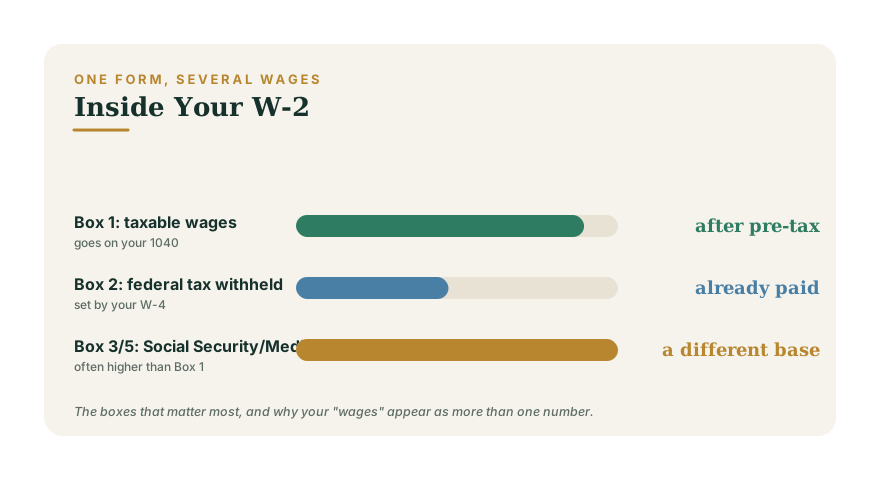
Box 1: the number that actually goes on your return
Box 1 is your federal taxable wages — the figure that flows onto your Form 1040. Crucially, it is usually lower than your gross salary, because pre-tax deductions have already been subtracted. Money you put into a traditional 401(k), and the premiums you pay for employer health insurance, come out before federal income tax is calculated, so they shrink Box 1. This is the core reason a $70,000 salary might show roughly $62,000 in Box 1. Those pre-tax deductions are doing exactly what they are supposed to: lowering the income the government taxes. The mechanics of how that taxable number turns into a tax bill are covered in How Tax Brackets Really Work.
Box 2: what you already paid
Box 2 is the federal income tax already withheld from your paychecks across the year and sent to the IRS on your behalf. This is not a tax you owe now — it is a tax you have prepaid. At filing time you compare what you actually owed (based on Box 1 and your situation) against what you prepaid in Box 2. Prepaid too much, you get a refund; too little, you write a check. That gap is governed entirely by the W-4 you filled out, which is worth getting right — see Tax Withholding and the W-4.
Boxes 3 through 6: Social Security and Medicare
Boxes 3 and 5 report Social Security wages and Medicare wages, and these are frequently higher than Box 1. The reason is the flip side of the pre-tax rule: a 401(k) contribution lowers your income-tax wages but is still subject to Social Security and Medicare tax. So your retirement saving reduces Box 1 but not Boxes 3 and 5. Boxes 4 and 6 show the Social Security and Medicare tax actually withheld — together this is the 7.65% FICA you may recognize from your first paycheck. Social Security wages also stop at an annual cap, so high earners may see Box 3 lower than Box 5.
The boxes people misread
- Box 12 — a set of coded entries. Code D is your 401(k) contribution; code W is HSA contributions; code DD is the total cost of your health coverage (informational only, not taxable). The letter codes confuse people, but they simply itemize things already reflected elsewhere.
- Box 13 — checkboxes, including "Retirement plan," which signals you were an active participant in an employer plan. That flag can affect whether your traditional IRA contribution is deductible.
- Boxes 15 to 20 — state and local wages and tax withheld, the state-level mirror of Boxes 1 and 2.
Common points of confusion at filing
Three issues account for most W-2 headaches. First, people panic that Box 1 is "wrong" because it is lower than their salary — it is supposed to be. Second, multiple jobs mean multiple W-2s, and all of them must go on your return; forgetting one triggers an IRS notice later. Third, an early W-2 can be corrected; if you get a W-2c after filing, you may need to amend. Always check that your name and Social Security number are exactly right before you rely on the form.
Put it to work
Your W-2 is also a diagnostic. If Box 2 produced a giant refund or a surprise bill, that is a signal to revisit your withholding. Run your numbers through the W-2 Tax Checkup or the W-2 Optimizer to see whether your paycheck is set up the way you actually want it.