Most tax-advantaged retirement accounts come with a catch: pull money out before age 59 and a half and you generally owe a 10 percent early-withdrawal penalty on top of income tax. For early retirees — anyone who stops working in their 40s or 50s — that is a real problem, because they need to live on their savings for years before the penalty lifts. The Roth conversion ladder is the most elegant workaround, and it rests on one specific rule the IRS built into Roth accounts.
The rule that makes it work
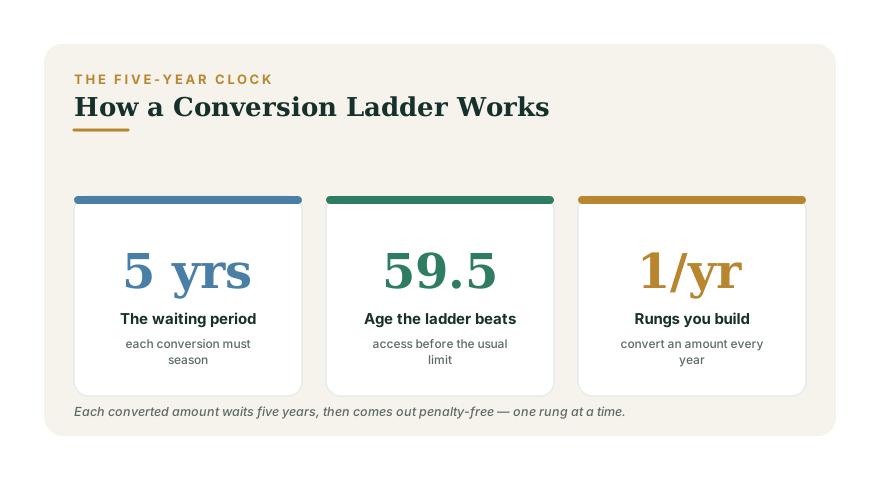
When you convert money from a traditional IRA or 401(k) to a Roth IRA, you pay income tax on the converted amount that year. In exchange, the converted principal can later be withdrawn tax- and penalty-free once it has sat in the Roth for five tax years — even if you are under 59 and a half. Each conversion starts its own five-year clock. Chain several conversions together, one per year, and you build a "ladder" where a fresh rung matures and becomes spendable every year. The IRS lays out the distribution ordering and the five-year rules for Roth IRAs at irs.gov/retirement-plans.
Step 1: get money into a traditional pre-tax account
The ladder starts with money in a traditional IRA or an old 401(k). Most people rolling into early retirement already have this from years of pre-tax contributions. If your money is in a current employer 401(k), you may first roll it over to an IRA after you leave the job — the mechanics are in How to Roll Over a 401(k).
Step 2: convert one year of expenses at a time
Each year, convert roughly one year's worth of living expenses from the traditional account to your Roth IRA. You will owe ordinary income tax on the amount converted, so the ideal time to do this is a low-income year — exactly what early retirement often provides. Converting only up to the top of a low tax bracket keeps the tax bill small. This is the same conversion tax math covered in The Roth Conversion Strategy Guide.
Step 3: wait five years for each rung
Here is the timing catch: the money you convert this year cannot be withdrawn penalty-free for five years. So the ladder requires a bridge — five years of spending money from another source to cover you while the first rungs season. That bridge usually comes from a regular taxable brokerage account or cash savings. Retire, convert in year one, and live off taxable savings for years one through five; by year six, your year-one conversion has matured and is ready to spend.
Step 4: climb the ladder
Once the first rung matures, the machine runs itself:
- Year 1: convert amount A, live off taxable savings.
- Year 2: convert amount B, live off taxable savings.
- Years 3 through 5: keep converting each year, keep spending taxable savings.
- Year 6: withdraw the matured year-1 conversion, penalty-free — and convert a new amount to keep the ladder going.
From year six onward, each year you spend a matured conversion and add a new one, so the ladder perpetuates until you reach 59 and a half, when the penalty rules no longer bind you.
Pitfalls to plan around
- You need a five-year bridge. Without taxable savings or cash to cover the first five years, the ladder does not work. Build that bridge before you retire.
- Order matters within the Roth. Withdraw contributions and matured conversions, not earnings, to stay penalty-free. Track which dollars are which.
- Conversions raise that year's income. A large conversion can push you into a higher bracket or affect health-insurance subsidies, so size each rung deliberately.
- Do not confuse it with a backdoor Roth. That is a different maneuver, explained in The Backdoor Roth, Step by Step.
Is it right for you?
The conversion ladder shines for early retirees with a chunk of pre-tax savings and a low-income window to convert into. It is less relevant if you will work until traditional retirement age. The broader early-retirement context — including how the FIRE crowd uses it — is in The Roth Conversion Ladder for Early Retirement. Model the conversions and their tax cost with the Roth Conversion Calculator, stress-test your early-retirement plan with the FIRE Calculator, and check your standing with the Retirement Readiness assessment before mapping it all at the planning hub.