One of the quiet costs of gig and contract work is that nobody hands you a retirement plan or a matching contribution. There is no HR portal to enroll in, no automatic payroll deduction, and no employer adding free money. That makes it easy to put retirement off indefinitely. But self-employed people actually have access to some of the most generous retirement accounts in the tax code — they just have to open them deliberately. Here is how the main options compare and how to keep saving when your income is anything but steady.
Start with the simplest: an IRA
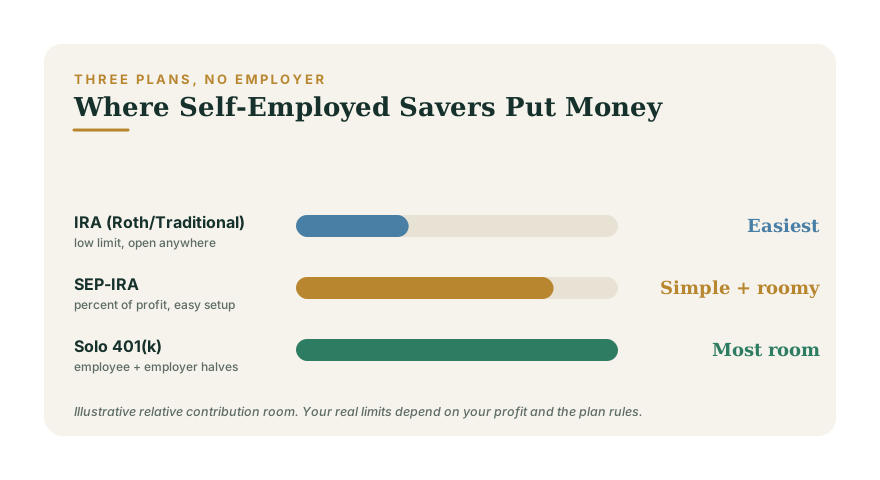
Anyone with earned income can open an IRA, traditional or Roth, at any brokerage in a few minutes. The contribution limit is modest compared with the plans below, but for someone just starting out it is the easiest possible on-ramp, and a Roth IRA is especially attractive in a low-income year because you lock in tax-free growth at a low rate. If you are unsure which flavor fits, see Roth vs Traditional IRA. Even if you later add a bigger plan, an IRA can sit alongside it.
The SEP-IRA: simple and roomy
A SEP-IRA is built for the self-employed and is famously easy to open and run — no annual government filing, and you can set it up and fund it as late as your tax deadline. You contribute a percentage of your net self-employment income, which means in a strong year you can shelter far more than an IRA allows. The trade-off: it is funded entirely from the "employer" side, so at modest income levels it may not let you save as much as a Solo 401(k). It also has no Roth version in most setups, and if you ever hire employees, you generally must contribute for them too.
The Solo 401(k): the most contribution room
A Solo 401(k) (also called an individual 401(k)) is for a business with no employees other than you and possibly a spouse. Its power is that you contribute as both the employee and the employer: you can put in an employee-style salary deferral up to the annual 401(k) limit, plus an employer profit-sharing amount on top. That stacked structure usually lets a given level of income shelter more than a SEP, especially at lower-to-middle profits, and many providers offer a Roth option for the employee portion. The cost is a bit more paperwork once the balance grows. For a fuller side-by-side, see Self-Employed Retirement Accounts.
Which one should you pick?
- Just starting, small profit? Open a Roth IRA and build the habit.
- Want maximum savings with minimum hassle? A SEP-IRA is hard to beat for simplicity.
- Want to shelter the most at a given income, or want a Roth option? The Solo 401(k) usually wins.
None of these choices is permanent. Many people start with an IRA, graduate to a SEP as income grows, and move to a Solo 401(k) when they want to maximize. The mistake is waiting for the "perfect" account instead of opening any of them.
Smoothing contributions on a lumpy income
The hardest part is not choosing an account — it is funding it when some months are flush and others are lean. A few techniques make it manageable:
- Pay yourself a contribution as a percentage, not a fixed dollar. Move a set share of every payment into your retirement bucket, so big months automatically contribute more and slow months less.
- Use a holding account. Sweep that percentage into a separate savings account during the year, then make your actual plan contribution in a lump near the tax deadline once you know your real profit. SEP and IRA rules generally allow funding for the prior year up to your filing date.
- Fund the floor first. Cover an emergency fund before locking money away — without a cash buffer, an irregular income forces you to raid retirement at the worst time.
Managing the variable-income part well makes everything else possible; Budgeting on an Irregular Income goes deep on the system.
Put a number on it
Retirement saving without an employer match feels abstract until you see the trajectory. Plug your age, expected contributions, and a conservative growth assumption into the Retirement Planner to see what consistent self-funded saving builds over time, and use the Retirement Readiness assessment to check whether your current pace is on track. The lack of a 401(k) is not the obstacle — starting late is. Open one account this month and automate a percentage, and your future self inherits the compounding.