One quiet penalty of self-employment is losing the workplace 401(k) — the automatic paycheck deferral and, often, an employer match. But gig workers, freelancers, and creators are not stuck with a plain IRA and its low limit. Two specialized accounts, the SEP IRA and the solo 401(k), let you shelter far more, and choosing between them is one of the highest-leverage financial decisions a self-employed person can make.
Why not just use a regular IRA
You can, and it is a fine place to start. But a traditional or Roth IRA has a relatively modest annual contribution limit, which the IRS adjusts each year. For a freelancer having a strong year, that ceiling fills up fast. The SEP IRA and solo 401(k) exist precisely to let self-employed people contribute much larger amounts, often several times the regular IRA limit, because you are wearing both the employer and employee hats. The general landscape is mapped in Self-Employed Retirement Accounts.
The SEP IRA: simplicity first
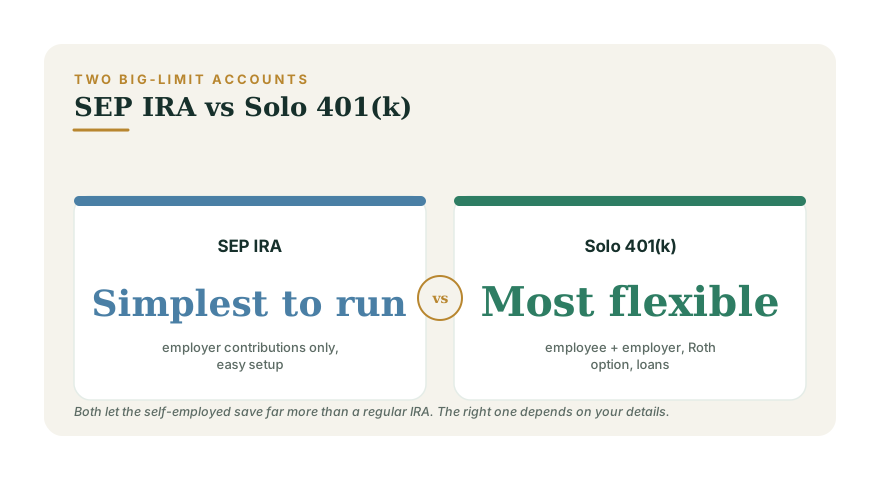
A SEP IRA is the low-effort option. You open it at almost any brokerage in minutes, and it involves essentially no ongoing paperwork. Contributions are made by the "employer" — which is you — as a percentage of your net self-employment income, up to a generous cap set by the IRS. Strengths and trade-offs:
- Dead simple to open and maintain, with no annual government filing.
- Flexible funding — you decide each year how much to put in, which suits lumpy freelance income.
- Employer-only contributions, so there is no separate employee deferral to stack on top.
- Traditional (pre-tax) only in most cases, with no built-in Roth version.
- Watch the employee rule — if you ever hire staff, a SEP generally requires you to contribute the same percentage for eligible employees, which can get expensive.
The solo 401(k): more power, more paperwork
A solo 401(k) (also called an individual 401(k)) is for a business with no employees other than you and a spouse. It is more capable but slightly more involved. Because you are both employer and employee, you contribute in two capacities — an employee salary deferral plus an employer profit-sharing contribution — which often lets you sock away more than a SEP at the same income level, especially at modest earnings. Highlights:
- Two contribution types — employee deferral plus employer share, both capped by IRS limits.
- Roth option is commonly available, letting you build tax-free retirement money.
- Higher totals at lower income because the employee deferral is a flat amount, not a percentage.
- Loan feature on many plans, letting you borrow against the balance in a pinch.
- More administration — once the balance grows past a threshold set by the IRS, you must file an annual information return, and it cannot easily accommodate non-spouse employees.
How to choose
A practical way to decide:
- Choose a SEP IRA if you value simplicity above all, your income is high enough that the percentage-based cap already lets you save plenty, and you want zero paperwork.
- Choose a solo 401(k) if you want to maximize contributions at a moderate income, you want a Roth option, or you like the loan flexibility — and you do not mind a bit more admin.
- Either way, remember these accounts reduce this year's tax bill (traditional versions) while building your future, so coordinate them with your quarterly estimated taxes.
You can generally have only one of these as your primary plan, though a SEP and a personal IRA can coexist. If you are weighing pre-tax versus Roth treatment, the Roth vs Traditional comparison helps.
Start now, optimize later
The worst choice is neither. Self-employed people who postpone retirement saving lose the one advantage a volatile income still offers: the ability to shelter big contributions in strong years. Open the simpler SEP if you are unsure, and upgrade to a solo 401(k) as your business matures. Project the long-term impact with the Retirement Planner and see how gig-specific saving fits together in Retirement Savings for Gig Workers. Check your standing with the Retirement Readiness assessment, then map it all at the planning hub.