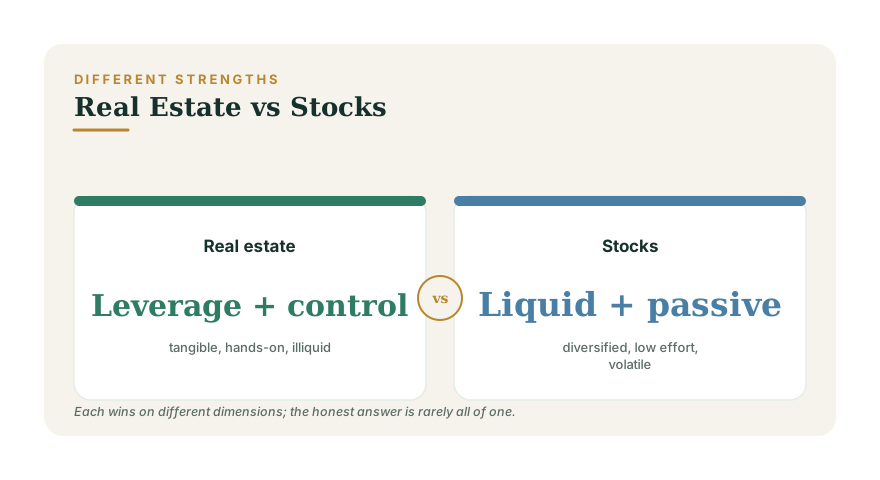
Few money debates are as tribal as real estate versus the stock market. Real-estate fans point to leverage and tangible assets; stock investors point to decades of compounding with no tenants to call. Both camps are partly right, and the framing as a winner-take-all contest is the real mistake. They are different tools that win on different dimensions, and most well-built plans use both.
Returns: closer than the arguments suggest
Over long periods, broad stock-market and real-estate returns have been in a similar ballpark, though stocks have generally led on price appreciation alone. But raw appreciation undersells real estate, because property also produces rental income, and the comparison depends heavily on the specific property and the specific era. The honest takeaway is that neither is a magic money machine; both reward patience, and both can disappoint over short windows. Where they truly diverge is everything around the return.
Leverage: real estate's biggest edge
Leverage is the strongest argument for real estate. You can buy a property with a fraction of its price as a down payment and borrow the rest, yet you capture the appreciation on the entire value. Put 20% down and a 5% rise in the property's price is a 25% gain on your cash, before counting rent and loan paydown. Mortgage debt for real estate is also cheap, long-term, and widely available in a way that borrowing to buy stocks is not.
The catch is that leverage cuts both ways: it magnifies losses just as cleanly, and you owe the mortgage whether or not the property is rented. Borrowing to buy stocks on margin carries even sharper risks, as covered in the basics of riskier strategies. Real estate offers leverage on relatively gentle terms; that is genuinely hard to replicate elsewhere.
Liquidity: stocks win decisively
You can sell a stock or index fund in seconds, in any amount, for a tiny cost. Selling a property takes months, costs thousands in commissions and fees, and forces an all-or-nothing decision — you cannot sell one bedroom to cover an emergency. If you might need access to your money, the stock market's liquidity is a major, underrated advantage. Real estate locks up capital, which is fine when you plan for it and painful when you do not.
Effort: passive vs hands-on
A diversified index portfolio is about as passive as investing gets: buy, hold, rebalance occasionally, ignore the noise. A direct rental is a part-time job — screening tenants, repairs, bookkeeping, and the duties laid out in Becoming a Landlord. That effort is not free; if you value your time, the real return on a rental is lower than the spreadsheet shows. Some people enjoy the hands-on control of property; others would rather never get the midnight maintenance call.
Diversification: an honest weakness of property
When you buy index funds, a modest sum buys you a slice of thousands of companies across the globe. When you buy a rental, a large sum is concentrated in one building, on one street, in one local economy. That concentration can pay off, but it also means a single bad neighborhood, a problem tenant, or a local downturn hits hard. Stocks make broad diversification almost effortless; direct real estate makes it expensive and slow.
You can get real-estate exposure without becoming a landlord
The either/or framing breaks down completely once you realize you can own real estate through the stock market. REITs — real estate investment trusts — let you buy a liquid, diversified, professionally managed slice of commercial or residential property with none of the landlord work, right inside a brokerage account. They trade like stocks but pass through real-estate income. For many investors, this captures much of what is attractive about property without the concentration or the effort, as explained in REITs: real estate without a landlord.
Why it is not strictly either/or
The strongest portfolios usually are not all of one thing. A common, sensible shape is a foundation of low-cost index funds in retirement accounts — liquid, diversified, passive — plus, for those who want it, some real estate through a primary home, a rental, or REITs for the leverage and tangible-asset exposure. Which mix fits depends on your timeline, your appetite for effort, and how much liquidity you need. Sketch your overall allocation with the portfolio builder, and let your real plan — not tribal loyalty to one asset — decide the split.