Options get pitched as a way to make stock-market-sized money with a fraction of the cash. That description is technically true and dangerously incomplete. An option is a contract, and like any leveraged bet, it can multiply a gain or vaporize your entire stake in a matter of days. Before you ever place a trade, it is worth understanding what these contracts actually are and why most people who trade them lose.
Calls and puts in plain terms
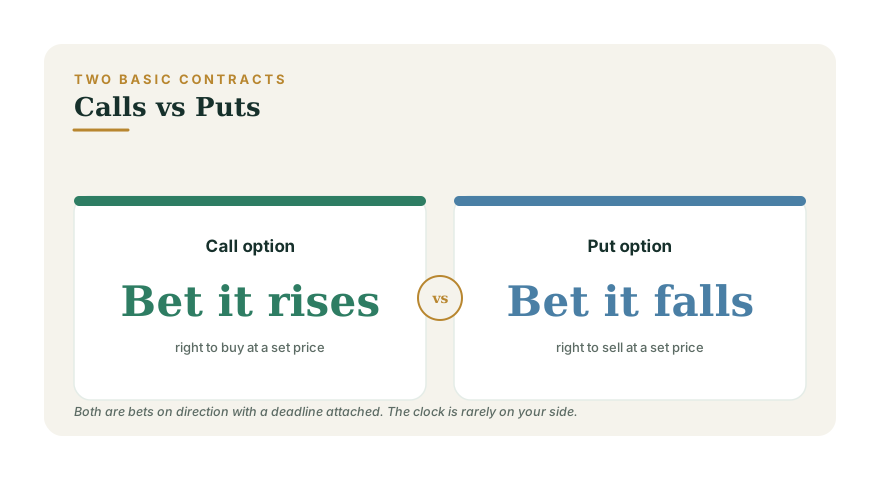
An option gives you the right, but not the obligation, to buy or sell a stock at a fixed price (the "strike") before a set expiration date. A call is the right to buy — you use it when you think a stock will rise. A put is the right to sell — you use it when you think a stock will fall. You pay a fee called the premium for the contract, and most contracts cover 100 shares.
Here is the catch built into every option: it has an expiration date. A stock can sit still or move the right way too slowly, and your option can still expire worthless. You are not just betting on direction; you are betting on direction and timing, which is far harder than it sounds.
Leverage cuts both ways
The appeal of options is leverage. For the price of one contract, you control 100 shares, so a small move in the stock can translate into a large percentage swing in the option. A 5% rise in the stock might double your money. That is the pitch.
The unspoken half is symmetry. The same leverage that doubles your money on a 5% move can wipe out your entire premium on an equally small move the other way — or on no move at all, as time decay quietly drains the contract's value every single day. Unlike owning a stock, where you can wait out a downturn, an option can hit zero and stay there. Leverage does not change the odds; it only amplifies the stakes. The same lesson shows up with borrowed money in Buying on Margin: Why Leverage Cuts Both Ways.
Why most retail option traders lose
The structural reality is stacked against the casual trader. A few reasons recur:
- Time decay works against buyers. Every day an option loses a little value as expiration approaches, even if the stock does nothing. You are paying rent on a position that may never pay off.
- You are trading against professionals. The other side of your trade is often a sophisticated firm with better pricing models, faster execution, and far deeper pockets.
- Spreads and fees nibble constantly. The gap between the buy and sell price, plus commissions, means you start each trade slightly underwater.
- It encourages overtrading. The speed and excitement pull people into frequent bets, and frequent betting is how edges get ground away.
This is the same trap that catches active stock pickers, just turbocharged. If reliable outperformance is hard for trained professionals — and it is, as Why Professional Stock Pickers Fail lays out — it is harder still for a part-time trader using a far riskier instrument.
The conservative edge case: covered calls
Not every use of options is a gamble. The most defensible strategy for ordinary investors is the covered call. If you already own 100 shares of a stock, you can sell a call against them and collect the premium as income. If the stock stays flat or rises modestly, you keep the premium. If it surges past the strike, you are obligated to sell your shares at that price — so your upside is capped.
It is genuinely lower-risk than buying options, because you own the underlying shares and you are the one collecting the premium rather than paying it. But it is not free money: you are trading away your big-upside scenarios for a steady trickle of income, and you can still lose money if the stock falls. It is a tool for a specific situation, not a strategy that beats simply holding a diversified portfolio.
Where options fit (and don't) in a real plan
For the overwhelming majority of people building long-term wealth, options have no place in the core portfolio. The boring approach — owning broad, low-cost index funds and leaving them alone — has beaten active strategies for decades. If you are tempted by options because you want growth, the better move is usually to invest more, not to take more risk. Start with How to Start Investing and a simple set of model portfolios.
If you are genuinely curious about your own appetite for risk before you do anything speculative, take the Investor Profile assessment first. It will tell you, honestly, whether high-risk trading fits the financial life you are actually trying to build — which for most people, it does not.