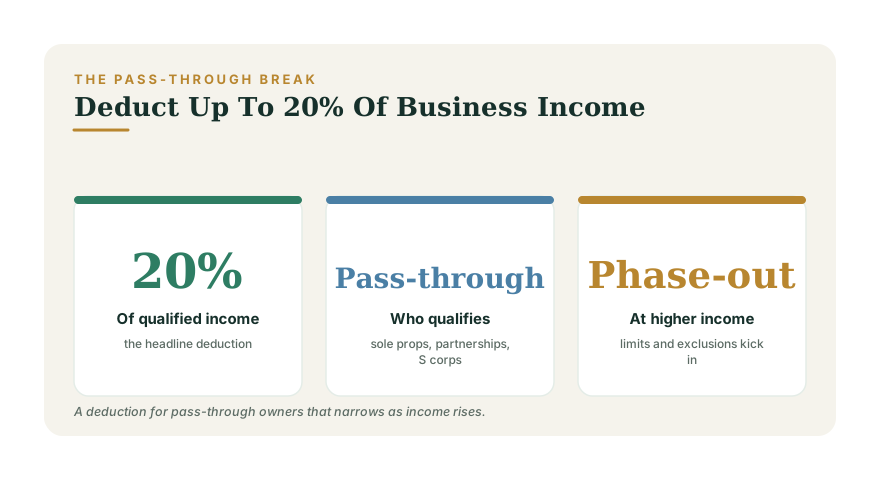
The Qualified Business Income deduction — often called QBI or the Section 199A deduction — is one of the most valuable tax breaks available to small-business owners, and one of the most confusing. In its simplest form, it lets owners of pass-through businesses deduct up to 20% of their qualified business income before calculating tax. A sole proprietor earning $100,000 of qualifying profit might deduct $20,000 and only be taxed on $80,000. The catch is that the clean 20% figure only stays clean at lower incomes; above certain thresholds, a maze of limits and exclusions takes over.
What counts as a pass-through business
The deduction is aimed at businesses whose profits "pass through" to the owner's personal return rather than being taxed at the entity level. That includes sole proprietors (Schedule C), partnerships, S corporations, and most LLCs. Regular C corporations do not qualify — they got a separate corporate rate cut instead. If you freelance, run a side business, or own a stake in a small company, you are very likely in pass-through territory. How the business is structured affects the math, which is part of the broader LLC vs S corp decision. The IRS describes eligibility on its qualified business income deduction pages.
The simple case: below the income threshold
If your total taxable income is below a threshold that the IRS adjusts each year, the deduction is refreshingly straightforward. You generally get to deduct 20% of your qualified business income, full stop — no wage tests, no restrictions on your line of work. This is where most freelancers and small operators live, and it is a meaningful reduction in the effective tax rate on their business profit. It applies on top of, not instead of, your ordinary business deductions, so the sequence is: deduct your legitimate expenses first, then take 20% of what remains.
Above the threshold: where it gets complicated
Once your taxable income climbs above the threshold, two additional layers appear:
- The wage-and-property limit. Your deduction can be capped based on how much your business pays in W-2 wages and how much depreciable property it owns. A profitable business with few employees and little equipment may see its deduction shrink at high income, which is one reason some owners revisit paying themselves or others through payroll.
- The specified service business (SSTB) exclusion. Certain fields — including health, law, accounting, consulting, financial services, performing arts, and any business whose principal asset is the reputation or skill of its owners — are labeled "specified service trades or businesses." For these, the QBI deduction phases out entirely above the income threshold. A high-earning consultant or doctor operating as a pass-through can lose the deduction completely, while a manufacturer at the same income keeps it (subject to the wage-and-property limit).
Between the lower threshold and a higher one is a phase-in range where these limits apply partially. This band is exactly where careful planning pays off.
Planning levers that matter
Because the deduction turns on your taxable income relative to the thresholds, several ordinary moves can preserve or restore it:
- Reduce taxable income to stay under a threshold. Maxing a retirement plan such as a solo 401(k) or SEP-IRA lowers taxable income, which can pull an SSTB owner back under the line and rescue the deduction. This can create an unusually high effective return on a retirement contribution.
- Mind your entity and payroll. For non-service businesses hitting the wage limit, S-corp structure and reasonable W-2 wages can support a larger deduction — again tied to the LLC vs S corp analysis.
- Coordinate spouse income and timing. Because the threshold is based on household taxable income, a spouse's earnings can push you into the phase-out even if the business itself is modest.
- Keep clean books. QBI excludes items like capital gains, most dividends, and reasonable compensation you pay yourself, so accurate records are needed to compute the deductible base correctly.
Other things to know
The deduction reduces income tax but not self-employment tax, so it does not lower the Medicare and Social Security portion you owe — plan your quarterly estimated taxes on the full picture. It is also a "below the line" deduction you can take whether you itemize or use the standard deduction. And like many favorable provisions, its long-term future depends on Congress, so treat it as valuable now rather than permanent.
The bottom line
The QBI deduction can cut the tax on business profit by up to a fifth, and for most small owners below the income threshold it is nearly automatic. Above the threshold it becomes a planning exercise — watch the wage-and-property limit, the service-business exclusion, and the powerful lever of retirement contributions to manage your taxable income. Estimate the impact with the Self-Employed Hub and the Tax Strategies tool, then check your footing with the Tax Health assessment and the planning hub.