The US tax system is pay-as-you-go. For employees, that happens automatically through paycheck withholding. But if you earn income that arrives without withholding — freelance and self-employment pay, investment income, rental income, large capital gains, or a big bonus that was under-withheld — the IRS expects you to send in tax throughout the year yourself, in four estimated tax installments. Skip them and you can owe an underpayment penalty even if you pay every dollar you owe by the April deadline.
The penalty catches people off guard because it is really an interest charge for paying late during the year, not a fine for filing late. The IRS explains the rules and deadlines on its estimated taxes pages. The encouraging part: the rules include clear "safe harbors" that, once met, protect you regardless of how your final bill turns out.
Who needs to pay estimated taxes
You generally need to make estimated payments if you expect to owe a meaningful amount when you file and your withholding will not cover enough of it. That commonly includes:
- Freelancers, gig workers, and the self-employed, whose clients do not withhold anything — see Self-Employed Tax Deductions for how to lower the base first.
- Investors with substantial interest, dividends, or capital gains, especially in a year with a large sale that may also draw the Net Investment Income Tax.
- Landlords, retirees drawing from taxable accounts, and anyone with side income beyond a W-2 job.
If your only income is a regular paycheck with adequate withholding, you almost certainly do not need to bother — your employer is already paying as you go on your behalf.
The safe harbors that protect you
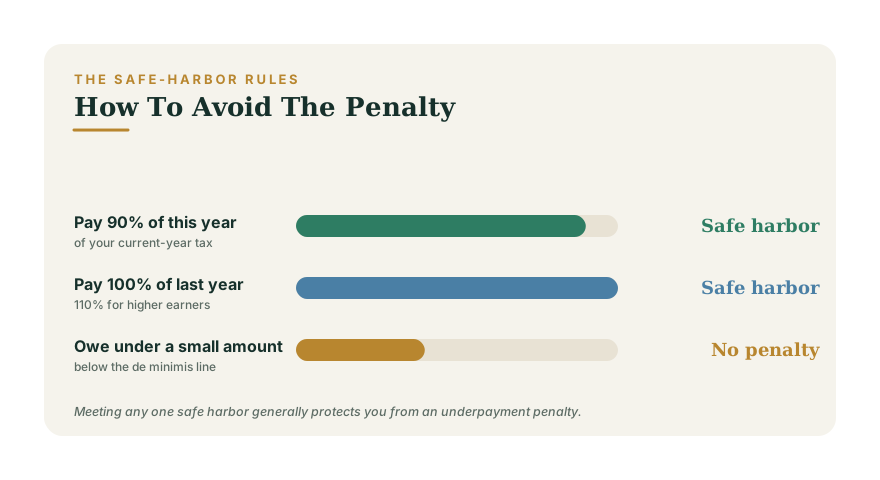
Here is the key: you do not have to predict your final tax perfectly. You avoid the penalty if your total withholding plus estimated payments meets any one of these safe harbors:
- 90% of the current year's tax. If you pay in at least 90% of what you end up owing this year, you are covered.
- 100% of last year's tax. If you pay in at least the total tax shown on last year's return, you are covered — even if you earn far more this year. For higher earners above an income threshold, this rises to 110% of last year's tax.
- A small balance due. If you owe less than a modest de minimis amount at filing, no penalty applies.
The 100%/110% safe harbor is the most useful for people with unpredictable income: because it is based on last year's known number, you can hit it precisely without guessing how this year will finish. The exact percentages come from the IRS underpayment rules.
The four deadlines
Estimated payments are due roughly in April, June, September, and the following January — and the "quarters" are not evenly spaced, which trips people up. Two things matter beyond the dates. First, the payments should be reasonably level across the periods; dumping everything in the fourth installment does not undo a shortfall in the first three, because the penalty is calculated period by period. Second, if your income is genuinely lumpy — say a big gain in the fall — an annualized-income method lets you match payments to when you actually earned, avoiding a penalty for periods when you had little income.
A simpler alternative: crank up withholding
There is an elegant trick for people who have both W-2 wages and untaxed side income. Withholding is treated as if it were paid evenly throughout the year, no matter when it actually happened. So instead of juggling four estimated payments, you can increase the withholding on your paycheck (or on a year-end bonus, or on a retirement distribution) late in the year to cover the whole shortfall, and it counts as timely. Adjusting your Form W-4 is often the least painful way to stay penalty-free. The W-2 Optimizer can help you dial in the right withholding.
How to actually pay and track it
- Set aside tax as income arrives. A common rule of thumb is to park a chunk of every freelance payment in a separate account so the quarterly payment is already funded. The Self-Employed Hub helps you estimate the set-aside.
- Pay electronically. The IRS offers free direct payment and an online account so you can schedule and confirm each installment.
- Keep records of each payment so you can reconcile them on your return and prove they were made on time.
The bottom line
Estimated taxes are not optional for untaxed income, but they are not hard once you pick a safe harbor and stick to it. For most people the cleanest path is to aim at 100% (or 110%) of last year's tax, split it into four level payments or top up withholding, and set the money aside as you go. Size your quarterly numbers with the Self-Employed Hub, sanity-check withholding with the W-2 Optimizer, and review your overall footing with the Tax Health assessment and the planning hub.