Leveraged and inverse ETFs are some of the most misunderstood products available to ordinary investors. The names sound straightforward — a "3x" fund that triples the market, an "inverse" fund that profits when the market drops. People buy them expecting a simple multiplier on their returns. The way these funds are actually built means that, held over time, they often do something very different from what the label implies.
What these funds claim to do
A leveraged ETF aims to deliver a multiple of an index's return — say 2x or 3x the daily move of the S&P 500. An inverse ETF aims to deliver the opposite of an index's move, so it rises when the market falls. Some combine both, like a -3x fund. On the surface, they look like an easy way to amplify a bet or hedge a portfolio.
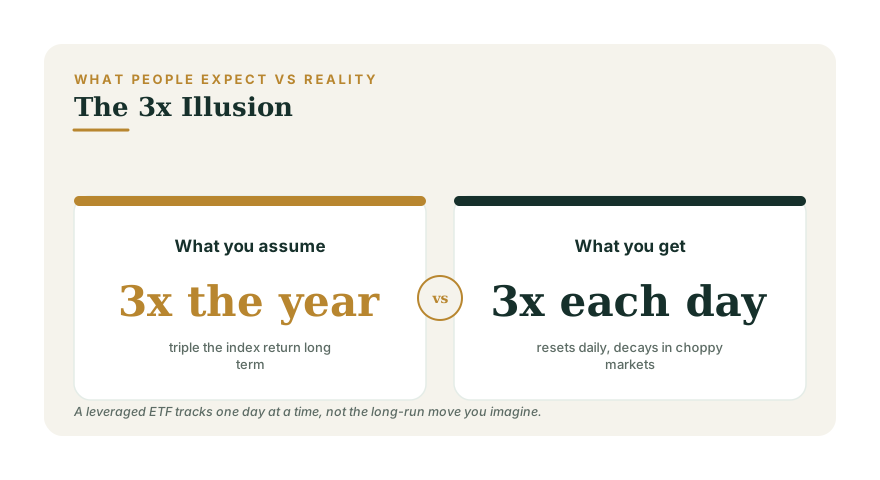
The crucial word buried in every one of these funds' descriptions is daily. They are designed to hit their multiple over a single trading day — and that one word changes everything about how they behave when you hold them longer.
The daily reset mechanic
Each day, the fund resets to deliver its stated multiple of that day's return, then starts fresh the next morning. It is not tracking the index's move over a week, a month, or a year — only one day at a time, compounding the results.
Because of that daily reset and compounding, the returns over longer periods do not line up neatly with the multiple you expect. A 3x fund held for a year will almost never deliver 3x the index's yearly return. Depending on the path the market took to get there, it can deliver much less — and in choppy markets, it can lose money even if the underlying index ends up roughly where it started.
Volatility decay: the silent erosion
The reason is a phenomenon called volatility decay. Consider a simple example. Suppose an index drops 10% one day, then rises about 11% the next, ending almost exactly where it began. A 3x fund, though, falls 30% on day one and then gains 33% on day two — and because it gained 33% on a balance already shrunk by 30%, it does not recover to its starting point. It ends below where it started, even though the index is flat.
Repeat that pattern over weeks of normal up-and-down trading, and the leveraged fund bleeds value steadily. The choppier the market, the worse the decay. This is why holding a leveraged ETF for the long haul tends to disappoint: the math of compounding daily returns works against you whenever the market zigzags, which is most of the time. Markets are volatile by nature, as Understanding Market Volatility explains, and that volatility is exactly what these funds erode against.
Why they are trading tools, not investments
Leveraged and inverse ETFs were designed for sophisticated traders making short-term, single-day bets — not for long-term investors. Even the fund providers say so plainly in their own disclosures. Held for a day or two with a specific tactical purpose, they do roughly what they advertise. Held for months as a "supercharged" version of the market, they expose you to:
- Leverage risk — the same double-edged sword as buying on margin, where losses are magnified just as much as gains. The parallel is spelled out in Buying on Margin: Why Leverage Cuts Both Ways.
- Volatility decay — the steady erosion described above, which can cost you money even when your directional call is right.
- Higher fees — these funds carry expense ratios well above ordinary index ETFs, an extra drag every year.
An inverse ETF in particular is a poor "insurance policy" to hold for protection. If you buy one and the market keeps rising, you lose money the whole time, and the decay means it will not even reliably offset a future drop the way you expect.
The plain version works better
For building wealth, ordinary low-cost index ETFs do the job without the traps. They track the market over the long run exactly as intended, charge a fraction of the fees, and never suffer volatility decay. If you are still sorting out how standard ETFs compare to index mutual funds, start with Index Funds vs ETFs.
If you are tempted by a leveraged or inverse fund because you want bigger returns or downside protection, the better path is almost always a sensible allocation held patiently. Map yours with a set of model portfolios, and check your real tolerance for risk with the Investor Profile assessment before you ever reach for leverage you do not need.