Buying on margin means borrowing money from your brokerage to buy more investments than your cash alone would allow. The pitch is simple: if you can borrow at one rate and your investments grow faster, you pocket the difference. The reality is that leverage magnifies everything — including the losses — and it can force you to sell at exactly the wrong time.
How buying on margin works
When you open a margin account, your broker lets you borrow against the value of the cash and securities you hold. If you put in $10,000, you might be able to control $20,000 of stock by borrowing the other half. Your investments serve as collateral for the loan, and you pay interest on the borrowed amount for as long as you hold it.
As long as prices rise, this looks brilliant. A 10% gain on $20,000 of stock is $2,000 — a 20% return on your own $10,000. The math that makes leverage attractive on the way up is the same math that makes it brutal on the way down.
Leverage cuts both ways
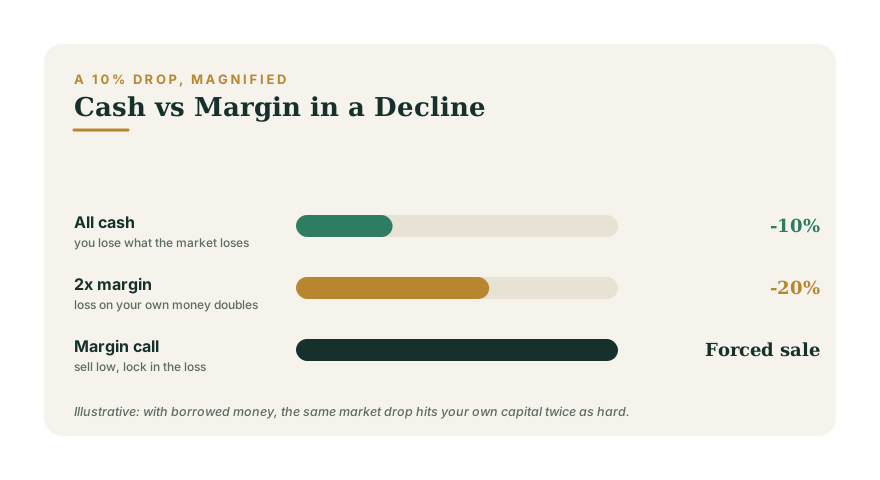
Run the same example in reverse. If that $20,000 position falls 10%, you lose $2,000 — but that is 20% of your money, not 10%. Borrowing doubled your exposure, so it doubled your loss. And unlike a paper loss on stock you own outright, a margin loss comes with a loan you still have to repay in full, plus interest.
Markets fall more often and more sharply than beginners expect. A normal, healthy market routinely drops 10% or more, as Understanding Market Volatility explains. With borrowed money, an ordinary dip can turn into a personal crisis.
The margin call: forced to sell at the worst time
This is the real danger. Your broker requires you to keep a minimum amount of your own equity in the account — the "maintenance margin." When prices fall far enough that your equity dips below that line, you get a margin call: a demand to either deposit more cash immediately or sell investments to cover the shortfall.
If you cannot come up with the cash, the broker can sell your holdings for you — without asking, and at whatever price the market offers. Margin calls cluster precisely when markets are crashing, which means you are forced to sell low, crystallizing losses at the worst possible moment and removing any chance to recover when prices bounce back. An ordinary investor with no leverage can simply wait out a downturn. A margin investor often does not get that choice.
The interest cost nobody mentions
Margin loans are not free. Brokers charge interest on the borrowed balance, and the rate is often higher than people assume — frequently in the same neighborhood as other consumer borrowing. That interest is a guaranteed drag: your investments have to clear that hurdle every year just to break even on the borrowed portion. In a flat or down market, you are paying to lose money. The cost compounds against you the longer you hold.
Why beginners should avoid it entirely
Margin combines three things that are individually risky and collectively dangerous: leverage, forced timing, and an ongoing interest cost. It removes your single biggest advantage as a long-term investor — the ability to do nothing and wait. The investors who build durable wealth almost never need it.
- It converts normal volatility into forced selling.
- It adds a guaranteed cost on top of market risk.
- It can turn a recoverable downturn into a permanent loss.
If your goal is more growth, the answer is rarely more leverage — it is more time, more contributions, and a sensible allocation. The same caution applies to other leveraged products covered in Options Trading: The Basics and the Real Risks and Leveraged and Inverse ETFs: Not What You Think.
Build wealth without borrowing against it
Before reaching for leverage, pressure-test what steady, unborrowed investing can do over time. The Wealth Simulator shows how ordinary contributions compound across decades, and the Investor Profile assessment helps you size the risk you can actually live with. For nearly everyone, the patient path beats the leveraged one — and it lets you sleep through the next downturn instead of dreading a margin call.