Municipal bonds — debt issued by states, cities, and local agencies to fund things like schools, roads, and water systems — have one defining feature that matters enormously to high earners: the interest they pay is generally exempt from federal income tax. For someone in a top bracket, that exemption can flip the math so that a muni yielding less than a corporate or Treasury bond actually delivers more money to your pocket.
The tax exemption, in plain terms
Interest from most municipal bonds is exempt from federal income tax. If the bond was issued in the state where you live, the interest is often exempt from your state income tax too, giving in-state residents of high-tax states a double benefit. The IRS explains the treatment of tax-exempt interest on its tax-exempt bond pages. This is fundamentally different from a taxable bond, where every dollar of interest gets taxed at your ordinary income rate — the highest rate you pay. For the basics of how these bonds work, see Municipal Bonds, Explained.
Tax-equivalent yield: the comparison that matters
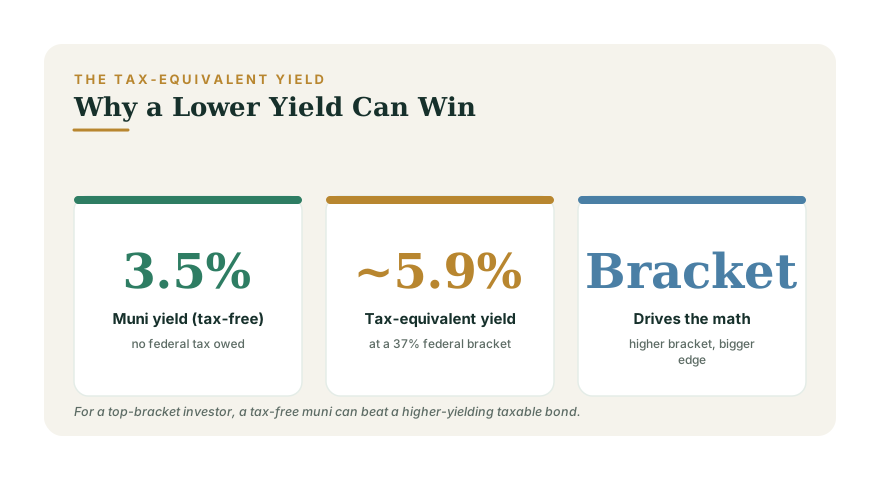
You cannot compare a muni's yield to a taxable bond's yield directly, because one is after-tax and the other is pre-tax. The fix is the tax-equivalent yield: divide the muni yield by one minus your marginal tax rate. A 3.5% muni for someone in the 37% federal bracket is worth 3.5% divided by 0.63, or about 5.9% — meaning a taxable bond would have to yield roughly 5.9% to leave you with the same after-tax income. The higher your bracket, the larger that gap grows, which is precisely why munis skew toward high earners. If you include state tax, the equivalent yield climbs further. The Tax Strategies tool can help you run your own bracket through this.
Why the exemption favors high brackets
For someone in a low tax bracket, the exemption is worth little — a 3.5% muni might be tax-equivalent to only 3.9%, and a plain taxable bond fund could easily beat it. For someone at the top, the same muni jumps well past 5%. This is why munis are rarely the right call for a modest-income investor and often a strong call for a high earner, especially one who lives in a high-tax state and buys in-state bonds.
The risks people underweight
Tax-free does not mean risk-free. Keep these in mind:
- Credit risk. Municipalities can and occasionally do default. General-obligation bonds backed by taxing power are typically safer than revenue bonds tied to one project. Diversify across issuers, usually through a fund.
- Interest-rate risk. Like all bonds, munis fall in price when rates rise, and longer maturities fall more — the same duration mechanics covered in Understanding Bond Yields and Duration.
- The AMT. Certain "private activity" munis pay interest that is taxable under the alternative minimum tax. Funds labeled "AMT-free" avoid this.
- Lower headline yields. Munis generally pay less than comparable taxable bonds; the advantage exists only after the tax break, so it disappears in a tax-advantaged account.
Put munis in the right account
This is a critical and often-missed point: municipal bonds belong in a taxable account, never in an IRA or 401(k). Inside a tax-deferred account, the interest would have been shielded anyway, so you would be giving up yield for a tax break you cannot use. Putting the right assets in the right accounts is the whole subject of asset location. A high earner typically holds taxable bonds inside retirement accounts and munis in the taxable account.
The bottom line for high earners
If you are in a top federal bracket, hold bonds in a taxable account, and especially if you live in a high-tax state, municipal bonds deserve a serious look — the tax-equivalent yield often beats the taxable alternatives. If you are in a lower bracket or investing inside retirement accounts, they usually are not worth it. Run your own bracket and state through the Tax Strategies tool and the Model Portfolios tool, then pressure-test the plan with the Tax Health assessment and map it all at the planning hub.