The Alternative Minimum Tax, or AMT, is one of the least understood corners of the tax code, partly because it works by running a second, parallel calculation alongside your normal return. The idea behind it is simple: decades ago, Congress noticed that some high earners were stacking enough deductions and special breaks to owe little or no income tax, so it built a backup system to make sure they paid at least a minimum amount. The execution, unfortunately, is anything but simple.
Here is the mental model. You compute your tax the normal way, with the usual brackets and deductions. Then you compute it again under the AMT rules, which strip out many of those breaks and apply their own rate. You pay whichever of the two numbers is higher. If your regular tax is already the bigger figure, the AMT never touches you — which is the case for most people.
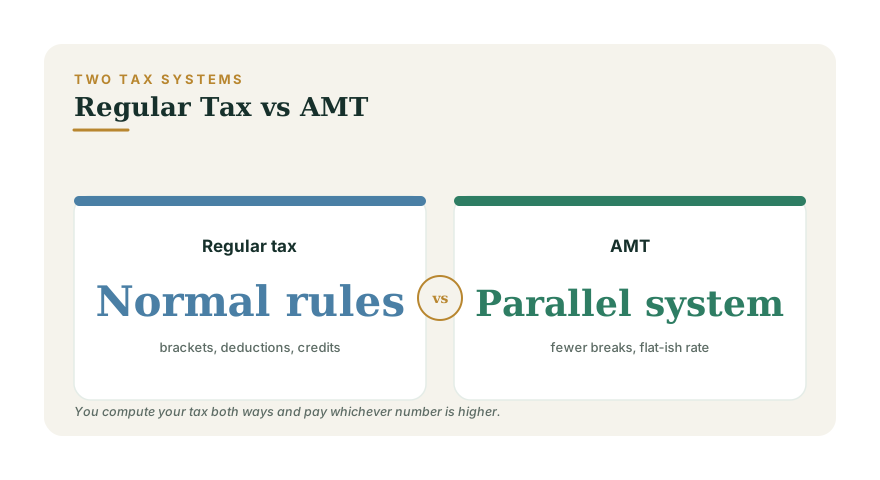
How the AMT calculation works
The AMT starts from your taxable income and then adds back a list of items it does not allow. From that larger income figure, you subtract a generous AMT exemption, and the remainder is taxed at one of two flat rates (a lower rate on the first chunk and a higher rate above a threshold). Because the exemption is large, modest incomes rarely trigger AMT at all.
The catch is that the exemption phases out as income climbs. Once you cross a certain income level, you lose part of the exemption, which is a big reason the AMT tends to bite hardest in the upper-middle and high-income range rather than at the very top.
Who tends to get hit
The AMT is far less common than it used to be, because reforms raised the exemption and changed which deductions matter. Today it most often affects:
- People who exercise incentive stock options (ISOs) and hold the shares — often the single biggest AMT trigger.
- Households with very high state and local taxes, large miscellaneous deductions, or certain private-activity bond interest.
- Taxpayers with a lot of dependents or specific preference items in a high-income year.
If none of those describe you, you almost certainly will never compute an AMT bill. The tax software does the parallel math automatically and tells you if it applies.
Preference items: where AMT income comes from
The items the AMT adds back are called preference items or adjustments. The headline one for many readers is the ISO exercise. When you exercise an incentive stock option, the difference between the strike price and the market value — the "bargain element" — is invisible to your regular tax that year if you hold the shares, but it counts as income for AMT purposes. Exercise a big block of appreciated ISOs and hold, and you can owe AMT on paper gains you have not actually cashed in. Other add-backs include certain depreciation differences and some types of municipal bond interest.
This is why option-holders need to plan exercises carefully rather than clicking "exercise all" without a tax projection. The interaction between ordinary income, capital gains, and AMT is exactly the kind of thing worth modeling before you act — our broader guide to how credits and deductions reduce tax explains why the regular-system breaks you are used to may simply vanish under AMT.
The AMT credit: not always a permanent loss
One redeeming feature: AMT triggered by certain timing differences — most notably an ISO exercise where you keep the shares — can generate a minimum tax credit you carry forward to future years. In years when your regular tax exceeds your AMT, that credit can offset some of the difference. It does not make you whole instantly, but it means AMT from an ISO exercise is often a prepayment rather than a pure penalty. The mechanics are intricate, and this is a good place to involve a tax professional.
How to anticipate it
You do not need to memorize the AMT formula; you need to recognize the warning signs and run the numbers before year-end. A few practical habits:
- Project before you exercise options. Estimate the bargain element and ask whether holding the shares pushes you into AMT, and by how much.
- Watch the exemption phase-out range. If your income lands in that band, an extra dollar of certain income can have an outsized effect.
- Use a checkup. A quick read on your overall tax picture can flag whether AMT is even a risk for you this year. Our Tax Health assessment is a fast way to surface red flags worth a closer look.
The AMT rewards people who look ahead. Pair a year-end projection with the capital gains tool and, if you understand how the ordinary brackets work, the article on how tax brackets really work, and you will rarely be surprised by a parallel tax you did not see coming.