People fall in love and then discover, months or years later, that they never really talked about money. That silence is costly: financial disagreements are consistently among the leading sources of stress and conflict in marriages. The good news is that most of it is preventable with a handful of honest conversations before you make a lifelong commitment. These are not romantic, but they are among the most loving things you can do for a relationship.
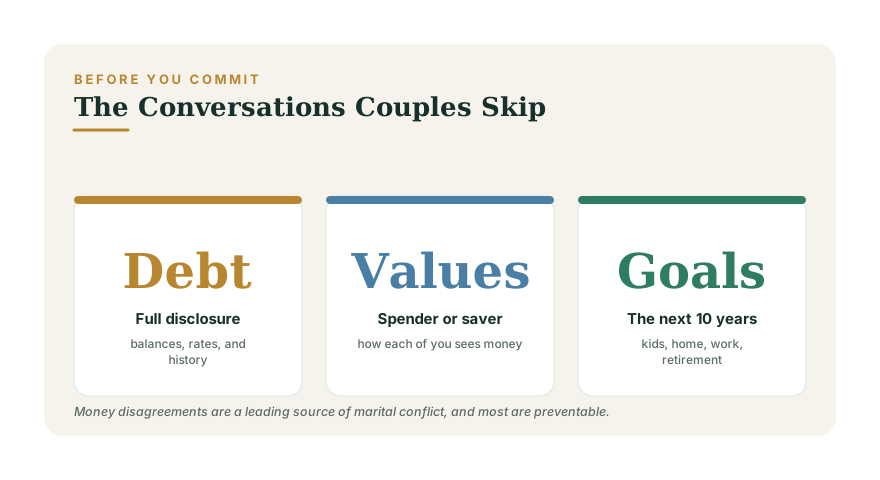
Full disclosure of debt and obligations
Start with the most concrete topic: what you each owe. Lay it all on the table — credit cards, student loans, car loans, medical debt, any money owed to family, and any past bankruptcy. Hiding debt from a partner is a form of financial infidelity that erodes trust when it inevitably surfaces. The point is not to judge; it is to know what you are walking into together. Debt does not automatically become your partner's after marriage, but it shapes your shared cash flow, your ability to buy a home, and your stress levels.
Spender or saver: your money values
Numbers are easy compared to values. People carry deep, often unspoken money scripts from how they were raised — one partner sees saving as safety, the other sees it as deprivation. Talk about how each of you grew up around money, what makes you anxious, and what you consider a splurge versus a necessity. A saver married to a spender is not doomed, but only if both understand the other's wiring. Understanding your own patterns first, covered in Understanding Your Money Psychology, makes the conversation far more productive.
Credit and its consequences
Share your credit situation honestly, because it has practical consequences. After marriage you may apply for a mortgage or car loan together, and a partner's low score can raise your rate or sink an application. You do not merge credit reports by marrying, but joint accounts and co-signed loans link you. Knowing where you both stand lets you plan — improving a score together before a big purchase, for instance. If either of you is unsure where you stand, it is worth checking before big decisions.
Goals for the next ten years
Money only makes sense in service of a life, so compare the lives you each picture. Do you want children, and if so, will one of you step back from work? Do you want to own a home, and where? How important is career versus time off? When do you each imagine retiring? You do not need identical answers, but you need to know where they diverge, because those divergences drive every future budget. This flows naturally into How to Set Financial Goals as a couple.
How you will actually manage money together
Finally, get practical about mechanics — a topic worth revisiting after the wedding in Combining Finances When You Marry. Will you pool everything, keep separate accounts, or run a hybrid with a joint account for shared bills? Who pays what, and how do you decide on large purchases? There is no single right structure, but agreeing on one prevents a thousand small resentments. Many couples find a shared budgeting rhythm helps, as described in How to Budget as a Couple.
Make it a habit, not a one-time talk
One conversation before engagement is a start, not the finish. Couples who talk about money regularly — a short monthly check-in — head off the resentment that builds in silence. Deepen these conversations with Money Conversations Before Marriage, get a shared view of where you stand with the Net Worth Tracker, and take stock together with the Financial Wellness assessment. When you are ready to build a joint plan, start at the planning hub.