Couples plan the flowers, the venue, and the guest list in exhaustive detail, then walk into marriage having never had a real conversation about money. It shows: financial conflict is consistently one of the top sources of stress and a leading factor in divorce. The reassuring truth is that the money problems wrecking marriages are rarely about not having enough — they are about mismatched expectations that were never discussed. The fix is a series of honest conversations, and they are far easier to have before the wedding than after.
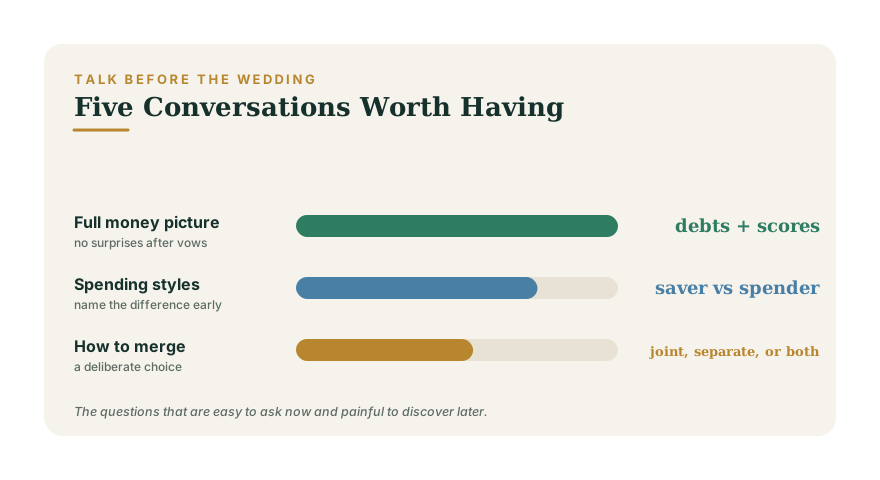
Put the full financial picture on the table
Start with full transparency, because nothing erodes trust faster than a money secret discovered after the vows. Each of you should share the real numbers: income, savings, retirement balances, and — most importantly — all debts. Student loans, car loans, credit card balances, money owed to family. Hidden debt, sometimes called financial infidelity, is a genuine relationship killer, and it is far better to face a balance together now than to stumble onto it later. Share credit scores too. A score is not a character judgment, but it is practical: after marriage, your combined credit affects whether you can rent or buy together and the rates you will pay. If one partner has work to do, it becomes a shared project — approached the way Debt Avalanche vs Snowball lays out — rather than a buried surprise.
Talk about spending styles — and where they came from
Almost every couple pairs a relative saver with a relative spender, and that gap is the friction point in countless money arguments. Neither style is wrong, but unspoken they breed resentment: one partner feels controlled, the other feels anxious. The conversation worth having goes a layer deeper than "you spend too much." Ask each other what money meant in the home you grew up in, what you each fear and value about it, what a "splurge" and a "waste" look like to you. These inherited beliefs — your money scripts — drive behavior more than logic does, and naming them dissolves a surprising amount of conflict. There is a whole article on it: Your Money Scripts: The Psychology Behind Spending. Once both styles are on the table, you can design a budget that respects both instead of pretending one of you should simply change.
Align on goals and timelines
You may both want a comfortable life and assume that means the same thing — until you discover one of you is picturing a house in three years and the other is picturing a few years abroad with no mortgage. Get specific together: Buy a home or keep renting? Kids, and what would that cost? How important is early retirement versus enjoying money now? Whose career leads if a move comes up? You do not need identical dreams, but you need to know where they diverge so you can plan one shared financial life instead of two quietly competing ones.
Decide how you will handle the money day to day
There is no single right structure — only the one you both choose on purpose. The three common models:
- Fully joint — all income and expenses flow through shared accounts. Simple and transparent; works when both partners are aligned and comfortable.
- Fully separate — each keeps their own accounts and splits shared bills by some agreed formula. Preserves autonomy; takes more coordination and can feel less unified.
- The hybrid — a joint account for shared goals and bills that both fund proportionally, plus personal accounts each partner spends freely from, no questions asked. For many couples this captures the best of both.
What matters is choosing deliberately rather than drifting into a default. Whatever you pick, agree on a "check-in" threshold — a dollar amount above which you talk before buying — so big purchases never blindside the other person. The mechanics of actually combining accounts are covered in Combining Finances When You Marry.
Make it a recurring habit, not a one-time talk
These are not single conversations to check off before the wedding and never revisit. The couples who fight least about money tend to hold a brief, regular "money date" — monthly or so — to review the budget, track progress on goals, and surface anything before it festers. Keeping it light and routine prevents the dread that builds when money only comes up during a crisis. Over time these check-ins become one of the most connecting habits in a marriage, not the most stressful.
Having these conversations before you marry does not mean you expect trouble — it means you are building the partnership on the same page. Use a tool to make it concrete: sit down together with the Budget Analyzer to design a plan you both endorse, and take the Financial Wellness assessment individually, then compare results. The gaps you find on the couch today are the arguments you will not have at the kitchen table later.