When people picture infidelity in a relationship, money is rarely the first thing that comes to mind. Yet financial deception is common, and for many couples it does as much damage as any other betrayal. It can be a secret credit card, a stash of cash, an undisclosed debt, or a steady habit of hiding purchases. Whatever the form, the wound is the same: a partner discovers that the person they trusted has been keeping a part of their shared life hidden.
What financial infidelity actually is
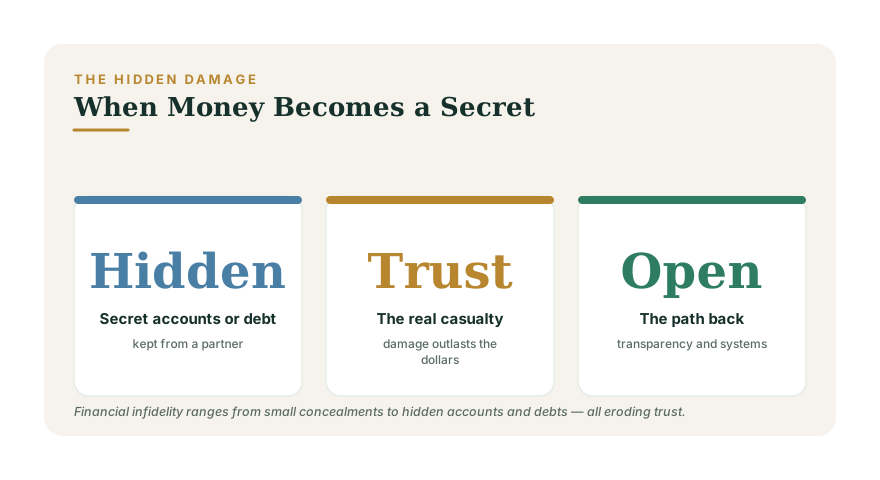
Financial infidelity is the deliberate concealment of money matters from a partner with whom you have a shared financial life. It exists on a spectrum. At the milder end are small, private purchases hidden to avoid a conversation. At the more serious end are secret bank accounts, hidden credit cards, undisclosed debts, gambling losses, or money quietly funneled to family or a habit. The defining feature is not the dollar amount — it is the deception. Spending money is not infidelity; hiding it is.
It is worth separating this from healthy privacy. Partners can absolutely keep some independent "no questions asked" money by mutual agreement. That is the opposite of infidelity, because it is openly agreed upon. The problem begins where there is an understanding of transparency and one partner breaks it in secret.
Why it happens
People rarely hide money out of pure malice. The motives are usually more human, which is part of what makes the subject so tangled:
- Shame. A partner who overspent or hid a debt is often more afraid of judgment than of the money itself, so they conceal to avoid the conversation.
- Control and autonomy. Someone who feels controlled — or who controls — may use secret money to reclaim a sense of independence.
- Avoiding conflict. In relationships where money talks always end in a fight, hiding can feel easier than another argument.
- Differing money values. When one partner is a spender and the other a saver, the spender may hide purchases rather than defend them every time.
Understanding the why matters, because the deeper issue is usually not the money at all — it is shame, fear, or a breakdown in communication. Those root causes are often traceable to each partner's money psychology, the beliefs about money absorbed long before the relationship began.
The damage
The financial cost of hidden money can be real — a surprise debt can derail shared goals or even credit. But the deeper damage is to trust, and trust is the foundation everything else in a partnership stands on. Discovering a financial secret makes the betrayed partner question what else they do not know. It turns the relationship's shared project — building a life and a future together — into something one person was quietly working against.
That is why financial infidelity so often outlasts the dollars involved. The money can be repaid; the sense that a partner is fully knowable and reliable takes much longer to rebuild. Left unaddressed, the secrecy also compounds: hidden debt grows, and each new concealment makes the eventual disclosure harder.
Rebuilding trust
Recovery is possible, but it asks for honesty and patience from both people. A few steps tend to matter most:
- Full disclosure. Trust cannot rebuild on a partial confession. The whole picture — every account, every debt — needs to come out, ideally all at once rather than dripped out over months.
- Curiosity over blame. The betrayed partner has every right to be hurt, but a conversation that becomes pure punishment usually drives the next secret underground. Understanding why it happened is part of preventing a repeat.
- Address the root cause. If shame, control, or chronic money fights drove the hiding, those have to change, or the secrecy returns in a new form.
- Get help if needed. A financial counselor or couples therapist can be invaluable when the breach is serious or the conversations keep stalling.
Transparency systems for couples
The most durable protection is a money setup where hiding is simply difficult and talking is routine. Couples who avoid financial infidelity usually are not more virtuous — they have built transparency into their structure:
- Regular money meetings. A short, recurring check-in — monthly is plenty — where both partners look at accounts, spending, and goals together. When money is discussed openly and often, secrets have nowhere to grow.
- Shared visibility. Both partners can see the household's accounts, even if some money is kept individual. Visibility is not surveillance; it is the baseline of a shared financial life.
- An agreed "no questions" allowance. Giving each partner a small amount of personal spending money removes much of the motive to hide in the first place.
- Joint goals. When a couple is visibly working toward shared targets, money becomes a team effort rather than a private battleground.
The practical mechanics of running money as a team are in how to budget as a couple, and the foundational conversations are covered in combining finances when you marry.
Trust is built in the open
Financial infidelity thrives in silence and dies in daylight. The surest prevention — and the surest path back — is a relationship where money is discussed openly, often, and without judgment. If you and your partner have never had a real money conversation, that is the place to start. A neutral, structured starting point is the Financial Wellness assessment, which gives you both a shared picture to talk about rather than a confrontation to brace for.