Money is consistently named as one of the things couples argue about most. But the fights are rarely about the dollars themselves — they are about mismatched expectations, different spending styles, and decisions that were never actually discussed. Two people can be perfectly responsible on their own and still clash, simply because they never built a shared system. The good news: budgeting as a couple is less about the math and more about a few habits that keep both people informed and respected.
Start with a no-judgment money conversation
Before any spreadsheet, you need an honest baseline. Each person should lay out their full picture: income, debts, savings, credit, and — just as important — their feelings about money. One of you may have grown up where money meant security and saving; the other where it meant freedom and spending. Neither is wrong, but if those scripts stay unspoken, every disagreement becomes a values clash. Name them out loud. Understanding why your partner treats money the way they do defuses most of the conflict before it starts.
Make money dates a regular habit
The single most effective tool for couples is the money date: a short, recurring, low-stakes check-in to review finances together. Monthly is plenty for most couples. Keep it light — a coffee or a glass of wine, not an interrogation — and run the same simple agenda: what came in, what went out, are we on track for our goals, and is anything coming up we should plan for?
The magic of a regular money date is that it prevents the blow-up. Problems get caught while they are small, both people stay informed, and money stops being a topic that only surfaces during an argument. It turns finances into a team project instead of a source of surprise.
Choose an account structure that fits you
There is no universally correct setup. Three common models:
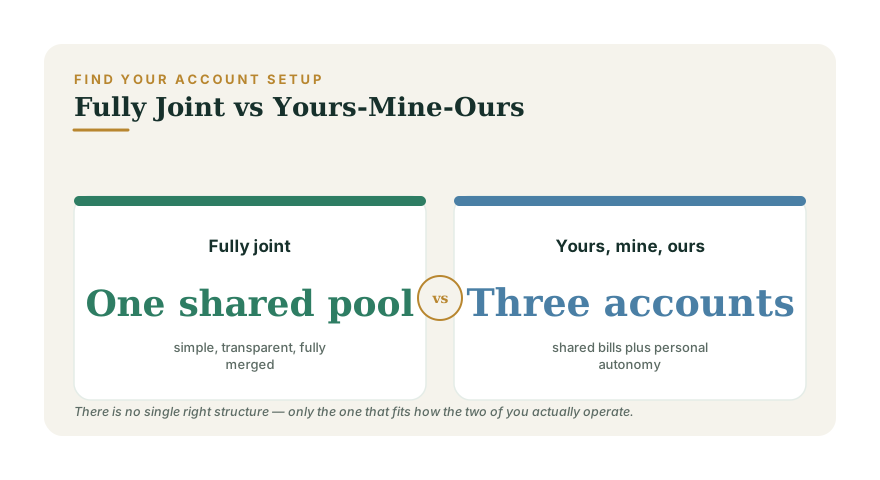
- Fully joint. All income flows into shared accounts and all spending comes out of them. It is simple and maximally transparent, and it suits couples who think of their money as fully "ours." The trade-off is less individual privacy and autonomy.
- Fully separate. Each person keeps their own accounts and splits shared bills. It preserves independence but makes joint goals harder to coordinate and can feel less like a partnership.
- Yours, mine, and ours. The most popular hybrid: a joint account for shared expenses and goals, plus each person keeps a personal account for no-questions-asked spending. You get teamwork on the big stuff and autonomy on the small stuff.
The "ours" model resolves a surprising amount of friction, because it gives each partner a pool of money they can spend without needing to justify it. The broader mechanics of merging are covered in combining finances when you marry.
Split contributions fairly, not necessarily equally
When incomes differ, a strict 50/50 split can quietly strain the lower earner — an equal dollar amount is a much bigger share of a smaller paycheck. Many couples find a proportional split fairer: each person contributes to shared expenses in proportion to their income. If one partner earns 60% of the household total, they cover 60% of the shared bills. It keeps both people contributing meaningfully without making the lower earner feel squeezed. There is no rule that says it must be proportional — some couples prefer equal, some pool everything — but decide deliberately rather than defaulting into resentment.
Handle different spending styles without a referee
Often one partner is the saver and the other the spender. The instinct is for the saver to police the spender, which breeds resentment on both sides. A better approach is structural: agree on the shared priorities and savings rate together, automate those, and then give each person personal-spending money they control completely. The saver gets the security of funded goals; the spender gets guilt-free freedom within a limit. The personal accounts act as a buffer that ends the constant low-grade negotiation over small purchases.
For larger purchases, set a threshold — say, anything over a couple hundred dollars — that you agree to discuss first. It is not about permission; it is about no surprises.
Set shared goals you are both excited about
Budgeting as a couple is far easier when you are aiming at something together. A trip, a home, an early-retirement target, a fully funded emergency fund — shared goals turn sacrifice into teamwork. Build them the same way you would individually, using how to set financial goals that stick, and give each one a labeled bucket so you can both watch it grow. The structure of a basic plan is the same as a solo one; start from how to build a budget that works and simply build it together.
Make it a system, then run it together
The couples who avoid money fights are not the ones who agree on everything — they are the ones who built a system: a regular money date, an account structure that fits, fair contributions, and personal autonomy inside shared goals. Set yours up, then check where you stand together with the Financial Wellness Score and map your shared numbers in the Budget Analyzer.