Most people do not fail at money because they lack discipline. They fail because they never set a real target. "I should save more" or "I want to be better with money" feels like a goal, but it gives you nothing to aim at and no way to know if you are winning. The fix is not more willpower — it is a clearer goal. Here is how to set financial goals that are specific enough to act on and flexible enough to survive a changing life.
Start with what you actually want, not what you "should" want
A goal you borrowed from someone else rarely sticks. Before you touch a number, write down what you genuinely want your money to do — buy back time, feel safe, take a year off, give your kids an easier start, stop dreading the first of the month. These are not financial goals yet, but they are the why underneath them, and the why is what carries you through the boring months. The actual dollar targets come next; they are just the measurable shape of these wishes.
Turn each wish into a specific, time-bound target
A useful goal answers three questions: how much, by when, and why. Compare these:
- ❌ "Build an emergency fund." → vague, no finish line.
- ✅ "Save $9,000 (three months of expenses) by December 2027, so a job loss doesn't become a crisis."
The second version tells you exactly what to do this month: roughly $500 set aside. That is the whole point of a specific target — it converts a someday wish into a this-paycheck action. Do this for each thing you wrote down. If you do not know your monthly expenses yet, start with How to Build a Budget That Actually Works — a budget is just a goal expressed month by month.
Sort goals by time horizon — it decides where the money goes
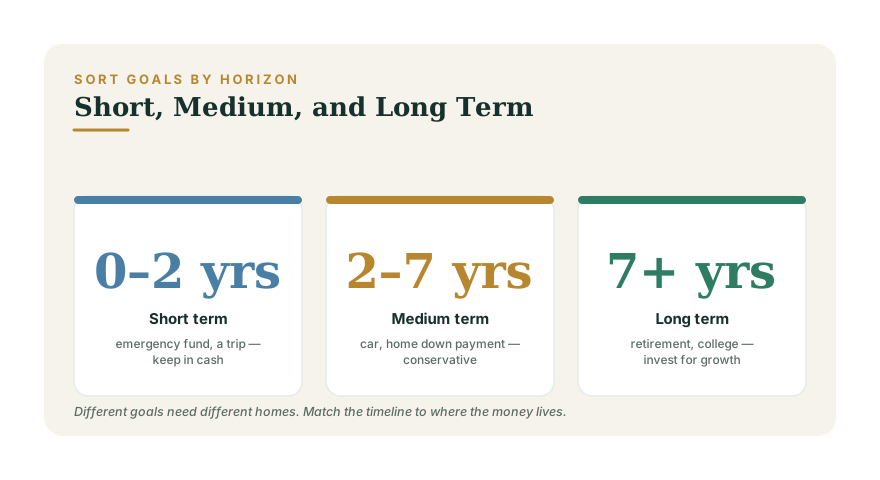
Not every goal belongs in the same account. The single most useful sort is by how soon you need the money, because the horizon determines how much risk the money can take.
- Short term (0–2 years) — your emergency fund, a vacation, holiday gifts. This money should be safe and liquid: a high-yield savings account, not the stock market. A new emergency fund is almost always the first goal to fund.
- Medium term (2–7 years) — a car, a wedding, a home down payment. A mix of cash and conservative investments; you have some time, but not enough to ride out a big crash.
- Long term (7+ years) — retirement, a young child's college fund. Here time is your ally, so this money belongs invested for growth. See How to Start Investing.
Putting a 30-year retirement goal in a savings account, or a next-year vacation fund in stocks, are two of the most common and costly mismatches. The horizon fixes both.
Don't fund every goal at once — sequence them
Trying to chase six goals simultaneously usually means none of them move. A sane order for most people: (1) a small starter emergency fund of about $1,000, (2) capture any employer retirement match — that is free money, (3) pay off high-interest debt, (4) finish a full 3–6 month emergency fund, then (5) everything else, from the down payment to investing more. Fund the foundation first; the exciting goals are far more durable when they are not sitting on a cracked base. You can sketch and pressure-test this whole sequence with the planning hub.
Build goals into a system you don't have to think about
A goal that depends on remembering to save will lose to a goal that saves automatically. Once a target has a monthly number, automate it: set a transfer to the right account on payday so the money moves before you can spend it. Give each goal its own labeled savings bucket — many banks let you create several — so you can see "Emergency Fund: $4,200 / $9,000" instead of one anonymous balance. This is the idea behind sinking funds, and it is what turns a goal into a habit.
Make goals survive life changes — the part everyone skips
This is where most goals quietly die. A new job, a baby, a move, a layoff, a marriage, a health scare — life reliably rearranges your priorities, and a goal set in one season can feel impossible or pointless in the next. The mistake is treating that as failure and quitting. A goal is a plan, not a promise; it is supposed to be revised.
Two habits keep goals alive through change:
- Adjust, don't abandon. When life shifts, change the number or the date rather than scrapping the goal. Lost income? Pause new contributions but keep the goal on the list. Got a raise? Raise the monthly amount before lifestyle creep absorbs it.
- Schedule a check-in. Put a recurring date on the calendar — quarterly, or at minimum once a year — to review every goal: still relevant? on track? need a new amount or deadline? A new chapter (a child, a home, a career change) should trigger an immediate review, not wait for the calendar.
The Annual Financial Checkup is built for exactly this review, and the Financial Wellness Score gives you a quick read on whether your goals and your reality are in sync.
Track progress so motivation compounds
You will stick with goals you can see moving. Watch the two numbers that matter: each goal's bucket against its target, and your overall net worth over time. Watching net worth climb is one of the most reliable sources of money motivation, because it captures every goal at once — debt shrinking and savings growing both push it the same direction. Tools like the Net Worth Tracker, the Emergency Fund Calculator, and the Retirement Planner let you set a target and see how today's contributions get you there.
The whole thing in one paragraph
Write down what you actually want; turn each wish into a "how much, by when, and why" target; sort the targets by time horizon and match each to the right account; fund them in sequence rather than all at once; automate the monthly amount; and review everything whenever life changes instead of giving up. Do that, and "be better with money" stops being a wish and becomes a plan you can actually finish.