You can know every rule of good money management and still blow the budget on a stressful Tuesday. That is not a failure of intelligence or discipline — it is a sign that money is rarely about math. Behind most spending sits an emotional pattern, often inherited in childhood, running quietly in the background. Researchers call these patterns money scripts: the unspoken beliefs about money you absorbed long before you earned any. Until you can see yours, willpower keeps losing to a story you did not know you were following.
Where your money beliefs come from
Children are exceptional observers and poor interpreters. You watched how money moved through your home — whether it was tight or plentiful, fought over or never mentioned, a source of pride or shame — and you drew conclusions that hardened into rules. A kid who heard "we can't afford that" on repeat may grow up either terrified to spend or compelled to prove they finally can. A kid who watched money smooth over every problem may come to believe more income is the answer to any unhappiness. These conclusions feel like simple facts about the world, not beliefs you chose, which is exactly why they are so hard to spot from the inside.
The common scripts
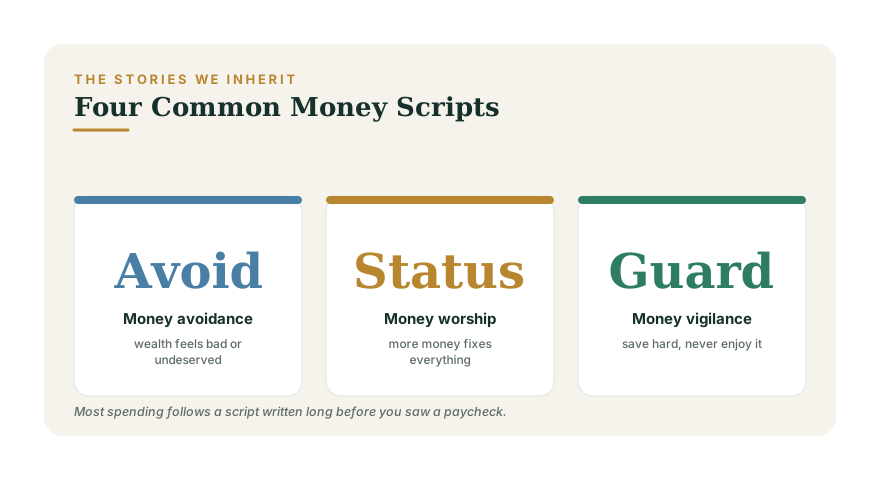
Psychologists who study this group most patterns into a few families. You may recognize more than one:
- Money avoidance — a belief that money is bad, or that wanting it makes you greedy. It can show up as ignoring statements, undercharging for your work, or self-sabotaging just as things go well.
- Money worship — the conviction that more money will solve your problems and that you can never quite have enough. It drives overwork, overspending to project success, and the sense that contentment is always one raise away.
- Money status — tying self-worth to net worth, where what you own signals who you are. This is the engine behind keeping up with peers and buying the visible upgrade.
- Money vigilance — a watchful, frugal stance that saves diligently but struggles to ever enjoy or share the money. Healthier than the others in many ways, but it can curdle into anxiety and an inability to spend on a good life.
None of these is purely good or bad. The point is not to judge your script but to notice it, because an unseen script makes your decisions for you.
Emotional spending triggers
Scripts set your defaults; triggers pull them in the moment. Most overspending is not a craving for the object — it is an attempt to change how you feel. Common triggers include stress ("I deserve this after the week I had"), boredom, loneliness, celebration, social comparison after scrolling a feed, and the small dopamine hit of a checkout button. Retailers design around these on purpose: one-click ordering, limited-time urgency, and "treat yourself" messaging all aim straight at the emotional brain, bypassing the part of you that made a budget. The gradual upgrade of your whole lifestyle as income rises is its own slow-motion trigger — see Lifestyle Creep and How to Fight It.
How awareness changes behavior
Here is the encouraging part: simply naming the pattern weakens its grip. When you can say "this is my stress-spending script talking, not a real need," you create a gap between the feeling and the purchase — and decisions get made in that gap. A few practical ways to build the gap:
- Name the feeling before you buy. Pause and ask what you are actually feeling. Often the urge to spend fades once the emotion is acknowledged directly.
- Use a waiting rule. For any non-essential purchase over a set amount, wait 24 to 72 hours. Triggers are time-limited; most urges do not survive the delay.
- Add friction. Remove saved cards, log out of shopping apps, unsubscribe from sale emails. Convenience is the trigger's best friend.
- Find the real fix. If stress is the trigger, a walk or a call costs nothing and works better than a purchase that adds a bill on top of the stress.
Rewrite the script, then build the system
You cannot delete a money script, but you can update it with adult evidence. If "I'll never have enough" was the inherited line, watching a savings balance grow over months is direct, lived proof that contradicts it. This is also why couples clash over money: two people often arrive with opposite scripts and assume the other is simply wrong. Surfacing both stories early prevents years of friction — a theme in The Money Conversations to Have Before Marriage.
Awareness is the start; a system makes it durable. A budget that routes money to your goals automatically means good outcomes no longer depend on winning every emotional moment — see How to Build a Budget That Actually Works. To get a quick, honest read on where your relationship with money stands today, take the Financial Wellness assessment and treat the result as a starting point, not a verdict.