Ask where to keep idle cash and two answers come up again and again: a high-yield savings account (HYSA) and a money market fund. The names are close, the yields are often within a hair of each other, and both let you get at your money quickly. It is easy to assume they are interchangeable. They are not — and the difference that matters most is one most people never check.
The heart of it: a high-yield savings account is a bank deposit protected by federal insurance, while a money market fund is an investment — a low-risk mutual fund held at a brokerage that is not insured the same way. Understanding that one distinction tells you almost everything about when to use each.
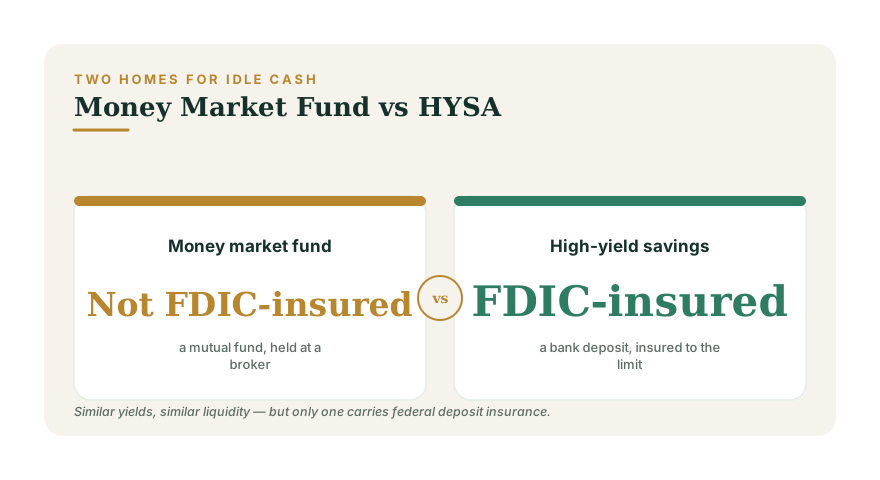
The insurance difference
A HYSA is a deposit at a bank, so it carries FDIC insurance up to the coverage limit per depositor, per bank — you can verify any institution through the FDIC. If the bank fails, the government makes you whole up to that limit. A money market fund (distinct from a money market deposit account, which is a bank product) is a mutual fund that invests in very short-term, high-quality debt. It is not FDIC-insured. Brokerage accounts carry SIPC protection against the brokerage failing, but that is not the same as insuring the fund's value, and it does not cover investment losses. In practice, prime and government money market funds are extremely stable, but "extremely stable" is not "government-guaranteed," and that is the honest distinction.
Where the two are actually similar
For everyday purposes they behave a lot alike:
- Yield. Both track short-term rates set by the Federal Reserve, so their rates rise and fall together and usually sit close.
- Liquidity. Both let you access money quickly, though a savings account can often transfer to checking a touch faster, while a money market fund settles like a trade.
- Variable rate. Neither locks your rate. When the Fed cuts, both drop — which is the scenario in Where to Park Cash When Interest Rates Start Falling.
Where they diverge
- Safety guarantee. HYSA has explicit federal insurance; a money market fund relies on the quality and stability of its underlying holdings.
- Where it lives. A HYSA sits at a bank; a money market fund sits in a brokerage account, which is convenient if you also invest there because you can move cash straight into stocks or bonds.
- Tax flavor. Some money market funds hold government or municipal debt, giving them a tax-advantaged edge for certain investors that a plain savings account cannot match.
- Minimums and expenses. Money market funds carry a small expense ratio and sometimes a minimum investment; good HYSAs have neither.
A fuller primer on how the fund itself works is in What Is a Money Market Fund?.
Which should you use?
Match it to the money:
- Emergency fund and core cash. Lean HYSA. The explicit FDIC guarantee is exactly what you want for money you cannot afford to lose, as reinforced in High-Yield Savings Accounts in 2026.
- Cash inside your brokerage. A money market fund is ideal as a parking spot for money between investments, or as your settlement fund, so it earns yield instead of sitting idle.
- Tax-sensitive high balances. A government or municipal money market fund can beat a taxable savings rate after tax for some investors — worth checking against your bracket.
You can use both
Most people end up with a HYSA for their insured emergency fund and a money market fund inside their brokerage for investable cash. That is a perfectly sensible split, not a contradiction. If you want a fixed rate instead of a floating one, that is where a CD ladder or a Treasury bill comes in. Compare after-tax yields across these options with the Opportunity Cost Calculator, size your insured cash first with the Emergency Fund Calculator, and check your overall cash posture with the Financial Resilience assessment. Tie it all together at the planning hub.