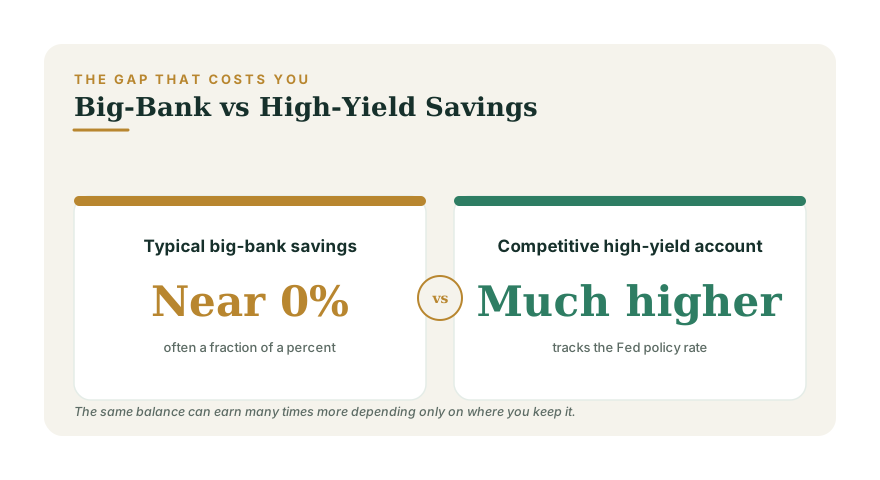
If your cash is sitting in an ordinary savings account at a large national bank, it is almost certainly earning close to nothing. A high-yield savings account (HYSA) — usually offered by an online bank — pays many times more on the exact same dollars, with the same federal insurance and roughly the same ease of access. In 2026, after the interest-rate swings of the past few years, the gap between a lazy account and a competitive one is still one of the easiest money wins available.
The catch is that "high-yield" is a marketing phrase, not a guarantee. Rates move, teaser numbers expire, and a headline figure can hide conditions. Choosing well is less about finding the single highest number and more about finding a durable, no-strings account you can leave your emergency fund in for years.
What actually sets the rate
HYSA rates are not random. They track the short-term interest rate set by the Federal Reserve, whose policy decisions ripple through the whole cash market. When the Fed raises its target rate, savings yields climb within weeks; when it cuts, they fall just as quickly. That is the single most important thing to understand about any variable savings rate: it is a floating rate, not a locked one. The number you open with today can be lower next quarter if the Fed eases, which is exactly the scenario covered in Where to Park Cash When Interest Rates Start Falling.
What a competitive 2026 rate looks like
Rather than quote a number that will age badly, use a simple benchmark: a genuinely competitive HYSA pays close to the Fed's short-term target rate, while a typical brick-and-mortar savings account pays a small fraction of it. If your account is paying dramatically less than the prevailing policy rate, it is not competitive, full stop. Online banks can pay more because they have no branches to fund, and they pass much of that saving to you. Check where the Fed's rate sits, and expect a good HYSA to land in the same neighborhood.
How to choose without getting played
Once several accounts are in the same rate range, the differences that actually matter are the boring ones:
- FDIC insurance. Confirm the bank is FDIC-insured so your balance is protected up to the coverage limit per depositor. You can verify any institution through the FDIC. For fintech apps that are not banks themselves, make sure deposits are held at a real insured partner bank.
- Teaser vs ongoing rate. Some accounts advertise a bonus rate for a few months, then drop. Read whether the headline number is promotional or the standing rate.
- Minimums and caps. Watch for balance minimums to earn the rate, or a cap above which the high rate no longer applies.
- Fees and access. A good HYSA has no monthly fee. Check transfer times to your checking account — a day or two is normal — and whether there are withdrawal limits.
- Stability of the payer. An account that quietly lets its rate drift down after you open is worse than one that consistently stays near the top, even if its launch number was slightly lower.
Where a HYSA fits — and where it does not
A high-yield savings account is the natural home for money you might need on short notice: your emergency fund and near-term goals. It is safe, liquid, and insured. It is not where longer-term money should live, because over many years its return will trail a diversified portfolio. The dividing line between cash you should keep liquid and money you should invest is drawn in The Best Way to Save for Short-Term Goals. For the emergency fund specifically, size it first using The Emergency Fund Guide.
HYSA vs the alternatives
A HYSA is not your only cash option. A money market fund can pay a similar or slightly higher yield with different tradeoffs, compared head to head in Money Market Funds vs High-Yield Savings. If you can lock money away, a certificate of deposit fixes your rate — useful when you expect cuts, and the mechanics are in Building a CD Ladder Now That Rates Have Shifted. Online banks generally win on all of these versus traditional branches, a point made in Online Banks vs Traditional Banks.
Set it and let it work
The winning move is unglamorous: open one competitive, no-fee, FDIC-insured high-yield account, move your emergency fund and short-term savings into it, and automate a monthly transfer. Do not chase every new teaser rate — the tax and hassle of constant switching usually outweighs a small edge. Size the cash you actually need with the Emergency Fund Calculator, see how the interest compounds over time with the Opportunity Cost Calculator, and pressure-test your overall cash setup with the Financial Resilience assessment. Map the rest of your plan at the planning hub.