If you have owned your home for a while, you may have built up equity — the difference between what your home is worth and what you still owe. Two common products let you borrow against that equity: a home equity loan and a home equity line of credit, or HELOC. They sound similar and are often confused, but they behave very differently.
What equity is and how much you can borrow
Equity grows two ways: as you pay down your mortgage principal, and as your home's value rises. If your home is worth $400,000 and you owe $250,000, you have $150,000 of equity. Lenders will not let you borrow all of it — most cap your total mortgage debt at around 80% to 85% of the home's value, leaving a cushion. In that example, your combined loans might be capped near $320,000 to $340,000, so you could borrow roughly $70,000 to $90,000 on top of the existing mortgage.
Home equity loan: the fixed lump sum
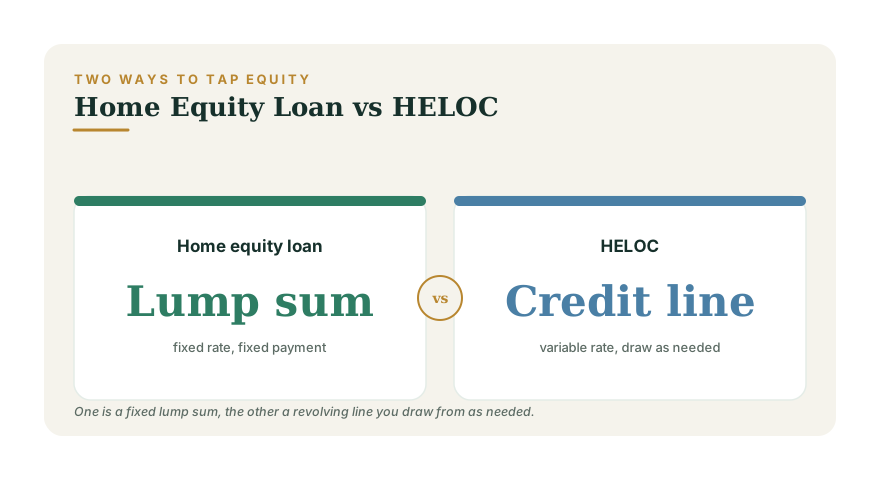
A home equity loan is a second mortgage. You borrow a set amount once, receive it as a lump sum, and repay it over a fixed term at a fixed interest rate with predictable monthly payments. Because the rate and payment never change, it is the right tool when you know exactly how much you need and want certainty — for example, a single large home renovation with a firm budget.
HELOC: the revolving credit line
A HELOC works more like a credit card secured by your home. You are approved for a credit limit and can draw from it as needed during a draw period (often around ten years), paying interest only on what you actually use. After the draw period ends, you enter a repayment period where you can no longer borrow and must pay down the balance, often with a jump in the required payment.
The catch is that HELOCs usually carry a variable interest rate, so your payment can rise if rates climb. The flexibility is ideal for costs that come in stages — a multi-phase remodel, or a series of tuition payments — but the variable rate and the payment shock at the end of the draw period are real risks to plan for.
The risk you are actually taking
Both products are secured by your home. That is what makes their rates lower than credit cards or personal loans — and it is also the danger. If you cannot repay, the lender can ultimately foreclose. You are converting your most important asset into collateral, so the stakes are higher than with unsecured debt. This is the same reason careful homeowners think hard before prepaying a mortgage instead of keeping liquidity elsewhere.
Sensible uses vs reckless ones
Borrowing against your home can be reasonable when it funds something that builds value or replaces costlier debt:
- ✅ A renovation that adds lasting value or fixes a structural problem.
- ✅ Consolidating genuinely high-interest debt — if you also stop adding new balances.
- ✅ A planned, financeable cost like a down payment on a rental property when the numbers work.
It tends to go wrong when used for consumption:
- ❌ Funding a vacation, a wedding, or a car you cannot otherwise afford.
- ❌ Covering ongoing living expenses, which signals a deeper budget problem.
- ❌ Investing the proceeds in something risky and hoping it beats the loan rate.
The honest test: would you still want the loan if it were unsecured at a higher rate? If the only thing making it attractive is your house on the line, reconsider.
How these compare to a cash-out refinance
A third option, a cash-out refinance, replaces your whole mortgage with a larger one and hands you the difference. It can make sense if you also want a better rate on the main loan, but it resets your primary mortgage — weigh it against the math in the break-even analysis on refinancing. A home equity loan or HELOC leaves your first mortgage untouched, which is usually better if your existing rate is already low.
Decide with the numbers
Before tapping equity, map the full cost — interest, fees, and the worst-case payment if rates rise — against what the money will do for you. Use the debt payoff calculator to compare consolidating high-interest debt this way, and run a financial resilience check to confirm you could still make the payments if your income dropped. Borrowing against your home can be a smart, low-cost move — but only when the use justifies the collateral.