Property taxes fund local schools, roads, police, fire, and libraries — the services that make a community work. For most homeowners, the property tax bill is one of the largest annual costs of owning a home, second only to the mortgage itself. Yet very few owners understand how the number is calculated, which means very few notice when it is wrong.
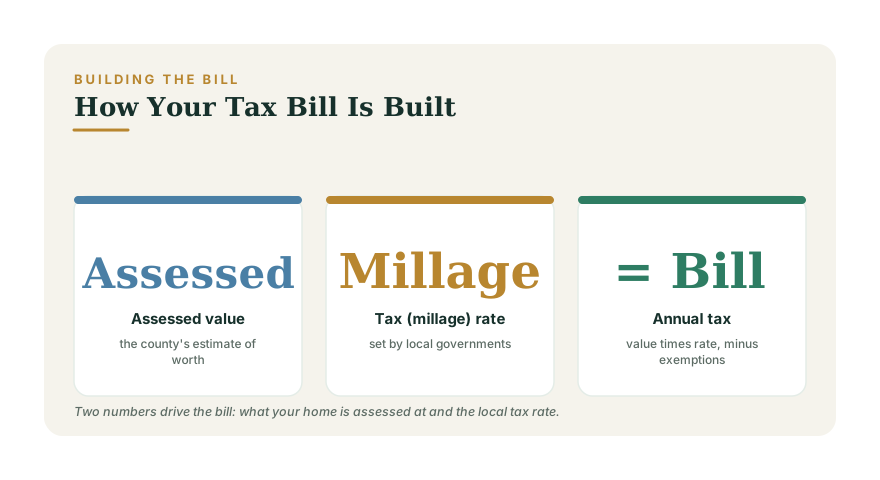
The two numbers that build your bill
Your property tax bill comes from multiplying two things: the assessed value of your home and the tax rate set by your local governments.
The assessed value is the local assessor's estimate of what your property is worth. Depending on where you live, this may equal the full market value or some fixed percentage of it. The tax rate is often expressed as a millage rate — mills, where one mill equals one dollar of tax per $1,000 of assessed value. A millage rate of 20 mills means $20 of tax for every $1,000 of assessed value, or 2%.
A worked example
Suppose your home is assessed at $250,000 and your combined local millage rate is 18 mills. Your tax is $250,000 / 1,000 = 250, times 18 = $4,500 per year. If your area also offers a homestead exemption that reduces your taxable value by, say, $25,000, the math becomes $225,000 / 1,000 times 18 = $4,050. Exemptions for primary residences, seniors, veterans, and people with disabilities are common and can lower your bill meaningfully — make sure you have claimed every one you qualify for.
How property taxes get paid: escrow
Most homeowners with a mortgage do not pay property taxes directly. Instead the lender collects roughly one-twelfth of the annual bill with each monthly payment, holds it in an escrow account, and pays the tax (and often homeowners insurance) when due. This is why your monthly mortgage payment can change even on a fixed-rate loan — if your tax bill or insurance premium rises, the escrow portion rises with it. When you budget for a home, plan for taxes and insurance, not just principal and interest; the first-time homebuyer roadmap walks through the full monthly cost.
Why assessments are often too high
Assessors value thousands of properties at once using mass appraisal models, not individual inspections. That means errors are common: the records may overstate your square footage, list a finished basement you do not have, or rely on stale comparable sales from a hotter market. Because your tax is a direct multiple of the assessed value, an inflated assessment quietly overcharges you every single year until you fix it.
How to appeal an over-assessment
If you think your assessment is too high, you can usually appeal — and the process is more approachable than people expect:
- Read your assessment notice. Note the assessed value, the deadline to appeal (often short — a matter of weeks), and the exact steps your jurisdiction requires.
- Check the property record for errors. Pull your property card from the assessor and verify square footage, lot size, bedroom and bath counts, and features. A factual error is the easiest appeal to win.
- Gather comparable sales. Find recent sales of similar nearby homes that sold for less than your assessed value. These "comps" are the heart of most successful appeals.
- File and present. Submit the appeal with your evidence. Many cases are resolved on paper; some involve a short hearing where you simply explain why the number is too high.
You are appealing the assessed value, not the tax rate, and not whether you like your taxes. Stick to the evidence that your home is worth less than the assessor claims.
Budgeting for increases
Property taxes rarely stay flat. Reassessments, rising home values, and new local levies all push bills up over time, sometimes sharply after a major reassessment. Build a cushion into your housing budget and revisit it yearly. The same discipline applies to homeowners insurance, which also tends to climb. To see how taxes fit into the true cost of owning versus renting, run the buy versus rent calculator, and use the home affordability tool to make sure taxes and insurance are baked into what you can comfortably carry.