Working for yourself means trading a steady paycheck for freedom — and trading an employer's benefits package for a stack of decisions you now have to make alone. No one is enrolling you in health insurance, matching your retirement, or quietly covering you if you get hurt. The upside is that you control all of it, and a few of the costs are tax-deductible. Here is how to assemble a safety net that an employee gets handed automatically.
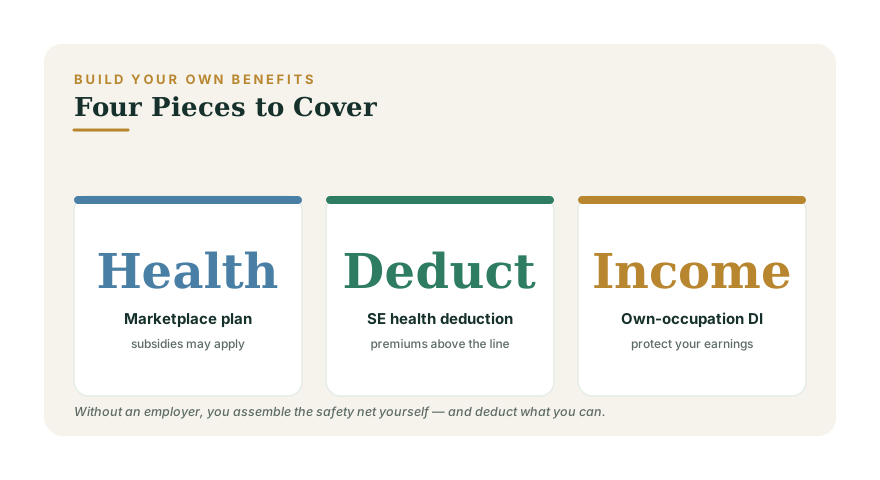
Health insurance: start at the marketplace
Your main option is the ACA marketplace, where you buy an individual plan. Because your income may be lower or lumpier than a salaried worker's, you may qualify for premium subsidies that bring the cost down meaningfully. The full walkthrough — metal tiers, subsidies, enrollment windows — is in Buying Health Insurance on the ACA Marketplace.
One self-employed pitfall: many marketplace plans use narrow networks, so confirm your doctors are covered before enrolling. See In-Network vs Out-of-Network: Why It Matters. Other routes worth a look are a spouse's employer plan, a professional or trade association group plan, or COBRA if you recently left a job (often expensive, but useful as a bridge).
The self-employed health insurance deduction
Here is a benefit employees do not get: if you are self-employed and turn a profit, you can generally deduct the premiums you pay for medical, dental, and qualifying long-term-care insurance for yourself and your family. This is an above-the-line deduction, meaning you get it even if you do not itemize, and it lowers your adjusted gross income directly.
That lower income figure can have a useful ripple effect — it may also increase the marketplace subsidy you qualify for. The interaction is genuinely complex, so it is worth modeling. For a broader view of write-offs available to you, see Self-Employed Tax Deductions, and pressure-test the numbers with the Self-Employed hub.
Disability insurance: your most ignored risk
For a self-employed person, your ability to earn is the business. If an illness or injury stops you from working, there is no employer short-term disability and no paid sick leave to fall back on. This makes individual disability insurance (DI) arguably more important for you than for anyone with a job — and it is the coverage freelancers most often skip.
A few things to look for when buying your own policy:
- "Own-occupation" coverage — it pays if you cannot do your specific job, not just any job at all. This is the stronger, and usually worth-it, definition.
- A benefit period and elimination period you can live with — how long benefits last, and how long you wait before they start. A longer waiting period lowers the premium and pairs well with a solid emergency fund.
- Non-cancelable, guaranteed-renewable terms so the insurer cannot drop you or hike rates arbitrarily.
- Residual or partial benefits that still pay something if you can work part-time but at reduced income — common during recovery.
Because no employer is subsidizing it, an individual policy costs more than a group one — but it is portable and tailored to you, and it follows you from client to client and job to job. It is consistently the most overlooked policy in personal finance, precisely because nothing forces you to think about it. A rough benchmark is to insure enough to replace a solid share of your take-home income; agents typically can cover around 60% of gross earnings, since benefits you pay for yourself usually arrive tax-free.
The HSA: a tax shelter you should not skip
If you pair your marketplace plan with a qualifying high-deductible health plan, you can open a Health Savings Account — and for the self-employed it is a standout. Contributions are tax-deductible, the money grows tax-free, and withdrawals for qualified medical expenses are tax-free too. Unused funds roll over forever and can be invested, so an HSA doubles as a stealth retirement account for future healthcare costs. The full case is in The HSA's Triple Tax Advantage.
Keep a bigger emergency fund than an employee would
One piece of the self-employed safety net is not a policy at all — it is cash. Salaried workers can often get by with three to six months of expenses set aside, but self-employed income is lumpier: clients pay late, a slow quarter happens, a contract ends abruptly. A larger cushion, on the order of six to twelve months of expenses, does double duty here. It carries you through dry spells, and it lets you choose a higher insurance deductible and a longer disability waiting period — both of which lower your premiums. In effect, your emergency fund and your insurance work together: more cash on hand means you can self-insure the small stuff and buy coverage only for the catastrophes.
Put the pieces together
Build the safety net in order of consequence: get health coverage in place, layer disability insurance over your income, fund an HSA, and keep a larger-than-average emergency fund to smooth out irregular income. Then capture the deductions — the self-employed health deduction and your HSA contribution both lower your taxable income and can lift your marketplace subsidy. Map it all out and see what fits your cash flow at the planning hub.