Most people who have a Health Savings Account use it the way they use a checking account: money goes in, money comes out, and the balance hovers near zero. That is a waste of the best tax shelter the U.S. tax code offers an ordinary saver.
An HSA is the only account that gives you a tax break three separate times. Understanding that is the difference between a minor convenience and a serious wealth-building tool.
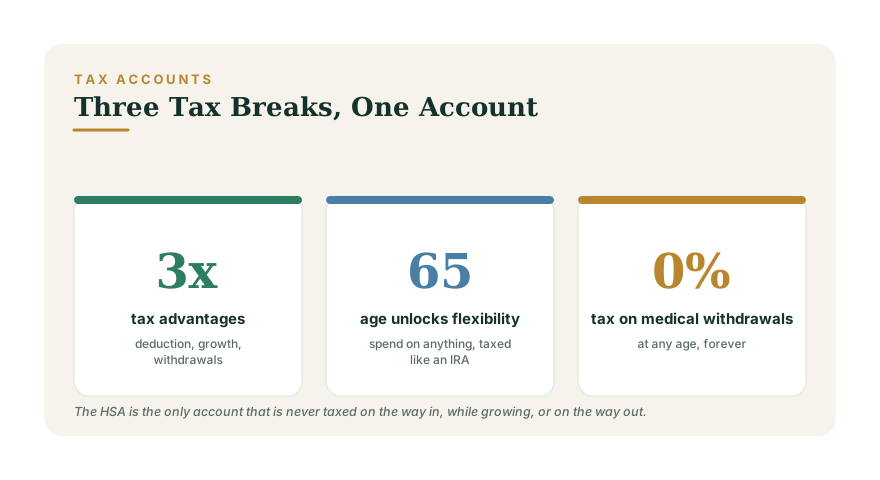
What "triple tax advantage" actually means
Three distinct breaks stack on top of each other:
- Going in: contributions are deductible (or pre-tax through payroll), lowering your taxable income this year.
- While invested: growth, dividends, and interest are never taxed inside the account.
- Coming out: withdrawals for qualified medical expenses are completely tax-free, at any age.
No other account does all three. A traditional 401(k) taxes you on the way out. A Roth taxes you on the way in. An HSA, used for health costs, never taxes you at all.
Who is eligible
You can contribute to an HSA only if you are enrolled in a qualifying high-deductible health plan (HDHP) and have no other disqualifying coverage. The annual contribution limit is set by the IRS and adjusted yearly, with separate amounts for individual and family coverage and a small extra "catch-up" amount once you turn 55. Whether an HDHP is right for you is a separate decision we cover in our guide comparing HDHP and PPO plans.
Invest the balance, don't let it sit
Most HSA providers let you invest the balance once it crosses a small threshold, typically in mutual funds or index funds. Yet a large share of account holders leave everything in cash earning almost nothing. If you have decades before you will need the money, leaving it uninvested forfeits the second tax advantage entirely. Treat the invested portion the way you would treat a retirement account.
The stealth retirement account
Here is the move most people miss. After age 65, you can withdraw HSA funds for any reason without penalty. Non-medical withdrawals are simply taxed as ordinary income, exactly like a traditional IRA. So in the worst case, an HSA behaves like a traditional IRA. In the best case, you spend it on medical costs, which are guaranteed in retirement, and pay nothing at all.
That asymmetry makes the HSA arguably better than a 401(k) for the dollars you can afford to leave alone. Many people max it out and pay current medical bills out of pocket so the account can keep compounding.
The receipts strategy
There is no deadline to reimburse yourself for a qualified medical expense. If you pay a $400 doctor bill today out of pocket and save the receipt, you can reimburse yourself from the HSA years or even decades later, tax-free. Meanwhile that $400 stays invested and grows.
The practical version: keep a folder (digital is fine) of every medical receipt from the year you opened the account. You are building a stockpile of tax-free withdrawal authority you can tap whenever you want cash out.
Common mistakes
- Leaving the whole balance in cash for years.
- Contributing while not actually HDHP-eligible.
- Spending it on every small copay instead of letting it grow.
- Throwing away receipts that could fund tax-free withdrawals later.
If you have access to an HSA and the cash flow to fund it, it deserves a high spot in your savings order. See where it fits in your broader plan at /plan.