Two patients can get the exact same procedure and walk away with wildly different bills — not because of their plan's metal tier, but because one provider was in their insurer's network and the other was not. Understanding networks is one of the most practical pieces of health-insurance literacy, because a single out-of-network visit can cost more than a year of premiums.
How networks actually work
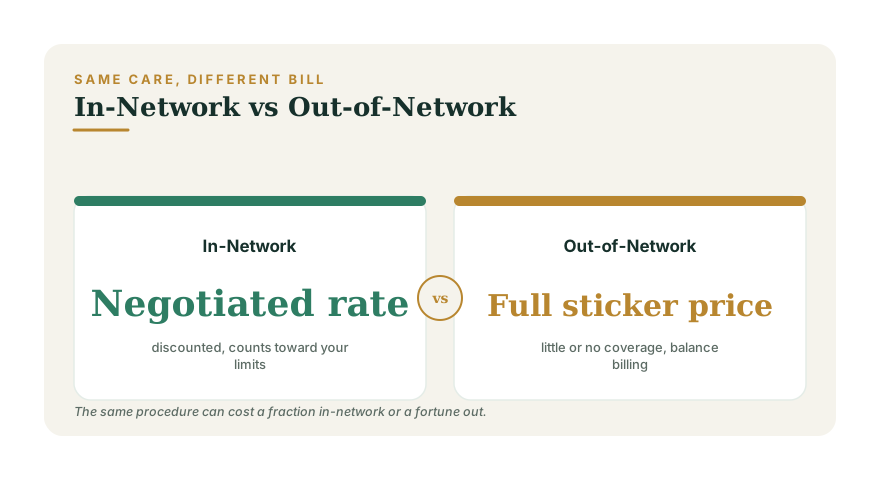
An insurer signs contracts with a set of doctors, hospitals, and labs — its network. In exchange for being steered patients, those providers agree to negotiated rates that are far below their list prices. When you see an in-network provider, you pay that discounted rate, and the amount you owe counts toward your deductible and out-of-pocket maximum.
Go out-of-network, and the calculus changes. Many plans cover out-of-network care at a much lower percentage, and some — especially HMO and EPO plans — do not cover it at all except in emergencies. You can also be charged the provider's full sticker price rather than a negotiated rate. To see how this interacts with your deductible and coinsurance, read Understanding Deductibles, Copays, and Coinsurance.
Balance billing and surprise bills
Balance billing happens when an out-of-network provider bills you for the difference between their charge and what your insurer paid. Historically the nastiest version was the surprise bill: you carefully chose an in-network hospital, but the anesthesiologist, the radiologist, or the ER physician who treated you turned out to be out-of-network — and you got a five-figure bill for a choice you never knowingly made.
The No Surprises Act
Federal law now blocks most of these surprise bills. The No Surprises Act protects you in the situations where you could not reasonably choose an in-network provider:
- Emergency care — emergencies must be billed as in-network, regardless of where you go.
- Out-of-network providers at an in-network facility — the anesthesiologist or pathologist you did not pick cannot surprise-bill you.
- Air ambulance services in most cases.
In these cases you only owe your normal in-network cost sharing; the provider and insurer settle the rest between themselves. If you get a surprise bill that should be covered, do not just pay it — dispute it. The steps overlap with How to Lower Your Medical Bills.
One important gap: the protections apply when you had no real choice. If you knowingly choose an out-of-network provider and sign a consent form acknowledging the cost, you can still be balance-billed. Read what you sign at registration.
Why plans have networks at all
It can feel arbitrary that the same doctor costs so differently depending on a contract you never saw. But networks are the main lever insurers use to control prices. By promising a provider a steady flow of patients, an insurer extracts a discount; by limiting which providers count as in-network, it keeps the plan's overall cost — and your premium — lower. A plan with a narrow network (fewer providers) is usually cheaper than a broad-network plan, because the insurer negotiated harder and steered patients more tightly. That is the real trade-off behind a low premium: you save money up front in exchange for less freedom in where you can be treated.
This is also why HMO, EPO, and PPO labels matter. An HMO or EPO typically covers only in-network care outside emergencies and may require referrals; a PPO costs more but lets you go out-of-network at a higher price. Knowing which type you have tells you how much a network mistake will hurt.
How to verify a provider is in-network
Never assume. Provider directories go stale, and a doctor can drop out of a network mid-year. Before any non-emergency care:
- Call your insurer, not just the provider's office, and confirm the specific doctor and facility are in-network for your exact plan. Get a reference number for the call.
- Ask about everyone involved. For a procedure, the surgeon, the facility, the anesthesiologist, and the lab can each have separate network status.
- Re-check at renewal. Networks change every plan year; a provider who was in-network last year may not be now.
- Get prior authorization where required. Even an in-network provider can leave you with a bill if the plan required pre-approval for a procedure and it was not obtained. Confirm what needs authorizing.
For planned, non-urgent care, it is also worth asking for a good-faith estimate of the cost in advance, which the No Surprises Act entitles uninsured and self-pay patients to receive. Knowing the expected price before you commit gives you room to shop, question, or plan for the bill rather than be blindsided by it weeks later.
Why it is worth the phone call
Verifying a network takes a few minutes and can save thousands of dollars. Networks are also a core reason cheaper plans are cheaper — a narrow network keeps premiums down but limits where you can go, a trade-off explained in How Health Insurance Actually Works. Before you pick or use a plan, map your regular doctors against its network, and use the Insurance Calculator to weigh a cheaper narrow-network plan against a broader one.