When you want a place for cash that is genuinely safe, it is hard to beat something backed by the full faith and credit of the US government. Two options fit that description and often get lumped together: Series I savings bonds (I bonds) and Treasury bills (T-bills). Both are federal instruments, both are exempt from state and local income tax, and both are far safer than any stock. But they solve different problems, and using the wrong one for your goal is a common mistake.
The short version: T-bills are for short-term cash you may need within a year, and I bonds are for money you can leave alone for years and want protected against inflation. Everything else follows from that difference.
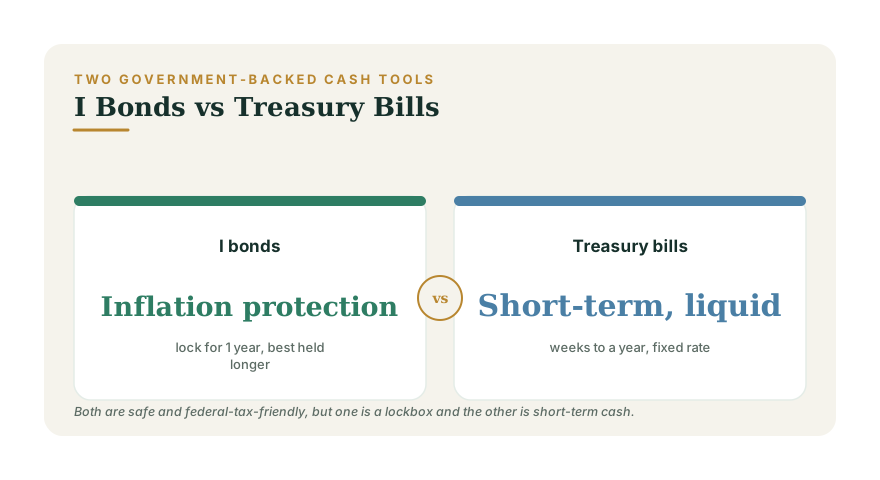
What I bonds are
An I bond is a savings bond whose interest rate has two parts: a fixed rate that stays for the life of the bond, plus a variable inflation rate that resets twice a year to track the consumer price index. That inflation component is the whole point — I bonds are built to preserve your purchasing power when prices rise. You buy them directly from the government through TreasuryDirect, there is an annual purchase limit per person, and the rules come with real strings:
- You cannot redeem an I bond for the first 12 months at all.
- If you redeem before five years, you forfeit the last three months of interest.
- Interest is deferred for federal tax until you cash out (state and local tax never apply).
That makes I bonds a poor choice for an emergency fund but a strong one for medium-term money you want shielded from inflation. The broader inflation-protection family, including TIPS, is covered in I Bonds and TIPS, Explained.
What Treasury bills are
A Treasury bill is a short-term government IOU. You buy it at a discount and it pays face value at maturity, with terms ranging from a few weeks up to a year. There is no inflation adjustment — the rate is fixed and known when you buy — but T-bills are extremely liquid, with a deep secondary market if you need to sell early. You can buy them at auction through TreasuryDirect or inside a brokerage account. Because they track short-term rates set by the Federal Reserve, T-bill yields move up and down with Fed policy, much like a savings account but with the rate locked for the length of the bill.
Head to head: which for your cash?
Match the tool to the job:
- Money you might need within a year. T-bills win. They are short, liquid, and you know the payoff up front. A ladder of T-bills works much like a CD ladder, keeping cash rolling due.
- Money you can lock for years and want inflation-proofed. I bonds win. The one-year lock and five-year penalty are acceptable when the horizon is long, and the inflation adjustment is protection a T-bill cannot offer.
- Your emergency fund. Neither, ideally. The 12-month I bond lock disqualifies it, and while T-bills are liquid, a high-yield savings account is simpler for true rainy-day money.
- Chasing the highest yield right now. Compare the current T-bill rate against the current I bond composite rate, but remember they are not really competing — one is a fixed short-term rate, the other is variable inflation protection.
The 2026 angle
In the current rate environment, the choice often comes down to your read on inflation versus rates. If you worry inflation could reaccelerate over several years, I bonds hedge that directly. If you mainly want a safe, known return on cash for the next several months while rates are still elevated, T-bills — or a T-bill ladder — do the job cleanly. If you expect the Fed to cut, locking a longer T-bill or a CD before rates fall is the relevant move, discussed in Where to Park Cash When Interest Rates Start Falling. And if convenience matters more than squeezing out the last basis point, a money market fund or high-yield savings account may be the easier home.
Use both, for different jobs
These are not rivals so much as tools for different drawers. Keep near-term cash in T-bills or savings for liquidity, and use I bonds for a slice of longer-term money you want inflation-protected. Buy both directly and cheaply through TreasuryDirect. Compare the real returns against your other cash options with the Opportunity Cost Calculator, make sure your liquid reserve is sized first with the Emergency Fund Calculator, and see how this cash tier fits your whole plan with the Financial Resilience assessment and the planning hub.