Before you tour homes or make an offer, lenders and sellers both want to know one thing: can you actually get the loan? A mortgage pre-approval answers that question in writing. It is one of the highest-value steps in home buying, and it is often misunderstood — especially how it differs from the quick "pre-qualification" many people start with.
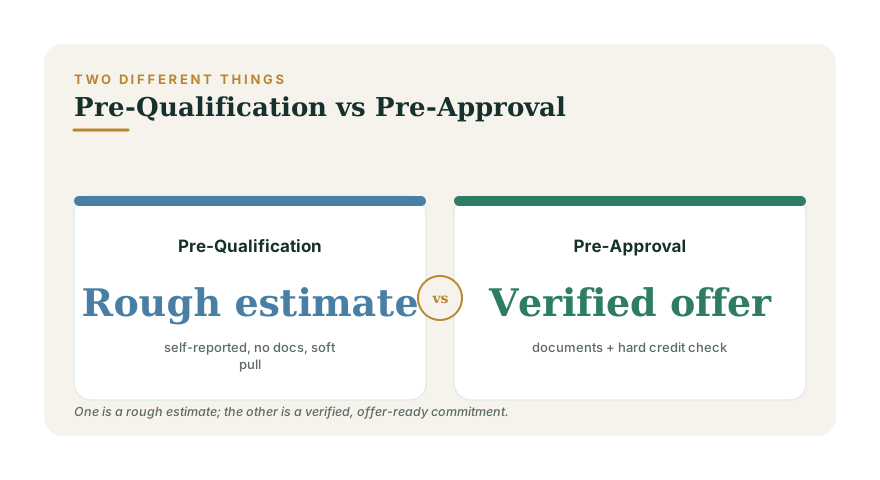
Pre-qualification vs pre-approval
These sound interchangeable but are not. A pre-qualification is a quick, informal estimate. You tell a lender your income, debts, and savings; they do a rough calculation and hand back a ballpark of what you might borrow. Nothing is verified, so it carries little weight with sellers. It is a useful gut check, no more.
A pre-approval is the real thing. The lender collects and verifies your documents, pulls your credit, and issues a letter stating how much they are prepared to lend, subject to a specific property and final underwriting. Sellers take a pre-approval letter seriously because it shows your finances have actually been checked. In a competitive market, an offer without one is often ignored.
The documents you will need
Pre-approval requires real paperwork. Gather these before you start so the process moves quickly:
- Income proof — recent pay stubs, plus W-2s or tax returns (typically the last two years). Self-employed buyers usually provide more, such as profit-and-loss statements.
- Asset statements — recent bank and investment account statements showing your down payment and reserves.
- Identification — a government ID and your Social Security number for the credit check.
- Debt details — the lender will see your obligations on your credit report, but be ready to explain anything unusual.
The lender uses these to confirm your income, your savings, and your debt-to-income ratio — the single number that most often decides how much you can borrow.
The hard inquiry, and why it is not scary
Pre-approval involves a hard inquiry on your credit, which can nudge your score down by a few points temporarily. This worries people more than it should. Two things soften it. First, the dip is small and short-lived. Second, credit scoring models are built for rate shopping: multiple mortgage inquiries within a focused window (commonly 14 to 45 days, depending on the model) are usually treated as a single inquiry. So you can get pre-approved with several lenders to compare rates without multiplying the damage. If your score needs work first, start with how to improve your credit score before you apply.
How it strengthens your offer
A pre-approval does more than tell you a number. It tells you your true budget so you do not waste time on homes you cannot finance, and it makes your eventual offer credible. When two buyers offer similar amounts, the one with a solid pre-approval letter — and sometimes a larger down payment — usually wins, because the seller sees a lower risk of the deal falling apart at financing. It also speeds up closing, since much of the verification is already done.
Keep it valid and use it well
A pre-approval letter typically lasts 60 to 90 days, after which the lender may re-verify your file. While it is active, avoid moves that change your financial picture — do not open new credit cards, finance a car, or change jobs without thinking it through, since underwriting checks again before closing. A surprise new debt can shrink or sink your approval.
Pre-approval pairs naturally with choosing the right program; review the main mortgage types so you apply for the loan that fits, and walk the full path with the first-time homebuyer roadmap. To gauge whether you are financially ready to start, take the Mortgage Readiness assessment first.